


South Africa’s cleaning industry sits at the intersection of urbanization, public health, commercial real estate expansion, and persistent unemployment.
While often perceived as a low-barrier entry sector, cleaning services operate within a structured regulatory, labour, and competitive environment that requires strategic planning and compliance discipline.
The market spans residential cleaning, commercial and office cleaning, industrial and warehouse sanitation, healthcare facility cleaning, hospitality services, and specialized segments such as pest control and post-construction cleaning. ,
Starting a cleaning company in South Africa is less about mops and detergents and more about understanding procurement systems, labour regulation, industry bargaining councils, and client acquisition channels.
How to start a cleaning company in South Africa
1. Understand the market structure
South Africa’s cleaning industry forms part of the broader contract cleaning and facilities management sector, which includes large corporates such as Bidvest Prestige and Servest, as well as thousands of small and medium enterprises (SMEs).
According to Statistics South Africa (Stats SA), the country’s services sector contributes over 60% of GDP, with community, social and personal services forming a significant portion. Cleaning services are embedded within this ecosystem, serving:
- Commercial office parks
- Retail shopping centres
- Hospitals and clinics
- Schools and universities
- Government facilities
- Residential estates
In addition, the construction industry generates demand for post-construction cleaning, while growth in gated communities and sectional title developments sustains residential contract cleaning.
Competitive dynamics
The market is highly fragmented at the SME level but consolidated at the corporate level. Large firms dominate high-value commercial and government tenders due to compliance capabilities, scale, and access to capital. Smaller operators typically enter through:
- Residential clients
- Small office contracts
- Subcontracting arrangements
- Municipal or local government tenders
Understanding this hierarchy is critical before entering the market.
Read Also: How to start a company in South Africa
2. Choose a business model
A cleaning company in South Africa typically adopts one of the following models:
a. Residential cleaning
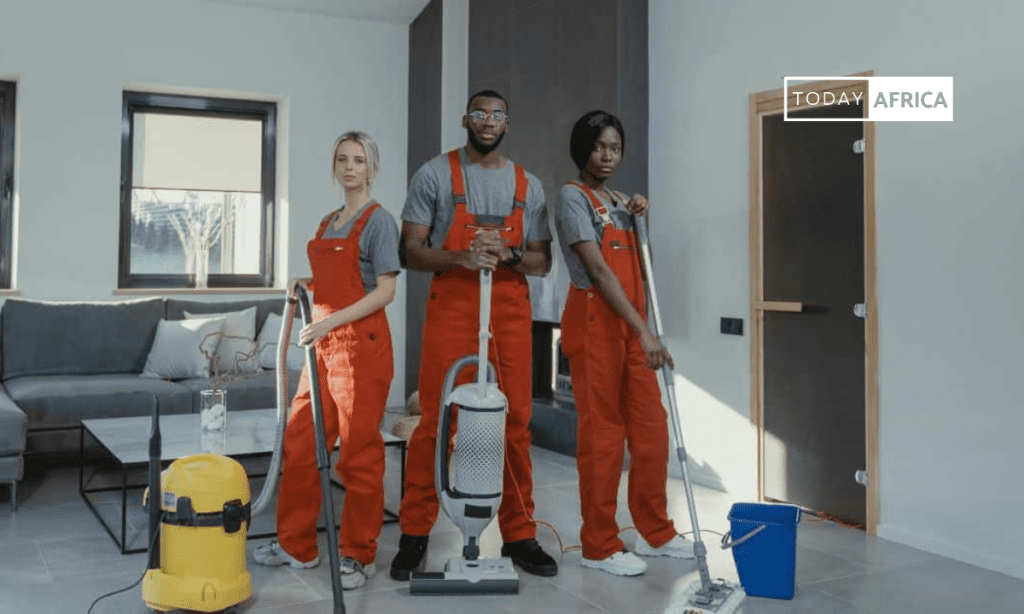
Services include house cleaning, move-in/move-out cleaning, and deep cleaning.
- Lower capital requirement
- Higher client turnover
- Strong reliance on referrals
b. Commercial cleaning
Contracts with offices, retail stores, and business premises.
- Longer-term agreements
- Structured service level agreements (SLAs)
- Requires formal compliance documentation
c. Specialized cleaning
Includes carpet cleaning, industrial cleaning, hazardous waste cleaning, or healthcare sanitation.
- Higher margins
- Equipment-intensive
- Requires technical training
d. Tender-based government contracts
Secured through municipal, provincial, or national procurement systems.
- Requires Central Supplier Database (CSD) registration
- BBBEE compliance is essential
- Competitive bidding environment
New entrants often begin in residential or small commercial segments before pursuing institutional contracts.
3. Legal registration and compliance
Operating formally is essential, particularly for commercial and government clients.
Company registration
Register your company with the Companies and Intellectual Property Commission (CIPC).
Common structures:
- Private Company (Pty) Ltd (recommended for credibility and liability protection)
- Sole Proprietorship (less formal, limited scalability)
CIPC registration can be completed online. Registration fees vary depending on service provider and method.
Tax registration
Register with the South African Revenue Service (SARS) for:
- Income Tax
- PAYE (if employing staff)
- UIF (Unemployment Insurance Fund)
- VAT (mandatory if turnover exceeds R1 million annually; voluntary registration possible above R50,000)
Industry compliance
Cleaning businesses that employ workers fall under the Contract Cleaning Sector, regulated by the National Bargaining Council for the Contract Cleaning Industry (NBCCI) in certain regions.
Compliance includes:
- Minimum wages (as per sectoral determinations)
- Leave provisions
- Working hours compliance
- Provident fund contributions where applicable
Failure to comply may result in penalties or loss of contracts.
Compensation for occupational injuries
Register with the Compensation Fund (COIDA) to cover workplace injuries.
4. BBBEE and market access
Broad-Based Black Economic Empowerment (BBBEE) compliance significantly influences contract eligibility, particularly for:
- Government tenders
- Corporate procurement
- Property management contracts
Cleaning companies often qualify as:
- Exempted Micro Enterprises (EMEs) if turnover is below R10 million
- Qualifying Small Enterprises (QSEs) if turnover is between R10 million and R50 million
BBBEE certificates are typically required for procurement.
Read Also: Why South Africa’s B2B market is becoming more strategic than consumer markets
5. Capital requirements and startup costs
Startup costs depend on scale and specialization.
Basic residential cleaning startup (Estimated Range)
- Equipment (vacuum cleaners, mops, buckets): R10,000 – R25,000
- Cleaning chemicals and consumables: R5,000 – R15,000
- Branding and uniforms: R5,000 – R10,000
- Registration and compliance costs: R2,000 – R5,000
- Transport (if leasing vehicle): variable
Estimated entry-level startup capital: R30,000–R80,000
Commercial cleaning setup
- Industrial-grade equipment
- Floor scrubbers and polishers
- Compliance documentation
- Insurance
- Working capital for payroll
Initial capital may exceed R150,000 – R300,000, depending on contract size.
Working capital is critical. Commercial clients often pay 30–60 days after invoice submission, meaning payroll must be covered in advance.
6. Equipment and operational systems
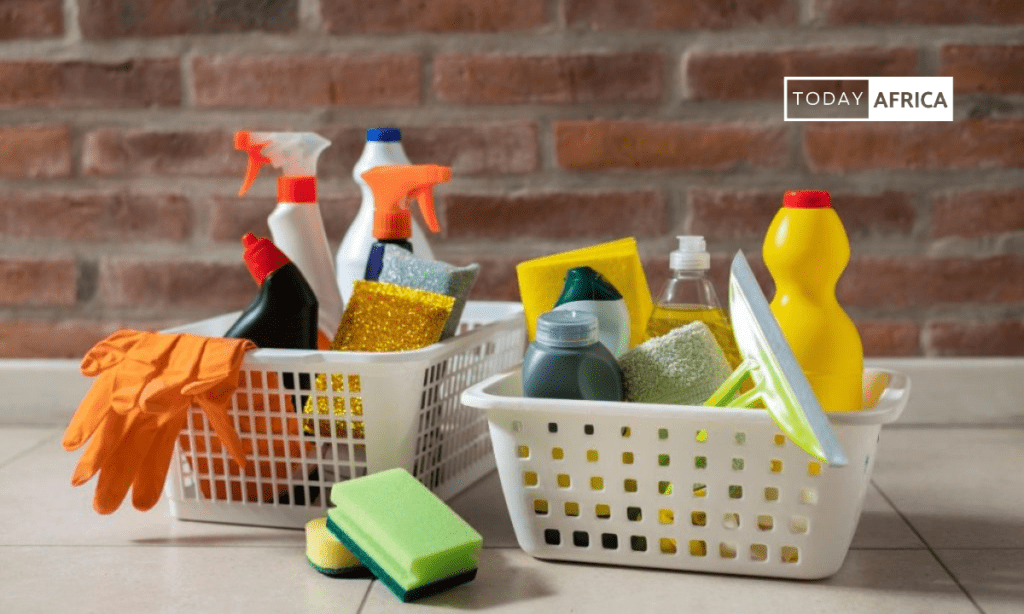
Professional equipment improves efficiency and contract eligibility.
Key equipment categories:
- Industrial vacuum cleaners
- High-pressure washers
- Floor scrubbers
- Carpet extractors
- Microfiber systems
Chemical selection must comply with health and safety standards. Increasingly, commercial clients prefer environmentally friendly cleaning products due to sustainability commitments.
Operational systems should include:
- Time tracking
- Staff scheduling
- Inventory management
- Client reporting systems
Digital tools improve transparency and client retention.
7. Labour management and human capital
Labour constitutes the largest cost component in cleaning businesses.
Minimum wage compliance
South Africa’s National Minimum Wage applies unless a sectoral determination specifies otherwise. Employers must ensure compliance with current wage legislation published annually by the Department of Employment and Labour.
Employment contracts
Provide:
- Written employment agreements
- UIF registration
- Payslips
- Overtime compensation
Training
Staff training should cover:
- Chemical handling
- Equipment operation
- Occupational health and safety
- Client confidentiality
High staff turnover is common in the sector. Structured onboarding reduces reputational risk.
Read Also: How to do digital marketing for small business
8. Insurance and risk mitigation
Cleaning companies operate in client premises, creating liability exposure.
Essential insurance:
- Public Liability Insurance
- Fidelity Insurance (if employees handle client assets)
- Equipment Insurance
- Vehicle Insurance
Many commercial contracts require proof of insurance before award.
9. Securing clients
Direct sales
Approach:
- Property managers
- Estate agents
- Body corporates
- Small business owners
Professional proposals should include:
- Scope of work
- Pricing structure
- Compliance documentation
- References
Digital channels
- Google Business Profile
- Local SEO
- Social media presence
- Online booking systems
Residential clients increasingly search for services online.
Tender portals
Register on:
- National Treasury eTender Portal
- Municipal procurement portals
- Central Supplier Database (CSD)
Tenders require detailed compliance documentation and financial capability evidence.
10. Pricing strategy
Pricing must cover:
- Labour
- Consumables
- Equipment depreciation
- Transport
- Administrative overhead
- Profit margin
Commercial pricing is typically based on:
- Square meter rates
- Hourly rates
- Fixed monthly contracts
Undercutting competitors may secure contracts but can create unsustainable wage pressure and compliance risks.
Read Also: Why ecommerce business in South Africa is thriving
11. Scaling the business
Growth requires:
a. Operational standardization
Document:
- Cleaning protocols
- Client service procedures
- Quality assurance systems
b. Contract diversification
Avoid reliance on a single large client.
c. Financial management
Maintain:
- Cash flow forecasting
- Reserve funds
- Structured payroll systems
d. Technology adoption
Software platforms for:
- Workforce management
- Billing
- Compliance tracking
e. Facilities Management Expansion
Many cleaning companies evolve into broader facilities management services including:
- Landscaping
- Security coordination
- Maintenance
12. Challenges and structural risks
Cash flow constraints
Delayed payments can strain SMEs.
Labour disputes
Non-compliance with labour laws can result in arbitration at the CCMA.
Competition from informal operators
Informal cleaners may offer lower rates due to non-compliance.
Economic cycles
Commercial property vacancies affect demand for cleaning services. Stats SA data has shown fluctuations in the construction and real estate sectors, which indirectly influence cleaning demand. Economic downturns typically reduce office occupancy and associated service contracts.
Conclusion
Starting a cleaning company in South Africa is viable but structurally demanding.
The sector offers relatively accessible entry points compared to capital-intensive industries, yet success depends on regulatory compliance, disciplined financial management, and operational reliability.
The industry’s long-term sustainability is tied to broader economic conditions, commercial property performance, government procurement budgets, and labour policy enforcement.
Entrepreneurs who approach the market with formal registration, compliance rigor, and scalable systems are better positioned to compete beyond the informal segment and secure institutional contracts.
Leave a comment and follow us on social media for more tips:
- Facebook: Today Africa
- Instagram: Today Africa
- Twitter: Today Africa
- LinkedIn: Today Africa
- YouTube: Today Africa Studio