
Nigeria’s foreign exchange market remains a central pressure point for monetary policy, capital allocation, and financial system credibility.
Enforcement actions in this space tend to carry implications beyond the parties involved, particularly for banks that sit at the intersection of official FX policy and private market demand.
Against this backdrop, the latest legal action by Nigeria’s anti-graft agency underscores the regulatory sensitivity surrounding FX transactions during periods of currency stress.
The case before the court
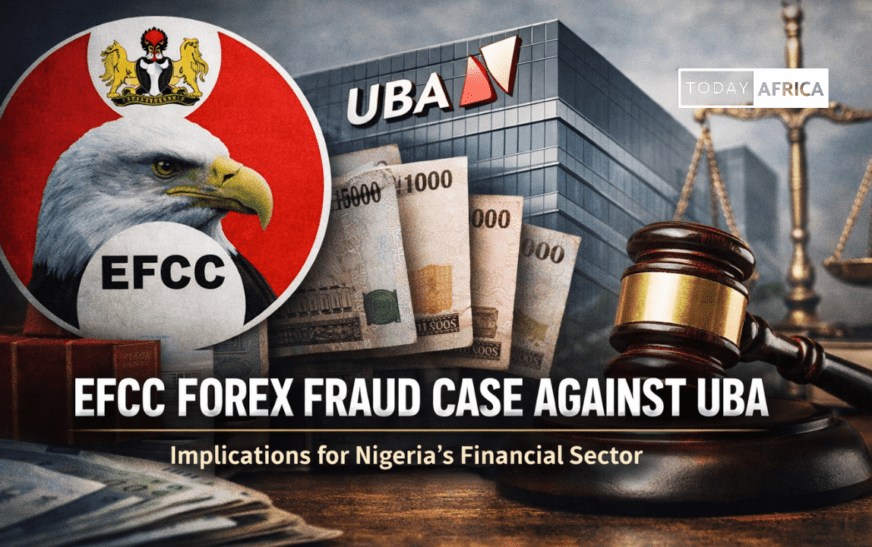
The Economic and Financial Crimes Commission (EFCC) has filed a ₦4.3 billion foreign exchange fraud case against United Bank for Africa (UBA), two corporate entities, Gesos Global Service Ltd and Fedat Global Ltd, and two individuals, Muyiwa Akinyemi and Amangbo Stephen.
The charges were brought before the Ikeja Special Offences Court in Lagos.
Proceedings did not commence at the latest hearing after none of the defendants appeared in court. EFCC prosecutors told the court that all parties had been served and were aware of the case, adding that two of the defendants are currently considered fugitives.
Justice Rahman Oshodi granted the commission’s request for additional time to ensure formal notification and attendance, and adjourned the matter to April 21 for arraignment.
Alleged transactions and regulatory context
According to court filings, the charges relate to transactions dated September 14, 2022, and March 20, 2023. The EFCC alleges that the defendants colluded to sell foreign currency at rates above those prescribed by the Central Bank of Nigeria (CBN) at the time.
The commission further claims that ₦4.3 billion belonging to Energy Shield Petrochemical Ltd was illegally converted and subsequently held and processed through UBA accounts.
One count specifically alleges that UBA retained the funds in one of its accounts in a manner that breached Nigeria’s financial crimes laws. T
he defendants face charges including conspiracy, theft, money laundering, and possession of proceeds from unlawful activity, under statutes such as the EFCC Act, the Advance Fee Fraud Act, and Lagos State criminal laws.
Read Also: NCC sets ₦250,000 authorization fee for new telcos to test their services
What this signals and what remains unclear
The case reflects continued regulatory emphasis on enforcing FX controls that were in place during a period of acute currency shortages and multiple exchange rates.
For banks, it reinforces expectations around transaction monitoring, customer activity oversight, and adherence to evolving FX directives.
At the same time, the allegations remain untested in court. Key questions include:
- the extent of institutional versus individual responsibility
- how compliance obligations are interpreted for banks acting as custodians of client funds
- and how enforcement aligns with subsequent reforms in Nigeria’s FX framework.
What to watch next
The April 21 arraignment will determine whether the case proceeds to substantive hearings and how the defendants respond to the charges. More broadly, observers will be watching how Nigerian regulators balance retrospective enforcement with a restructured FX market, and what precedent this case may set for banking compliance and accountability going forward.
Leave a comment and follow us on social media for more tips:
- Facebook: Today Africa
- Instagram: Today Africa
- Twitter: Today Africa
- LinkedIn: Today Africa
- YouTube: Today Africa Studio