
Most founders learn this the hard way. At some point, usually when the product is half-built and the cash runway is starting to feel shorter than planned, a decision emerges and refuses to be ignored.
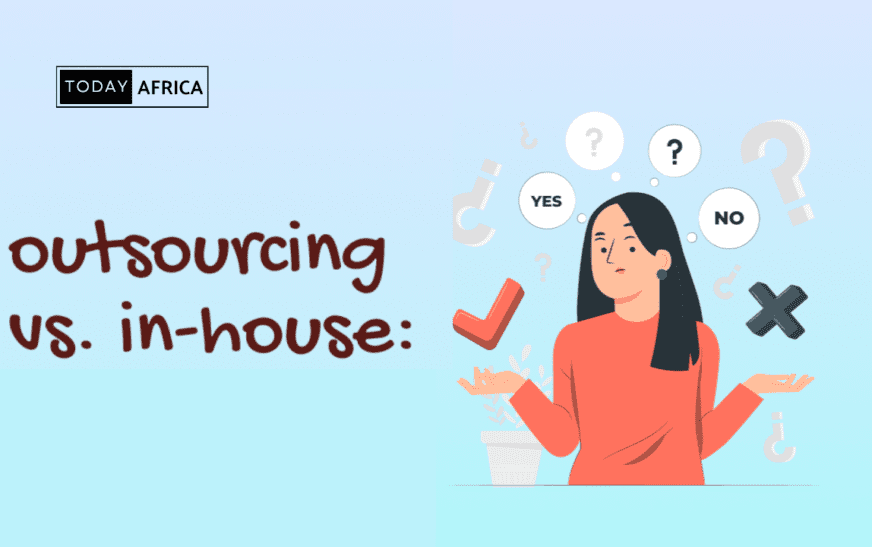
- Do we hire someone full time or do we outsource this work?
- Do we build internally or pay a third party and move faster?
- Or do we save money now or invest in control later?
It sounds like an operational question. In African startups, especially, this choice shapes everything that follows. Burn rate, culture, speed, quality, and even how investors read your maturity as a business.
And yet, many founders approach it with gut instinct or borrowed Silicon Valley advice that does not fit local realities. This article is not a motivational essay, nor is it a one-size-fits-all rulebook.
If you read to the end, you should be clearer about why the decision matters, how to think through it systematically, and what it means for building durable companies on the continent.
Why this decision matters more in Africa than most founders admit
Capital is scarcer and more expensive
In many African markets, capital does not just cost more. It is also slower, more conditional, and often arrives later than planned.
A founder in Lagos or Nairobi cannot assume easy access to follow on rounds if execution stumbles. Every hiring decision becomes a medium term bet, not a reversible experiment.
Outsourcing often looks cheaper at first glance. No benefits, no long-term commitment, and pay for output. But the hidden cost of misaligned vendors, rework, and slow feedback loops can quietly drain limited capital.
In-house teams are expensive, yes, but they also reduce coordination tax over time. This is why the outsourcing versus in-house question is really about capital efficiency, not just headcount.
Talent markets are uneven and fragmented
African talent is deep, but not evenly distributed. Engineering talent in Egypt and Nigeria looks very different from product design talent in Rwanda or customer support talent in Ghana.
Founders building regionally often face a mismatch between where the business operates and where skills are available. Outsourcing becomes a bridge across these gaps. Sometimes a necessary one.
At the same time, relying too heavily on external teams can delay the formation of internal knowledge. When the vendor leaves, so does the institutional memory.
Understanding this tension is key to knowing when to outsource and when to internalize.
Infrastructure and execution risks are real
Power, internet reliability, payment delays, and legal enforcement are not abstract risks. They affect delivery timelines, contract enforcement, and quality control.
A founder outsourcing core work without tight oversight is often betting that systems will behave better than lived experience suggests. In-house teams, while harder to build, offer more direct control over these uncertainties.
Read Also: A playbook for launching an MVP with less than $500
Simple decision tree founders can actually use
Before diving into functions like engineering or marketing, it helps to zoom out. Every outsourcing decision should pass through three core questions.
1. Is this function core to our competitive advantage?
If the answer is yes, pause.
Core does not mean important. Payroll is important. So is customer support. Core means the thing that makes your company meaningfully different.
For a payments startup, transaction reliability and fraud detection are core. For a logistics platform, routing intelligence and fleet optimization matter deeply.
For a media company like Today Africa, editorial judgment and voice are central. As a rule of thumb, core functions should eventually be owned internally. Outsourcing them early can make sense, but only with a clear transition plan.
2. Is speed more important than control right now?
Early stage startups often need momentum more than perfection.
Outsourcing can help you ship an MVP in weeks instead of months. This is valuable when you are still testing assumptions.
But speed without learning is wasted motion. If outsourcing prevents you from deeply understanding the problem you are solving, you are moving fast in the dark.
Ask yourself whether this phase is about learning or scaling. Learning favors in house. Scaling can tolerate more outsourcing.

3. Can failure here kill the company or just slow it down?
This question is uncomfortable, but useful. If an outsourced function fails, what happens? Do customers churn permanently? Do regulators step in? Or do you simply lose time? High blast radius functions demand tighter control. Low risk functions can be safely externalized.
Read Also: How to use customer discovery to avoid premature scaling
When outsourcing makes sense in African startups
1. Early product builds and MVP experiments
For many African founders, especially first timers, outsourcing early development is a rational choice.
Hiring senior engineers full time is expensive. In markets like Nigeria, Egypt, or South Africa, top engineers command global level compensation. Paying that before product market fit can sink a young company.
Outsourcing MVP builds allows founders to test ideas cheaply. Agencies in Eastern Europe, North Africa, or even local studios can help get a version out.
The key is scope discipline. Outsource experiments, not the vision. The founder must still own product decisions and user feedback loops.
2. Specialized expertise you rarely need full time
Some skills are critical but intermittent. Think legal structuring across multiple African jurisdictions. Tax compliance. Security audits. Brand identity work.
Hiring full time for these roles rarely makes sense early on. Outsourcing gives access to expertise without permanent overhead. Many successful African startups operate this way well into growth stages, especially for finance, legal, and PR.
3. Functions where output is clearly defined
Outsourcing works best when deliverables are concrete. Design assets, content production, data labeling, and customer support scripts.
Ambiguity kills outsourced relationships. If you cannot clearly define success, you are better off building internally. Founders who struggle with outsourcing often mistake unclear thinking for vendor incompetence.
4. Short term capacity gaps during growth spurts
Sometimes the business grows faster than the team. A marketing campaign takes off, customer support tickets spike, and engineering backlog explodes.
Outsourcing can act as a pressure valve. Temporary help without rushing permanent hires. The mistake is allowing temporary fixes to become permanent dependencies.
When building in-house is the smarter long-term move
1. Product and engineering at scale
At some point, product development stops being about shipping features and starts being about systems thinking. Performance trade-offs. Technical debt. Architecture decisions that shape years of development.
Outsourced teams, no matter how skilled, rarely carry the same long term accountability. They optimize for project completion, not company survival.
African fintechs offer a clear example. Early outsourcing helped many launch quickly. But the ones that scaled reliably invested heavily in internal engineering teams once regulatory and transaction complexity increased.
2. Customer experience and trust sensitive roles
In many African markets, trust is fragile. A delayed response, a tone deaf message, and a poorly handled dispute. These can spread quickly on social media and WhatsApp groups.
Customer support, community management, and fraud response often benefit from being in house. These teams absorb context. They learn cultural nuance. They align more closely with company values.
Outsourcing these roles too aggressively can save money while quietly eroding trust.
3. Strategic decision making and data ownership
Functions that shape strategy should not live outside the company. Data analysis, growth experimentation, and market research.
When insights live with vendors, learning slows. Decisions become reactive. Founders lose their feel for the business. Bringing these capabilities in-house, even with small teams, compounds learning over time.
Read Also: Why blockchain could solve identity problems in Africa
Hidden costs founders underestimate
1. Coordination and management overhead?
Outsourcing does not remove management work. It changes its shape. Time zones, communication gaps, misaligned incentives, and repeated onboarding.
Founders often underestimate how much of their own time outsourcing will consume. Especially if they lack experience managing vendors. In-house teams require management too, but over time, shared context reduces friction.
2. Knowledge leakage and dependency
When a vendor builds your systems, they understand them better than you do. This creates quiet dependency. Changing vendors becomes expensive. Internal troubleshooting becomes harder. Some founders only realize this when something breaks, and no one internally knows how to fix it.
3. Cultural drift
Culture is not slogans. It is how decisions get made under pressure. Outsourced teams do not absorb culture the same way. This matters more as companies grow. In-house teams create shared norms that shape execution quality long after early decisions are forgotten.

African case patterns worth learning from
1. Fintechs that insourced compliance early
Several African fintechs learned that outsourcing compliance was risky. Regulatory interpretation varies by country. Vendor mistakes can shut down operations. Companies that brought compliance expertise in house earlier often navigated expansion more smoothly, even if it cost more upfront.
2. Media and content startups that kept editorial internal
Across Africa, media startups that outsourced editorial voice struggled to differentiate. Those that invested in internal editors and writers built stronger brands, even if production scale was slower at first. Voice, it turns out, is hard to outsource without dilution.
3. Logistics startups that blended models
Many logistics companies use a hybrid approach. Core routing algorithms and ops leadership are internal. Fleet management, call centers, and last-mile operations are often outsourced or partner-led. This balance allows flexibility while protecting strategic intelligence.
Read Also: How to create content that converts for your startup
Practical framework for founders deciding today
If you are facing this decision right now, try this. Write down the function you are considering outsourcing.
Then answer these questions honestly:
- Is this function tied directly to why customers choose us?
- Will outsourcing prevent us from learning something essential?
- Can we clearly define success and failure here?
- What happens if this fails badly?
- Do we have a plan to bring this in-house later if needed?
If more than two answers feel uncomfortable, pause. Consider internal ownership, even if that means slower progress.
Conclusion
There is no moral high ground in building everything in house. And no shame in outsourcing early. The mistake is treating this as a purely cost based decision.
In African startups, where capital is scarce, talent is uneven, and execution risks are real, the choice of when to outsource shapes more than budgets. It shapes learning speed, trust, and long term resilience.
Outsource for speed, experimentation, and specialized expertise. Build in house for core advantage, trust sensitive functions, and strategic learning.
And remember, the best founders revisit this decision repeatedly. What made sense at pre seed rarely holds at Series A. The question is not simply when to outsource. It is when to take ownership.
Frequently asked questions
When to outsource in the earliest stage of a startup
Outsourcing makes sense when testing assumptions quickly and cheaply. MVP builds, design work, and short term experiments are common examples.
Is outsourcing always cheaper than hiring in-house?
Not always. Short term costs may be lower, but coordination, rework, and dependency can make outsourcing more expensive over time.
Can African startups build world-class teams internally?
Yes. Many already have. It often requires creative hiring, remote work, and patience, but the results compound.
Should founders outsource engineering?
Early on, sometimes. Long term, core engineering should usually move in house to protect product quality and learning.
What is the biggest mistake founders make with outsourcing?
Treating vendors as replacements for thinking. Outsourcing execution without owning clarity almost always fails.
Leave a comment and follow us on social media for more tips:
- Facebook: Today Africa
- Instagram: Today Africa
- Twitter: Today Africa
- LinkedIn: Today Africa
- YouTube: Today Africa Studio