


According to McKinsey, more than 70% of companies fail to achieve sustainable, profitable growth over 10 years, despite strong initial performance.
The issue is rarely ambition; it is usually strategy execution, poor capital allocation, or a misreading of market dynamics.
For firms operating in emerging and frontier markets, particularly across Africa, these challenges are amplified by infrastructure gaps, regulatory complexity, and fragmented consumer markets.
This article examines 5 business growth strategies that have consistently underpinned successful expansion across sectors and geographies.
What is a business growth strategy?
A business growth strategy refers to a well-defined plan or set of tactics used to achieve measured expansion and increased success over time. It clearly outlines how a company intends to grow its revenue, market share, customer base, or geographical footprint through various approaches and tactics.
Effective business growth strategies are crucial for any company seeking to remain competitive and maximize long-term viability.
They provide focus and direction toward clearly defined business goals. Without a clearly articulated growth strategy, it is difficult for a business to navigate market changes and capitalize on opportunities for advancement.
When developing a business growth strategy, companies should consider their desired growth targets in relation to financial objectives like revenue, profitability, and fundraising milestones.
But non-financial metrics relating to brand awareness, customer base expansion or market leadership are also important to include. The right growth strategy will depend on a company’s unique strengths, resources, and ambitions.
5 business growth strategies for expanding your company
1. Market penetration
Market penetration focuses on increasing a company’s share within its current market using existing products or services. It is often the least risky growth strategy, as it builds on established customer relationships, known demand patterns, and existing operational capabilities.
How market penetration drives growth
Companies pursuing market penetration typically aim to:
- Increase customer acquisition within the same demographic or geographic market
- Encourage higher usage or repeat purchases from existing customers
- Capture market share from competitors through pricing, distribution, or service differentiation
According to Bain & Company, increasing customer retention rates by just 5% can boost profits by between 25% and 95%, depending on the industry. This highlights why market penetration strategies often prioritize customer lifetime value rather than rapid expansion.
Common tactics
- Pricing adjustments or bundled offerings
- Loyalty programs and retention incentives
- Expanded distribution channels within the same market
- Incremental product improvements
Limitations and risks
Market penetration is constrained by market size. Once saturation is reached, growth plateaus. Aggressive pricing strategies can also erode margins if not supported by operational efficiency.
In highly competitive markets, penetration efforts may trigger price wars, reducing overall industry profitability.
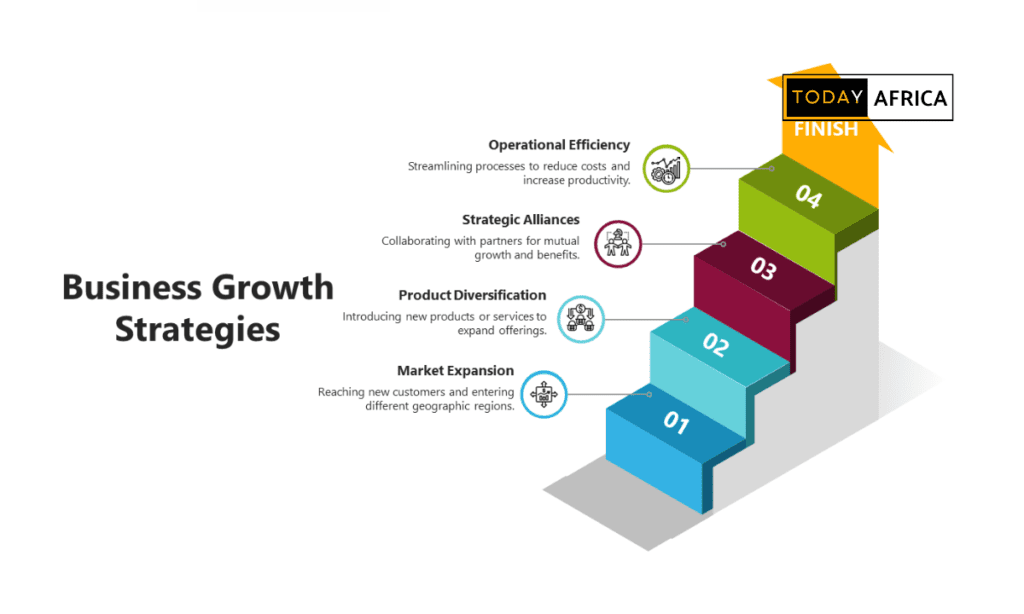
2. Market expansion
Market expansion involves taking existing products or services into new geographic regions or targeting new customer segments. For companies that have achieved maturity in their core markets, expansion is often the next logical growth lever.
The case for market expansion
The World Bank estimates that Africa’s consumer spending will reach over $2.5 trillion by 2030, driven by urbanization, population growth, and a rising middle class. This has made regional expansion a central strategy for African firms seeking scale beyond national borders.
Market expansion can unlock:
- New revenue streams
- Economies of scale
- Risk diversification across markets
Execution considerations
Successful expansion depends on:
- Local market research and regulatory understanding
- Adaptation of pricing, distribution, and marketing strategies
- Strong local partnerships or acquisition targets
For example, firms expanding across African markets often encounter differences in payment systems, logistics infrastructure, and regulatory enforcement. Companies that fail to localize operations frequently underperform despite strong demand fundamentals.
Risks
Expansion is capital-intensive and exposes companies to currency risk, regulatory uncertainty, and cultural misalignment. According to Harvard Business Review, more than half of international expansions fail to meet expected financial targets within the first five years.
Read Also: Companies that help businesses grow: Structures, services, & outcomes
3. Product development
Product development focuses on creating new products or enhancing existing ones to serve current markets more effectively. This strategy is particularly relevant in industries experiencing rapid technological change or evolving customer needs.
Why product development matters
Data from PwC shows that companies classified as “innovation leaders” generate up to 60% higher revenue growth than their peers. Innovation allows firms to:
- Defend against competitive threats
- Increase customer lifetime value
- Command premium pricing
Product development does not always mean radical innovation. Incremental improvements such as better user experience, added features, or improved reliability can deliver significant growth when aligned with customer pain points.
Success factors
- Strong customer feedback loops
- Investment in R&D or product teams
- Clear product-market fit validation before scaling
In emerging markets, product development often involves adapting global solutions to local constraints, such as low bandwidth environments, informal retail systems, or limited access to credit.
Risks
Product development carries high failure rates. CB Insights reports that 35% of new product failures result from a lack of market need. Without disciplined validation and staged investment, companies risk allocating capital to products that do not scale.
Read Also: Why your company needs business process management
4. Strategic partnerships and acquisitions
Partnerships, mergers, and acquisitions (M&A) enable companies to grow faster than organic strategies alone. By leveraging external capabilities, firms can access new markets, technologies, or customer bases more efficiently.
Why companies choose partnerships or M&A
According to Deloitte, companies that actively pursue partnerships grow revenue up to 2x faster than those relying solely on internal growth. Strategic collaborations can:
- Reduce time-to-market
- Share risk and capital requirements
- Strengthen competitive positioning
In Africa’s fragmented markets, partnerships with local distributors, fintech platforms, or logistics providers are often critical for scale.
Types of strategic growth deals
- Distribution or channel partnerships
- Technology or data-sharing alliances
- Acquisitions of competitors or complementary businesses
Execution challenges
M&A carries integration risk. KPMG research indicates that up to 70% of mergers fail to achieve anticipated synergies, often due to cultural clashes, poor integration planning, or overvaluation.
Successful partnerships require:
- Clear strategic alignment
- Defined governance structures
- Measurable performance metrics
5. Operational scaling and efficiency
Growth strategies fail when operational systems cannot support increased demand. Operational scaling focuses on strengthening internal processes, infrastructure, and talent to support expansion without proportional cost increases.
Why operational efficiency is a growth strategy
McKinsey estimates that operational inefficiencies can reduce EBITDA margins by 20–30% in scaling companies. Growth without efficiency often leads to:
- Cash flow strain
- Declining service quality
- Organizational bottlenecks
Operational scaling ensures that growth is profitable, not just visible.
Areas of focus
- Process automation and digitalization
- Supply chain optimization
- Talent development and leadership capacity
- Financial controls and data systems
For African businesses, investments in logistics, payments, and enterprise systems are often prerequisites for scale, given infrastructure variability across markets.
Risks
Over-investment in systems ahead of demand can lock up capital. Conversely, under-investment leads to operational fragility. The challenge lies in sequencing investments in line with realistic growth projections.
Read Also: How African Startups are Growing Without Burning Out
Steps to implement an effective business growth strategy
1. Conduct thorough market research
This research helps identify opportunities for growth, or “white space”, that align with the company’s strengths. It also allows a business to determine which of the strategic options – such as –
- market penetration
- market development
- new product development
- diversification
- strategic partnerships
- acquisitions, or disruption – are most promising based on factors like competitive landscape, customer needs, industry trends, and fit with organizational capabilities.
Comprehensive market research forms the foundation for developing strategies that have the highest likelihood of success.
2. Establish clear, measurable goals
Once opportunities are identified, the next step is to establish clear and measurable business goals that the growth strategies aim to achieve.
These goals should follow the SMART framework – being specific, measurable, achievable, relevant, and time-bound. Having quantifiable targets sets expectations and allows progress to be tracked over time.
Short-term goals of 3-6 months allow for more frequent evaluation and adjustment if needed, while longer-term goals of 6-12 months provide direction and motivation.
3. Develop tactical plans
With goals defined, it’s critical to develop tactical plans for implementing each growth strategy. The plans should include specifics on target metrics that align with organizational goals, such as revenue or customer acquisition goals.
They should also outline functional responsibilities, resource requirements like staffing and budgets, timeline for roll-out, and activities or tactics that will be used. Having clear tactical plans helps teams successfully execute their strategies.
4. Monitor key performance indicators
Tracking metrics like revenue, leads, conversions, customer retention, and more provides visibility into what is working well and what may need improvement. It allows strategies to be optimized based on data to ensure the best results.
Companies should establish a standardized process to routinely analyze performance indicators and make adjustments accordingly. Being data-driven helps maximize ROI from strategic initiatives.
Read Also: How to Build B2B Partnerships in Fragmented African Markets
5. Prioritize testing and automation
Testing growth strategies on a smaller initial scale before wide rollout can help reduce risk if adjustments are needed. Starting with a subsection of products, customers, or regions allows strategies to be refined based on actual performance before investing significant company-wide resources.
Automating strategic components also facilitates scaling and optimization. Leveraging technology to streamline processes, analyze data, and engage customers enhances implementation effectiveness and efficiency over time.
6. Communicate strategic objectives
For strategies to be effectively implemented, their important objectives and ongoing progress are openly communicated to all stakeholders. This includes internal teams as well as external partners and others impacted by strategic initiatives.
It generates understanding and buy-in, which supports successful execution. Many strategies also require collaboration across departments – communication is key to ensuring strategies are coordinated cohesively across the organization for maximum impact.
7. Remain agile to changes
To realize long-term goals, growth strategies must remain flexible and adaptable to changing market dynamics. Annual reviews, or reviews triggered by disruptive events, allow strategies to be re-evaluated and refined as business conditions evolve.
With today’s rapid changes, agility is critical to maintain strategic alignment and pursue new opportunities. Regular assessment keeps strategies optimized for ongoing relevance and effectiveness in driving growth for the organization.
Read Also: How to Build Scalable Distribution Channels in Africa
Conclusion
There is no universal formula for business growth. The most effective growth strategies are those aligned with a company’s stage of development, market conditions, and internal capabilities.
Evidence consistently shows that companies combining multiple growth strategies while maintaining disciplined execution are more likely to achieve durable, profitable expansion.
According to BCG, firms that balance organic growth with selective inorganic moves deliver shareholder returns up to 1.7 times higher than peers focused on a single approach.
The strategic question is not whether to grow, but how to grow responsibly. Growth strategies should be evaluated not only on revenue potential, but on capital efficiency, risk exposure, and long-term resilience.
In an increasingly complex global economy, a disciplined growth strategy is no longer optional, it is a core leadership responsibility.
Leave a comment and follow us on social media for more tips:
- Facebook: Today Africa
- Instagram: Today Africa
- Twitter: Today Africa
- LinkedIn: Today Africa
- YouTube: Today Africa Studio