
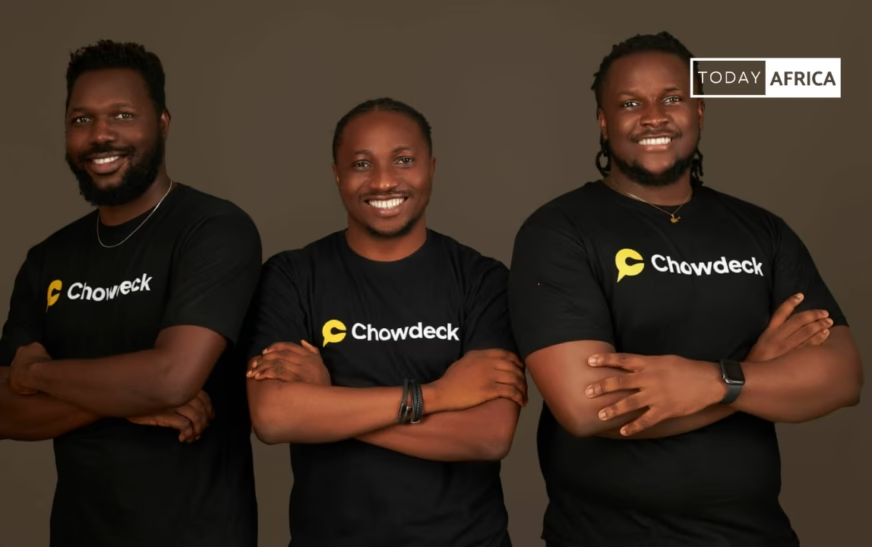
Y Combinator-backed on-demand delivery platform, Chowdeck, processes ₦1.4 billion in orders on Black Friday 2025: 52,000 deliveries in a single day, more than double last year’s 25,000.
By December 1st, the four-day campaign had hit 182,000 orders and 727,000 kilometres covered.
The company ran a live tracker at bfcm.chowdeck.com that displayed every order, every kilometre, every naira spent. 2.5 million people watched it tick up in real time.
Stripe does the same thing, their Black Friday dashboard this year showed $40 billion processed and 578 million transactions at a peak of 152,000 per minute. Chowdeck borrowed that move: if people can see your scale live, they trust you can handle it.
Black Friday didn’t exist in Nigeria until Jumia imported it in 2012. Chowdeck took that tradition and pushed it into food delivery, discounted meals, flash sales in Lagos, Abuja, Ibadan, Accra, and free delivery everywhere.
By 9 p.m. on November 28, they’d already passed 51,000 orders, beating their own internal target with hours left.
The infrastructure supporting this didn’t appear overnight. Chowdeck started in 2021 as Y Combinator-backed company, then evolved into a logistics platform handling groceries, essentials, vendor deliveries.
The model runs on geolocation, demand batching, rider incentives, boring backend work that becomes critical when 52,000 orders hit in 24 hours.
Earlier this year, Chowdeck cut staff to let AI handle operations, then quietly started hiring human customer support again before Black Friday.
Whether that was always the plan or a response to scaling pressure isn’t clear, but the timing suggests the company learned something about what AI can’t yet handle when order volumes spike.
Routing and batching work fine with algorithms; managing customer chaos at 52,000 orders a day apparently doesn’t.
Read Also: CBN revises Nigeria’s cash withdrawal and deposit limits
Monthly orders in Nigeria crossed 1 million recently, climbing from 30,000 daily to over 40,000 by November. The $9 million Series A in August is funding that expansion, and the Mira acquisition in June added payments and POS tools that push Chowdeck beyond delivery into commerce infrastructure.
Over 20,000 riders now cover routes that competitors like Bolt Food, Jumia Food, and OFood either abandoned or couldn’t make profitable. Nigeria hit 109 million internet users by the end of 2025: 45.5% penetration, enough to support digital-first businesses at scale.
The food delivery market was $1.04 billion in 2024 and is projected to reach $2.49 billion by 2033. Chowdeck’s ₦1.4 billion weekend won’t rival Stripe’s $40 billion, but it proves the same infrastructure can work in West Africa if you build it properly and staff it smartly.
Leave a comment and follow us on social media for more tips:
- Facebook: Today Africa
- Instagram: Today Africa
- Twitter: Today Africa
- LinkedIn: Today Africa
- YouTube: Today Africa Studio