
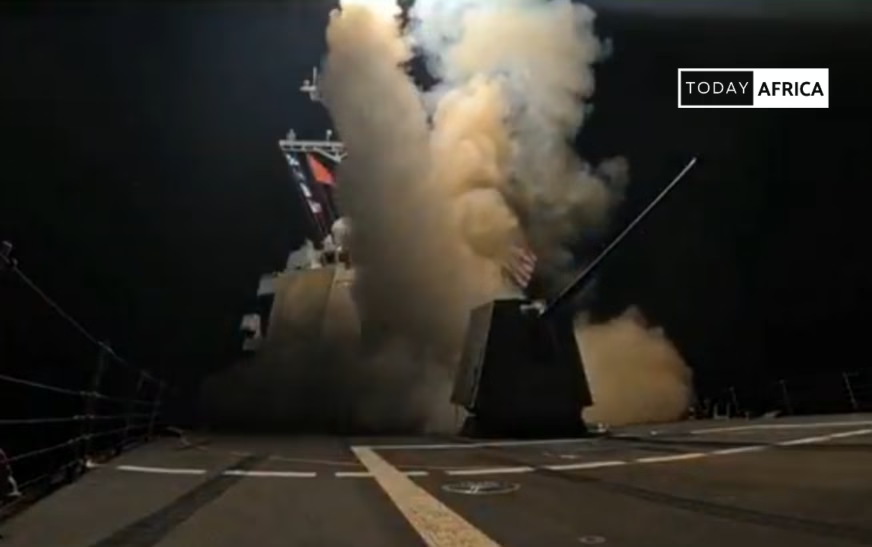
This moment feels bigger than the airstrikes themselves. Bigger than the Christmas Day timing, bigger than the words that grabbed attention.
It shows a change in how Nigeria is being talked about and treated by a major world power, and that change will have effects long after the smoke clears in Sokoto.
On the surface, the story looks simple. US forces, acting at Nigeria’s request, hit an Islamic terrorist camp in northwestern Nigeria. Several militants were killed.
This fits into years of security cooperation between Abuja and Washington. AFRICOM has done similar operations across the Sahel before. Counterterrorism cooperation is not new.
What has changed is the story being told
What has changed is the story being told.
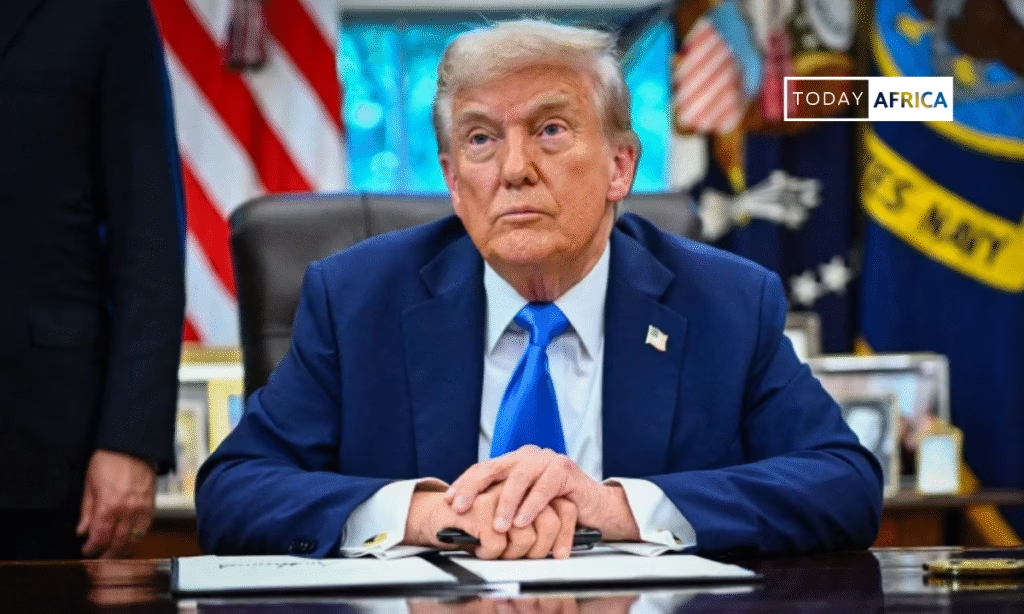
President Trump did not describe the strikes as a routine security operation against terrorists.
He described them as punishment. A warning kept. A defence of Christians facing an existential threat. His language was direct, emotional, and clearly religious. And it was shared publicly.
That matters.
Nigeria’s violence is more complicated
Nigeria’s violence, as bad and long lasting as it is, has never been easy to explain with one label. Boko Haram, ISWAP, banditry, communal clashes, kidnappings, farmer herder conflicts.
These problems overlap. They are driven by poverty, weak governance, climate pressure, illegal weapons, and weak local security. Religion is sometimes involved, sometimes used as a tool, but it is rarely the only cause.
By presenting the conflict mainly as the killing of Christians, Trump reduces all this complexity to one story. That story works well for parts of his political base at home, especially the Christian right.
But it does not sit well in Nigeria’s fragile social setting.
Old religious tensions can be reopened
Nigeria has a history of religious tension. The country has seen riots, revenge attacks, and deep mistrust based on religious identity.
When a foreign leader, especially the US president, says one religious group is facing genocide and backs that claim with military force, it changes how people see the conflict.
Militants can use it. Communities can absorb it. Anger can grow.
Even actions meant to help can make divisions worse.
Questions of sovereignty and control
There is also the issue of sovereignty. Yes, Nigeria asked for the strike. That is important. But public perception often matters more than official agreements.
For many Nigerians, this will look like a foreign military acting freely inside Nigeria while pushing a story the Nigerian government itself rejects.
Nigeria has avoided calling its crisis religious persecution. Not because the violence is fake, but because leaders fear that such language makes things worse.
When the US ignores this caution in public, Nigeria loses control of how its story is told.
Diplomatic pressure and mixed signals
There is also a diplomatic cost. Nigeria being placed back on the list of countries of concern for religious freedom, along with visa restrictions, shows a shift in US policy.
On one side, there is security cooperation. On the other, moral judgement. This creates tension. Nigerian leaders are criticised while still depending on US intelligence, training, and military help.
Over time, this can cause resentment inside Nigeria’s political and military circles. Cooperation becomes more about short term deals than long term trust.
Effects beyond Nigeria
There is also a regional effect. The Sahel is already unstable. Coups, extremist growth, and anti Western feeling are changing alliances.
US strikes in Nigeria, explained in religious terms, risk helping extremist propaganda across borders. Armed groups thrive on stories of crusades and invasion.
Trump’s words will help them more than any Nigerian government statement ever could.
Read Also: Nigeria, Google in talks for new subsea cable to strengthen digital backbone
Impact on politics at home
There is also a strong domestic political impact. Once Nigeria’s violence is labelled internationally as religious persecution, internal debates change. Security discussions become moral fights.
Every failure can be seen through a religious lens. This makes careful, practical solutions harder to defend and easier to attack.
This does not deny the suffering of civilians, including Christians targeted by extremists. Those deaths are real and serious. They demand action. But Nigeria’s most effective responses have usually been quiet and local. Intelligence sharing.
Community work. Police reform. Economic support for troubled areas. Less drama, more patience.
Trump’s approach is different. Loud. Symbolic. Absolute.
In the short term, militants were killed. That matters. In the long term, Nigeria is now pulled deeper into America’s culture wars, religious freedom debates, and election politics. That is risky for a country already struggling to manage its diversity.
The real question is not how many militants died on Christmas Day. It is whether Nigeria comes out of this more united or more divided.
Right now, that answer is unclear.
How the North is likely to see it
Things become more complicated when you look at Northern Nigeria. This may be where the biggest political effects appear.
The North is not one voice, but it is very sensitive to stories that describe insecurity as a religious war.
Many northern leaders, traditional rulers, clerics, and citizens have worked hard to reject the idea that the region is naturally violent or anti Christian.
Not because violence does not exist, but because the label feels unfair and imposed from outside.
So when the US president says Christians are being slaughtered in Nigeria and supports that claim with airstrikes, many in the North are likely to feel defensive or angry.
For many Muslims, it can feel like they are all being blamed. Like the region is being judged by a foreign power.
Some will see it as humiliation. Others as selective anger. Why Nigeria, why now, and why this strong language when violence elsewhere is discussed in calmer terms?
These feelings matter in politics.
Tinubu’s delicate position in the north
President Tinubu already leads with a delicate northern alliance. His Muslim Muslim ticket worked in the 2023 election, but it also raised expectations.
Many northern voters expected his government to protect their interests and be careful with regional identity. Trump’s language puts Tinubu in a difficult spot.
If Tinubu seems to agree with the US framing, he risks losing northern support. People may feel he allowed Nigeria to be described as a country that persecutes Christians.
Staying silent can also look like agreement. Open support would be worse.
But if he strongly challenges the US position, he risks harming relations with Washington. Nigeria still needs security support, investment, and diplomatic goodwill.
It is a narrow path, and the North will be watching closely.
Read Also: WASSMAS open applications for $10,000 Grant for West African agro-entrepreneurs
An opening for the opposition
Opposition figures will use this moment.
Insecurity in the North remains Tinubu’s biggest weakness. Banditry, kidnappings, and attacks continue.
Trump’s intervention could be presented as proof that Nigeria’s security situation has become so bad that foreign forces must step in. That is not a good image for a president seeking reelection.
Even more damaging is the religious angle. It adds a new problem to Tinubu’s electoral calculations.
Northern Muslim voters may start asking hard questions:
- Is Nigeria now seen as persecuting Christians?
- Is the North being blamed?
- And is Tinubu able to protect Nigeria’s image while keeping people safe?
In Nigerian politics, perception often becomes reality.
The danger of silent disengagement
There is also the risk of quiet disengagement. Not protests or violence, but low enthusiasm. A feeling that the government is losing control of the story.
In key northern states, that kind of apathy can reduce voter turnout enough to matter.
At the same time, Tinubu cannot easily balance this with gains in the South. Southern Christian voters may quietly welcome the strikes, but they will still judge Tinubu mainly on the economy.
Inflation, fuel prices, and daily hardship matter more. Foreign airstrikes do not guarantee political support.
A political paradox with long effects
So Tinubu faces a difficult situation. The strikes may weaken terrorist groups on the battlefield, but politically they complicate his support base.
He must convince the North that Nigeria is not a religious battlefield, while also showing the world that his government cares about protecting civilians.
Doing both at the same time requires careful communication, something Trump’s loud statements have made harder.
In the end, this episode may be remembered less for the military impact and more for the political effects. It sharpened identities. It brought foreign culture wars into Nigeria. And it forced Tinubu to react instead of lead.
For a president hoping for reelection, that is an uncomfortable place to be.
How the North responds, quietly or openly, will be one of the clearest signs of how costly this moment becomes. And how well Tinubu manages that response may shape the future of his presidency.
Leave a comment and follow us on social media for more tips:
- YouTube: Today Africa Studio
- Facebook: Today Africa
- Instagram: Today Africa
- Twitter: Today Africa
- LinkedIn: Today Africa