
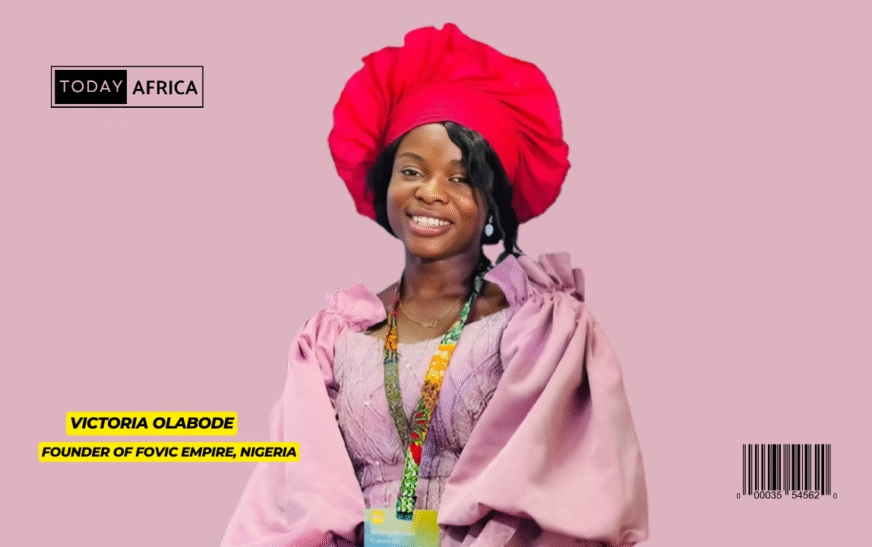
Most people hear “agribusiness” and think tractors, silos, maybe some weathered farmers in wide fields.
For Victoria Olabode, it started with something far more raw. Hunger. The kind that forces a child to scrape two or three spoons from a tray shared with thirty other kids, wondering why food suddenly became a luxury.
That crisis in 2010 didn’t just reshape her life. It burned itself into her memory.
Pawpaw on the table one minute, gunshots the next, then chaos, and the shock of watching strangers tear apart everything her family owned. The IDP camp and the realization that surviving depended on a struggle for every bite of food.
Something inside her shifted. She didn’t understand the food system back then. She only knew the ache of being hungry and the wish that she had her own farm so no one around her would ever feel that pain.
Years later, that instinct became Fovic Empire, an agricultural venture tackling food insecurity, unemployment, and climate change through sustainable farming.
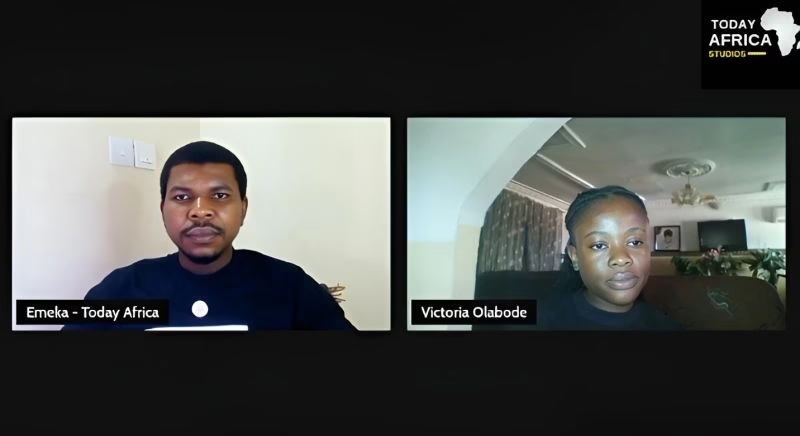
In this interview with Today Africa, Victoria shares the story that shaped her destiny, how she turned trauma into purpose, and why rebuilding Nigeria’s food system isn’t just business to her. It’s survival. And it’s hope.
Tell us more about yourself
Victoria Olabode speaks with a quiet certainty, but there’s a warmth behind her words. “I’m Victoria Olabode, the founder of Fovic Empire, a growing agri-business based in Plateau State, Nigeria, where we are tackling the challenges of food insecurity, unemployment, and climate change. I’m currently studying a master’s in Business Administration at Ahmadu Bello University. And I’m a sister, a friend, and a founder, that’s me.”
Tell us what happened in 2010 that reshaped your entire life and destiny
The memory is raw. “2010 was actually a tough year for my family and me. In fact, reliving it now is tough. I can never forget the date, January 10th, 2010,” she says, voice steady but edged with something unspoken.
She recounts a morning meant for ritual fasting, a simple childhood routine disrupted in an instant.
“We were about to break our fast. Dad prepared tea and pawpaw from our family garden. Then, while we were eating, we started hearing gunshots. People throwing stones on roofs, windshields breaking.”
Her father’s calm was fragile, tested by the chaos outside. He ushered them into hiding, and what followed felt surreal. “We were waylaid, but by some miracle, we found ourselves in somebody’s store.
From the window, we could see them burn our home, our father’s car, take valuables. And we could see the fear in our father. The person supposed to protect us was afraid. What are we going to do?”
For 5 days, Victoria and her siblings were separated from their parents, placed in the care of strangers at an IDP camp. Food was scarce, hygiene impossible, and the vulnerability of childhood was magnified.
“I was wishing we were at home, eating that pawpaw from our backyard. Then, with the mind of a child, I thought, I wish I had my own farm. I want the food for us, for everyone. I did not understand the food system at that point. It was just that pain. We were so hungry.”
Even in those early moments of fear and deprivation, a seed was planted, a sense that access to food should not be a privilege.
How did that experience become the seed of Fovic Empire?
That childhood hunger crystallized into purpose. “Nobody, whether child, woman, or man, deserves to go through that kind of hunger. I just wanted to have access to food,” she explains.
Fovic Empire began in 2021, fueled by passion. “I was about to graduate from university and thought, why wait? I reached out to friends already in agriculture. They said I didn’t understand farming, but I started anyway.”
Reality quickly tempered her enthusiasm. “It’s beyond just putting seeds in the ground. I discovered the practices were archaic. Soil was declining, yields were poor, climate change was real. That’s when I realized I had to step back and learn.”
A year of study and reflection later, Fovic Empire was officially registered in 2022, born out of both passion and practical knowledge.
Read Also: Meet Richard Afolabi, the Founder Using Tech to Preserve African History & Identity
Tell us more about Fovic Empire, the products, and services
Victoria initially focused on potatoes, but quickly shifted her sights.
“Plateau State is known for potatoes, but after my first trial, I realized I wanted to specialize in grain production. Presently, our products are grains. Beyond production, we focus on aggregation and farmers training.”
The training emerged from necessity. Traditional methods were failing farmers. “I knew about precision, climate-smart practices, good agronomic practices. Farmers around me were suffering losses. Why not share the knowledge?”
The response was immediate. Farmers were grateful and eager to learn, laying the foundation for a collaborative model.
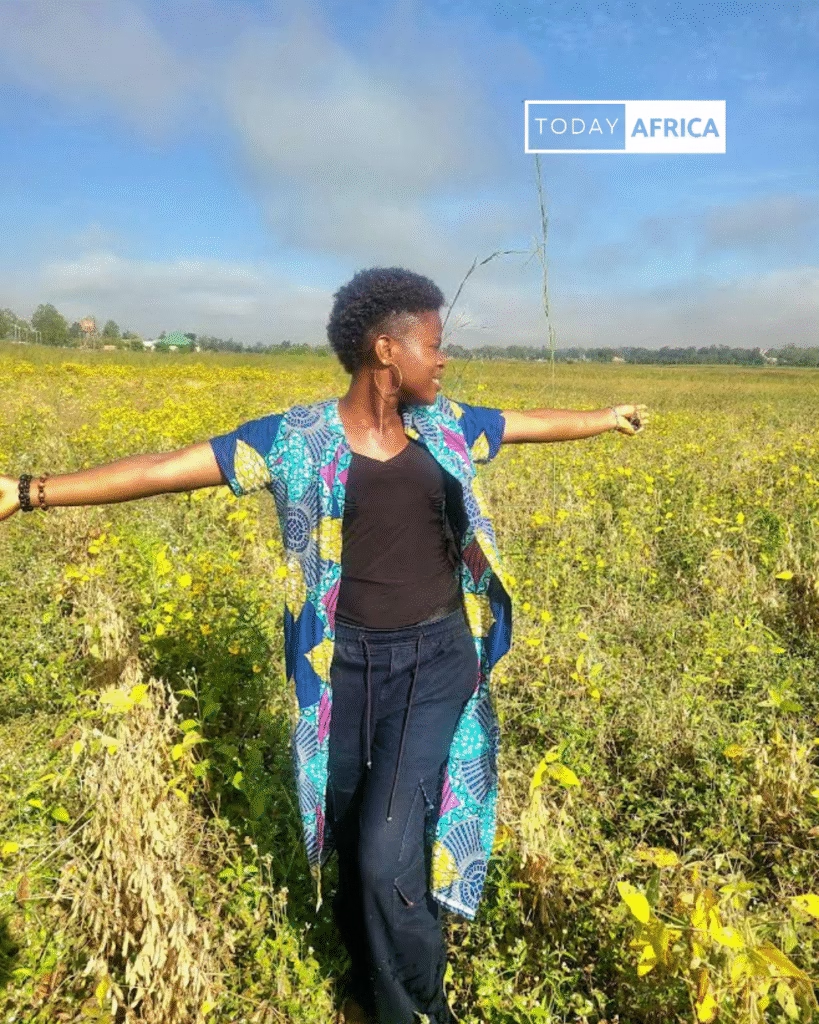
You’ve grown 200 tons of maize and soybeans. What systems allowed you to operate at this scale?
“It starts with understanding you cannot do it alone. You have to collaborate, build trust. People must see you’re here to make things better, not shortchange them,” Victoria says.
Those 200 tons were a collective achievement. Her farmers’ network, nurtured through training and trust, produced the bulk of it. Harvest season brought nearly 80 tons of soybeans ready for market, not from her organization alone, but from the collective effort of farmers in her circle.
How were you able to build collaboration with these farmers?
The idea of aggregation emerged organically. “During training, farmers asked, after doing all these things, how do we gain? That’s when the idea of creating market assets came up. I started small, gaining trust from a few people. One would bring 10 bags, another five. Step by step, the network grew.”
She still travels to meet her farmers, often across states. “Even last week, I went to Kaduna and Bauchi. It’s all about maintaining trust and ensuring they make a profit from the work.”
What marketing strategies did you use to break into the markets?
Victoria targeted processors directly, carving a niche. “I joined group chats, online platforms, Facebook, WhatsApp, where processors are. When I have a good number of products, I post: have this much at this price. Come pick it up. That’s how we started.”
Read Also: Niza Aritha Zulu: From Student Idea to Patent-holding Agritech Innovator
What story has stayed with you since you started training farmers and supporting women and youth?
A woman named Auntie Mary remains vivid in her memory. Initially struggling to make ends meet, she joined Victoria’s network and found opportunity. “She’s been instrumental. She speaks multiple local languages and helps us reach interior villages. She even wants to start her own outfit. Stories like hers keep me going.”
How do you ensure your work reaches not just farmers, but physically challenged and other excluded groups?
Victoria recounts her first foray into inclusive hiring. “I found a school for the deaf near my farmland. Initially, they were skeptical. I promised to pay, return tools, treat them equally. Eventually, they trusted me. Their students became reliable workers. That’s how I realized inclusion isn’t just moral; it’s practical.”
Since then, she has consistently included hearing-impaired workers in production, training, and aggregation, ensuring they have access and opportunity.
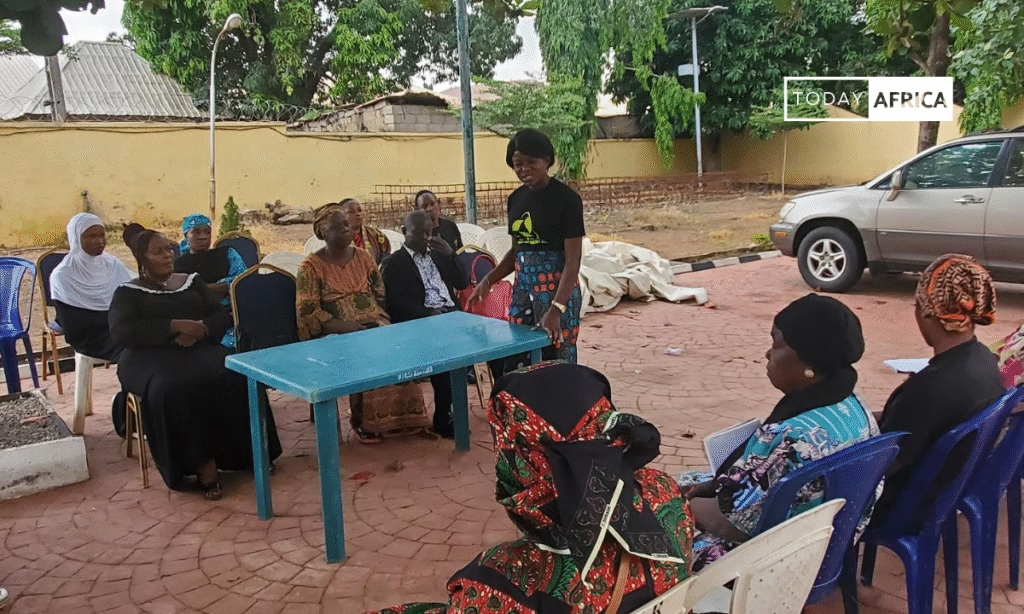
What convinced you that climate resilience must be core to African agriculture?
“Over 36 million Nigerians in Northern Nigeria face acute food insecurity,” she says. The drivers: economic instability, conflict, and climate shock. While little can be done about the first two, climate is actionable.
“Climate change is already here. Water is declining, soils are degrading, yields are down. Nigerian farmers must adopt climate-smart practices to survive and feed our people.”
Biochar is still new to many farmers. Why is it needed?
Victoria likens soil to a car: “If you use it without servicing, it will break down. Biochar revitalizes dead soil, improves fertility, water retention, root structure, and carbon sequestration. These are old practices we’ve abandoned for chemical fertilizers, and it’s degraded our soil.”
Read Also: Why Joan Kembabazi Won’t Stop Fighting Child Marriage in Uganda
Tell us more about biochar and its application
“It’s produced from farm waste. After harvesting, you can convert leftovers into biochar, cover your farmland with it. It acts as manure and a mulching film, helping the soil and crops.”
Agriculture is tough, unpredictable, and expensive. What keeps you rooted?
“The people. Auntie Mary, the physically challenged workers, others who reach out to partner. That purpose keeps me going. Without it, I would’ve given up a long time ago. Small collaborations, mechanization support, even offers from organizations in Kenya, all remind me why this matters.”

How are you coping with insecurity in and around your state?
Victoria has suffered direct losses from theft and stray animals. “Last year, cows ate my soybean farm in Kaduna. Thieves took half my maize. I had to strategize. Now, I farm in secure locations, paying for safety. Otherwise, I wouldn’t risk my capital.”
What is the one mindset shift every aspiring African farmer must embrace to survive climate change?
“Move from agriculture to agribusiness. Treat it as a business. Keep proper records, documentation, partnerships. Adopt new technology. Agriculture as tradition won’t survive changing seasons and climate shocks.”
How has technology played a role in your business?
Technology, for Victoria, is not flashy machinery but practical tools. “Simple apps on my phone can measure hectares. Simple tools ensure proper seed spacing. Even using jerry cans for irrigation is technology. It’s about adapting what works, not waiting for big investments.”

How have being a member of YALI and ForbesBLK shaped your leadership?
I’m going to speak specifically about YALI. That community has really done something to my mind. Before I joined YALI, I was thinking local. Let’s help these local people. Let’s just be here, let’s do these things small, and let’s not shout.
But when I joined YALI, they were like, shout. That is how you will see funding. That is how you will meet international buyers. That’s how you get good connections to do this.
Then they actually trained us in agriculture and in agribusiness. So you find out how to merge the two. So it actually changed my mindset.
They were the ones who actually took me to some of these farms I visited, and I saw some wonderful innovations people were doing in their farms.
You’ll connect to people that would help your business grow. I really appreciate YALI and for every other community I belong to, African Food Change Makers and AFAN and the rest.
Read Also: Meet Emmanuel Osemudiame, the Doctor Using Tech to Fight Mortality in Nigeria
How did you overcome the challenges that have come your way?
The challenges, when they arrive, hit hard. Victoria doesn’t pretend they don’t. She sits down, cries her eyes out, and lets it all come out.
“When I cry, my head will be clear.”
But the release isn’t the end, it’s the reset. After that, she thinks strategically: who can I reach out to, who can help me navigate this?
Mentors, people who’ve walked the path before her, become her compass.
“I think it’s Isaac Newton that said, it’s where I am today, is because I rode on the shoulders of those that have gone ahead of me.”
She talks to them, lays out the problem, asks for guidance, and they respond. Challenges don’t vanish, but with the right people, she learns how to scale them.
Read also: How Tigist Kebede is Transforming Ethiopia’s Film Industry with habeshaview
Where do you see Fovic Empire in the next 5 years?
Fovic Empire, for Victoria, is just getting started. She doesn’t want to remain a producer or aggregator.
Processing and exporting, that’s her plan for Fovic Empire.
“You always hear this annoying cliche talk that the farther away you are from the soil, the more money you make. Yeah, we’re there with the soil for now.”
She envisions a climate-smart training facility for people living with disabilities, having trained over 10,000 farmers in sustainable practices. A digital platform will connect farmers directly to buyers, giving them unprecedented market access.
What lesson have you learned so far in your journey as an entrepreneur?
Start with what you have. In 2021, that meant N45,000 for labor, seeds, transportation, and fertilizer.
It was enough to begin. From there, help came in small, unexpected ways, a supervisor negotiating better payment terms, someone offering subsidized seeds.
“You don’t need to have it 100% for you to start. Just start with what you have.”
Trust and collaboration are non-negotiable. No entrepreneur can go it alone. Building relationships and working with people are the levers that move an agribusiness forward, sometimes faster than capital or technology ever could.
What advice would you give to others who want to start their business?
Victoria is candid: the start is brutal. You need a tough skin. Two or three years in, it will ease, but the early days demand resilience. Her advice is practical: start small, especially if you didn’t grow up farming. Learn your market, experiment, demonstrate, and expand gradually.
Contact or follow Victoria Olabode:
Leave a comment and follow us on social media for more tips:
- Facebook: Today Africa
- Instagram: Today Africa
- Twitter: Today Africa
- LinkedIn: Today Africa
- YouTube: Today Africa Studio