


Startup business loans occupy a complex position in the early-stage financing landscape.
Unlike venture capital or angel investment, which exchange capital for equity, loans impose fixed repayment obligations on businesses that are often pre-revenue, operationally unproven, and highly sensitive to cash flow disruptions
Despite these constraints, debt financing remains a critical instrument for many startups, particularly those operating outside traditional venture hubs, in capital-intensive sectors, or in emerging markets where equity capital is limited or highly selective.
Globally, access to credit for new businesses remains uneven.
According to the World Bank’s Enterprise Surveys, more than 40% of small and young firms in developing economies identify access to finance as a major constraint, compared to about 15% in high-income economies.
Even in developed markets, startups frequently face structural barriers such as insufficient credit history, lack of collateral, and regulatory lending requirements that favour established firms.
This article examines startup business loans from an institutional perspective: how they are structured, who can access them, the risks involved for both lenders and founders, and how their role differs across economic contexts.
What are startup business loans?
Startup business loans are debt instruments provided to newly formed or early-stage businesses, typically within their first five years of operation.
Unlike personal loans, they are issued under a business entity or for business use, although in many cases, founders are required to provide personal guarantees.
Key characteristics include:
- Fixed repayment schedules, usually monthly
- Interest-bearing terms, either fixed or variable
- Defined maturity periods, commonly ranging from one to ten years
- No equity dilution, unless structured as convertible debt
The defining challenge of startup loans is risk assessment. Traditional credit models rely on historical cash flows, balance sheets, and asset-backed collateral, metrics that many startups lack. As a result, startup loans often carry higher interest rates, stricter covenants, or require external guarantees.
According to the OECD’s Financing SMEs and Entrepreneurs Scoreboard, banks continue to allocate a disproportionate share of credit to mature small and medium-sized enterprises (SMEs), while early-stage firms rely more heavily on alternative financing or public credit schemes.
Why should you get a loan for your business?
There are plenty of business costs you can cover with financing. Here are a handful of reasons to seek a loan:
- Buying inventory: With a startup loan, you can keep bestsellers in stock, lock in bulk discounts, explore new product lines, and optimize your supply chain.
- Marketing: You can use a startup loan to invest in search engine optimization (SEO) and paid search, collaborate with influencers, and launch a rewards or referral program.
- Product development: Develop prototypes, conduct market research, and launch new collections with a financial boost.
- Talent acquisition: Onboard experts and contractors, compete for top candidates, promote your best employees, and foster your team’s professional growth.
Types of startup business loans
1. Bank loans
Commercial bank loans remain the most conservative form of startup debt. They are typically available only to startups that meet at least one of the following conditions:
- Founders with strong personal credit histories
- Availability of collateral (property, equipment, or cash deposits)
- Government-backed credit guarantees
In the United States, for example, the Small Business Administration (SBA) does not lend directly but guarantees portions of bank-issued loans. SBA 7(a) loans, among the most common, can be used by startups, but approval rates are significantly higher for businesses with operating history.
Interest rates are generally lower than alternative lenders, but approval timelines can be long, and documentation requirements extensive.
Read Also: Side Hustle to Startup: Knowing When It’s Time to Go All In
2. Government-backed and development finance loans
Public-sector lending programs play a critical role in startup financing, especially in emerging markets. These loans are often issued through development banks, export-import banks, or specialized SME agencies.
Examples include:
- Development Bank of Nigeria (DBN) SME credit lines
- British Business Bank startup loan programs
- European Investment Fund-backed SME guarantees
According to the World Bank Group, credit guarantee schemes can increase SME lending volumes by 20–30% while reducing default risk for participating lenders. However, these programs are often constrained by budget ceilings, sector eligibility rules, and administrative capacity.
3. Online and alternative lenders
Fintech-enabled lenders have expanded access to startup loans by using alternative data such as transaction histories, payment flows, and digital sales data to assess creditworthiness.
These loans typically feature:
- Faster approval times
- Shorter tenors (3–24 months)
- Higher effective interest rates
While they fill a critical gap, especially for digital-first startups, studies by the Bank for International Settlements (BIS) indicate that fintech SME loans often cost significantly more than bank credit, reflecting both higher default risk and lower regulatory capital requirements.
4. Microfinance and cooperative loans
In many low- and middle-income countries, microfinance institutions (MFIs) and cooperative societies remain primary sources of startup debt, particularly for informal or semi-formal businesses.
Loan sizes are smaller, but repayment structures are often more flexible.
The Global Microfinance Review reports that MFIs serve over 140 million borrowers worldwide, many of whom operate early-stage businesses.
However, microfinance loans are generally unsuitable for capital-intensive or high-growth startups.
Read Also: How to Turn Your Simple Idea into a Business in Africa
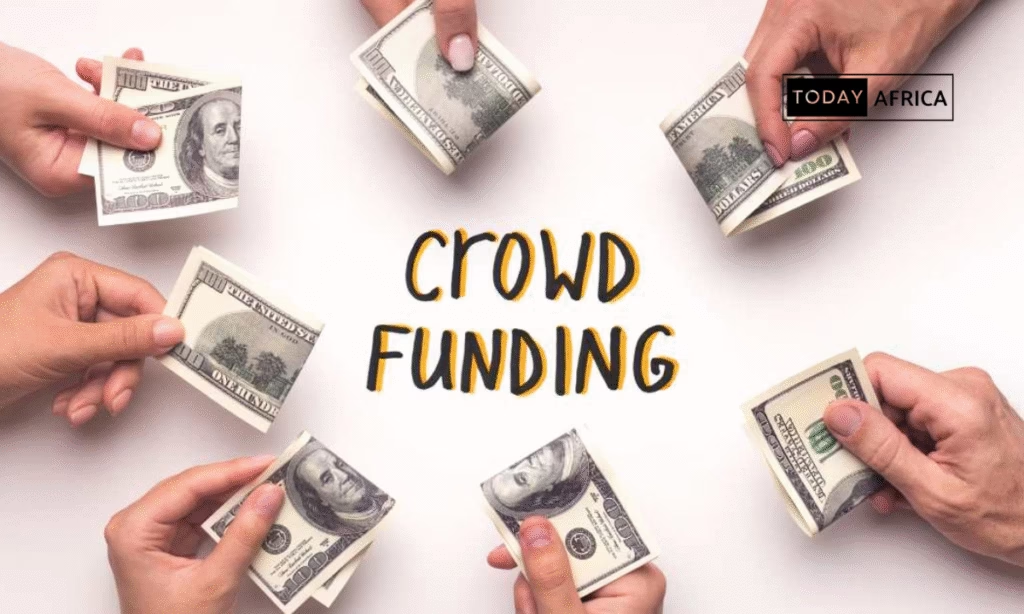
5. Crowdfunding
You can use online crowdfunding websites to get money for your business. There are different types of crowdfunding, including:
- Donation crowdfunding: This type of fundraising, facilitated by sites like GoFundMe, doesn’t require you to offer financial rewards or incentives for backers. You also don’t need to repay donors.
- Rewards-based crowdfunding: In this model popularized by Kickstarter, funders get rewards, like a thank-you note, special merch, or discounts, in exchange for helping to fund your business. Apps like Crowdfunder combine the rewards-based model with preorder functionality, giving crowdfunders early access to new products.
- Equity crowdfunding: With this option, you give people a stake in your company in exchange for their money. Registered equity platforms include Fundable, StartEngine, and Crowdcube.
Eligibility and credit assessment
Credit evaluation for startup loans differs significantly from that of established businesses. Lenders typically assess a combination of:
- Founder credit profiles (personal credit scores, repayment history)
- Business model viability (market size, revenue logic)
- Cash flow projections rather than historical performance
- Collateral or guarantees, where available
According to a Federal Reserve Small Business Credit Survey, nearly 70% of startups seeking loans are asked to provide personal guarantees.
This effectively transfers business risk to the founder’s personal balance sheet, a factor often underestimated by first-time entrepreneurs.
In emerging markets, lack of formal credit bureaus and financial statements further complicates assessment, leading lenders to rely heavily on relationship banking or group guarantees.
Cost of capital and risk implications
The cost of startup business loans is shaped by perceived default risk. Data from the International Finance Corporation (IFC) indicates that default rates among young firms are consistently higher than among mature SMEs, particularly within the first three years of operation.
As a result:
- Interest rates for startups are higher on average
- Loan tenors are shorter
- Grace periods are limited or absent
From a founder’s perspective, debt introduces fixed obligations that do not adjust to revenue volatility.
Unlike equity investors, lenders are not compensated for downside risk beyond interest payments, which is why they prioritize repayment certainty over growth potential.
Misalignment between loan structure and business cash flow remains a leading cause of early financial distress. Studies by the U.S. Bureau of Labor Statistics show that nearly 20% of new businesses fail within the first year, often due to liquidity constraints rather than lack of demand.
Startup loans vs equity financing
Startup business loans are often compared to equity funding, but they serve fundamentally different purposes.
| Dimension | Loans | Equity |
|---|---|---|
| Ownership | No dilution | Dilution required |
| Repayment | Mandatory | Conditional on exit |
| Risk Sharing | Founder bears most risk | Risk shared with investors |
| Control | Retained | Often shared |
| Suitability | Predictable cash flows | High-growth, uncertain models |
Debt financing is generally more appropriate for startups with:
- Stable or predictable revenue
- Asset-backed operations
- Clear paths to cash flow breakeven
Equity financing is better suited to startups pursuing rapid scaling, research-intensive development, or market expansion with delayed monetization.
Regional disparities in access
Access to startup business loans varies significantly by region.
- North America and Europe benefit from mature banking systems, credit guarantees, and diversified lending channels.
- Sub-Saharan Africa faces higher interest rates, shorter loan tenors, and stricter collateral requirements, according to the African Development Bank.
- Asia shows wide divergence, with strong SME lending in countries like China and South Korea, and limited access in frontier markets.
The World Economic Forum has consistently identified SME financing gaps as a structural constraint to entrepreneurship, estimating a global credit gap exceeding $5 trillion annually.
Read Also: 50 Low-cost Business Ideas with High Profit from Home
Policy and institutional considerations
Governments and financial institutions increasingly recognize that conventional lending models are ill-suited to startups. Policy interventions typically focus on:
- Credit guarantee schemes
- Interest rate subsidies
- Blended finance structures combining public and private capital
- Data infrastructure to improve credit assessment
However, poorly designed programs can lead to misallocation of capital, moral hazard, and rising non-performing loans. Sustainable startup lending requires institutional capacity, transparent criteria, and alignment between loan structure and business realities.
Conclusion
Startup business loans are neither inherently advantageous nor inherently harmful. They are financial instruments with specific risk profiles, best suited to particular types of businesses, markets, and stages of development.
For founders, loans can preserve ownership and accelerate execution, but only when repayment obligations are aligned with realistic cash flow expectations.
From a systemic perspective, expanding access to startup loans is not simply a matter of increasing credit supply. It requires robust financial infrastructure, credible borrower data, and lending models that account for the unique uncertainties of early-stage enterprises.
As global entrepreneurship continues to expand beyond traditional venture capital ecosystems, startup business loans will remain a necessary, if carefully constrained, component of the financing landscape.
Leave a comment and follow us on social media for more tips:
- Facebook: Today Africa
- Instagram: Today Africa
- Twitter: Today Africa
- LinkedIn: Today Africa
- YouTube: Today Africa Studio













4 Comments
Your article is amazing, i enjoy reading it, my blog is the top growing directory platform in germany, lokando24.de you can check it out. Thank you
Thank you for finding value in the article.
wow your article is simply a masterpiece, you can check the biggest webdesign freelancer platform in Germany called https://webdesignfreelancerfrankfurt.de/. Thank you for your wonderful post
Thank you for finding value in the article.
Comments are closed.