
It began in neighbourhoods where shop owners still ran on trust, thin margins, and whatever stock they could find that day.
The idea sounded almost too straightforward at first… what if small retailers could get inventory reliably, quickly, and without the usual friction that slowed them down?
With that simple but daring question, a young startup started pushing into a space many thought was too chaotic to modernize. Bit by bit, it pulled itself into regional conversations about last-mile delivery, digital trade, and how African cities might rethink distribution altogether.
What began as a local solution grew into a force that reshaped expectations about where transformative retailtech can come from and whom it’s meant to serve.
This inside Wasoko’s journey traces the founding story, their funding journey, strategic moves, societal impact, challenges, and lessons learned.
Disclaimer: Based on publicly available information as of December 2025 from reliable sources such as InstaDeep website, Rest of World, Techcrunch, Reuters, Endeavor, Sifted, and iAfrica.
Founding story of Wasoko
Founded in 2015 as Sokowatch, Wasoko grew from a scrappy pilot into one of Africa’s largest B2B retail platforms.
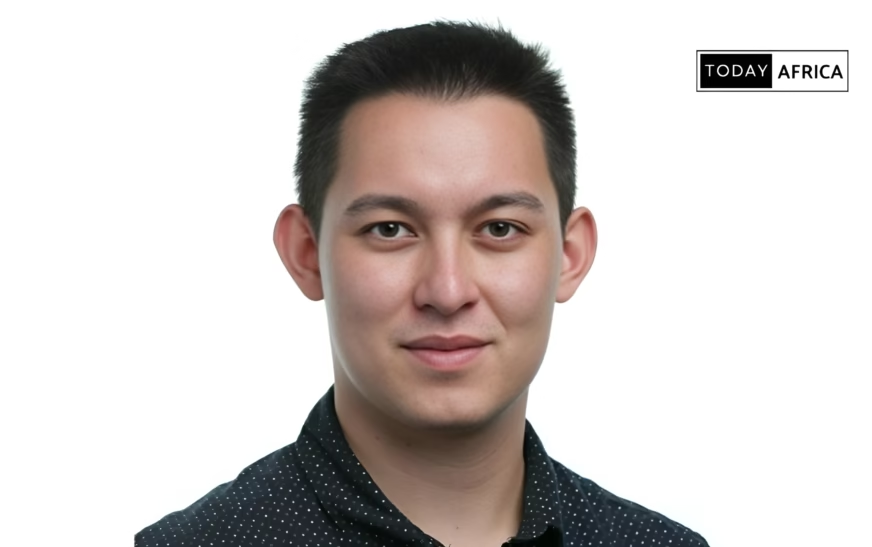
Its story begins with co-founder Daniel Yu, a University of Chicago student and software developer, who, after witnessing chronic stock-outs in Egyptian kiosks, conceived an idea to help small shopkeepers manage inventory via technology.
Captivated by the potential, Yu dropped out of college and moved to Nairobi, Kenya, to launch that idea.
With co‑founders David Jaress and Josh Raine, he built the first version of Sokowatch as a simple SMS ordering service for informal retailers.
In Kenya, they tested pilots on the streets of Nairobi, brokering orders between mom‑and‑pop shops and consumer goods suppliers. But they soon realized that just matching orders wasn’t enough, on-time delivery was the weak link.
As Yu later explained, “to deliver the quality of service these shops deserved, we needed to get more involved,” so Sokowatch began running its own logistics.
The early months were chaotic and full of learning. Sokowatch built a fleet of delivery vehicles, famously three‑wheel tuk‑tuks in city traffic, and opened its own warehouses.
The team managed inventory and fulfillment directly, transforming the startup from an “asset-light backend platform” into a full-stack e-commerce operation.
By 2018 it had expanded beyond Kenya into Tanzania, Rwanda and Uganda.
The company also introduced financial services early on: in 2019 Wasoko began extending small lines of credit to shop owners (who were typically unbanked), which doubled those merchants’ order volumes and sales.
Over this period Wasoko’s reputation grew, Daniel Yu won a White House Emerging Global Entrepreneur award and the Prince of Wales’s Young Entrepreneur Prize, and was named to Forbes 30 Under 30 (Social Entrepreneurs).
Tech media took notice too. By 2020 Sokowatch was reportedly serving ~15,000 informal retailers with free same-day delivery, saving merchants “at least 20% on supply-chain costs” for products they supplied.
In short, the startup carved out a reputation as a nimble disruptor, introducing mobile ordering apps, digital payments and merchant credit to East Africa’s mom‑and‑pop shops.
In mid‑2022, following the opening of new West African operations, Sokowatch rebranded as Wasoko (Swahili for “people of the market”) to underscore its Pan‑African ambitions.
Funding history, investors, and uses of capital
Seed round
A series of venture rounds fueled Wasoko’s growth. In July 2018, the startup raised a $2 million seed round (backers included 4DX Ventures, Lynett Capital, Outlierz Ventures, Village Global, and Golden Palm). These early funds underwrote the initial Kenya operations, building the ordering platform, delivery fleet, and staff needed to serve Nairobi’s thousands of small shops.
Series A
By February 2020, Wasoko closed a $14 million Series A led by Quona Capital (a fintech specialist) and joined by Amplo, Breyer Capital, Vertex Ventures, and repeat investor 4DX.
As CEO Daniel Yu told TechCrunch, the Series A was meant to “broaden [Wasoko’s] client services, from working‑capital to data analytics, and target new African markets”.
That meant scaling its warehouse network across East Africa, upgrading the ordering app, and deepening the credit and analytics tools that helped shopkeepers predict sales and access inventory loans.
Series B
The biggest infusion came in March 2022 when Wasoko announced a $125 million Series B co-led by Tiger Global and Avenir Growth (part of Madagascar’s Axian group), alongside new investors VNV Global, Flipkart co‑founder Binny Bansal, and Udaan co‑founder Sujeet Kumar.
This round valued Wasoko at about $625 million. According to wasoko.com and news reports, it supported two strategic goals: West African expansion and pan-African branding.
With the Series B cash, Wasoko launched in Abidjan (Côte d’Ivoire) and Dakar (Senegal), its first francophone markets, and officially changed its name to Wasoko.
The company also built out massive new warehouses and bolstered its fintech team to deploy even more working-capital loans to merchants.
Overall, in its first 6 years, Wasoko had raised roughly $140 million in institutional funding (seed + A + B), which backers hoped would capture a share of Africa’s $500+ billion informal retail market.
After 2022, the funding story shifted. Wasoko did not raise a public Series C; instead it continued scaling with existing capital even as the broader VC environment cooled. By late 2023, with both Wasoko and Egypt’s MaxAB (another B2B platform) eyeing consolidation, investors took a harder look.
Swedish firm VNV Global privately marked down Wasoko’s valuation sharply (from about $500M in late 2022 to $260M by the end of 2023), reflecting only partial delivery of the Series B proceeds and industry headwinds.
Reports show Wasoko raised over $230 million from global investors (including Tiger Global, Avenir, Quona, 4DX Ventures, and, through the MaxAB deal, Silver Lake and others).
The proceeds were largely ploughed into opening new country offices, hiring hundreds of operations and tech staff, building out ICT systems, and underwriting merchant credit programs across the continent.
Each financing round effectively raised Wasoko’s ambition: from a Kenyan pioneer in 2018, to a multi‑country East African network by 2020, to a pan‑African (and soon pan‑Mediterranean) supply chain player by 2022–23.
Read Also: Inside mPharma’s Journey: Fixing Pharmacy Supply Chains at Scale
Strategies fueling growth of Wasoko
1. Fully integrated commerce platform
Wasoko built a fully integrated commerce platform for informal retailers: shopkeepers could place orders via a simple mobile interface (SMS or a smartphone app) and Wasoko’s own logistics fleet would deliver goods from national distributors.
This “end‑to‑end” model digitized ordering, inventory management, and delivery in one go. By owning last-mile fulfillment themselves, Wasoko guaranteed service levels, as Yu notes, “we handle all of our last-mile logistics exclusively ourselves”, which was a differentiator against fragmented middlemen.
Over time, they layered on more merchant-facing tools too, such as point‑of‑sale inventory dashboards and sales reports that helped store owners know what to stock.
2. Data-driven fintech
From 2019 onward, it used the rich transaction data it collected to underwrite tiny lines of credit to clients. Traditionally unbanked shops could tap this credit to order more stock even without upfront cash.
Wasoko’s figures suggest this worked: retailers in their credit program doubled their order volumes and sales within a year. High repayment rates (often above 99% on small in-kind loans) meant the company could scale credit prudently.
In effect, Wasoko became as much a financial-services provider as a distributor. This capability extends embedded BNPL for groceries, captured investor excitement, since it promised a high-margin revenue stream on Wasoko’s existing merchant base.
3. Aggressive regional expansion
Wasoko pursued growth city by city. After conquering Nairobi, it spread to other Kenyan cities, then crossed borders into Dar es Salaam, Kigali and Kampala by late 2018.
Each new country added hundreds or thousands of retailers and new supplier partnerships. In 2022, flush with Series B funding, Wasoko “launched in Abidjan and Dakar”, a first foothold in West Africa.
Along with the rebranding, this Pan-African positioning helped it sign on global FMCG giants (Unilever, Procter & Gamble, etc.) as supply partners.
In effect, Wasoko packaged informal retail as one big digital market. By giving manufacturers and distributors a single portal to thousands of corner shops, Wasoko was “building out the largest B2B e-commerce network across Africa,” as Yu put it.
4. Technology and operations
It moved from text messaging to mobile apps and bulk ordering, developed algorithms to predict stockouts, and managed a growing team of drivers and warehouse staff.
This combination of tech and touch, a “digital platform plus physical trucks”, was central to Wasoko’s appeal. It also earned media attention: for example, Fast Company named Wasoko one of the World’s Most Innovative Companies in 2021, highlighting its novel market model.
Wasoko’s strategy was to attack every part of the informal supply chain: ordering, credit, logistics and data, which for a time allowed it to outpace peers and keep merchants buying from it.
Read Also: Inside InstaDeep’s Journey: From Two Laptops to a $682M Acquisition
Competition in the retailtech ecosystem
Wasoko was not alone in chasing Africa’s $500+ billion informal retail sector, and the landscape grew crowded. In Kenya itself, there were rivals like Twiga Foods, which focused on fruits and vegetables, and MarketForce, a local B2B ordering platform.
In Nigeria and West Africa, companies like TradeDepot, Omnibiz and Alerzo pursued a similar vision of delivering FMCGs to mom‑and‑pop shops. TradeDepot, for instance, connects hundreds of thousands of Nigerian retailers with fast-moving consumer goods and had raised over $100M by 2021.
All these startups pitched the same solution: digitize procurement, bundle products to lower costs, offer credit (often BNPL) and use logistics networks.
Despite shared goals, approaches varied. Twiga Foods integrated vertically (sourcing produce from farms) and later branched into retail (its ChopUp app), whereas TradeDepot and Omnibiz built broad marketplaces covering groceries, household items and more.
Some, like MarketForce, had a lighter asset base, hoping to aggregate orders without fully owning trucks (though even MarketForce eventually launched its own delivery app). The competition pressure was intense.
WeeTracker notes that by 2022, these B2B e-commerce startups “promised to digitize procurement, offer lower prices via bulk buying, provide credit, and ensure reliable delivery”, yet all were grappling with the same razor-thin FMCG margins.
Price wars broke out as multiple platforms offered deep discounts to win shopkeepers, driving margins dangerously low. As MarketForce’s CEO Tesh Mbaabu put it, the field became “perfect competition” and “a race to the bottom” on price.
Building such logistics-heavy businesses proved equally challenging. Every competitor learned that owning warehouses and fleets is capital-intensive.
For example, TradeDepot eventually owned warehouses and hundreds of trucks, much like Wasoko had done. When the funding climate shifted, companies like Twiga and Alerzo announced layoffs and portfolio shifts.
In many ways Wasoko’s path mirrored (and at times outshone) its peers: it became one of the first and largest such platforms in East Africa, with strong backing, but ultimately faced the same “brutal” economics.
In this ecosystem, Wasoko’s edge early on was its integrated model and first-mover status, but the business proved just as unforgiving as its rivals’.
Impact on society
Despite the challenges, Wasoko’s journey delivered tangible benefits to thousands of small businesses. By 2020 it was serving on the order of 15–16 thousand shops in East Africa.
These corner stores, long underserved by modern supply chains, began enjoying free delivery of household staples and wares, often within two hours of ordering.
According to Wasoko’s own estimates, merchants saved about 20% on supply-chain costs thanks to bulk procurement and lower logistics fees. Faster restocking meant less downtime and more sales at the shops.
Formal financing to the informal sector
Its merchant credit program extended tens of millions of dollars in inventory loans to shopkeepers.
For example, in a recent year, the platform’s fintech vertical (especially in Egypt after merging with MaxAB) disbursed over $20 million in loans to retailers, with repayment rates above 99%.
These data-driven loans helped owners buy inventory that banks would not finance, effectively acting as a micro-loan supplier. Beneficiary shops reported being able to stock more goods and grow their businesses.
This infusion of credit filled a historic gap: only about one-third of African SMEs have any bank credit, and Wasoko’s record-keeping enabled many retailers to gain access.
Employment
Its delivery drivers, warehouse staff, and tech teams numbered in the high hundreds. By 2022, Wasoko had grown from a tiny team in 2016 to some 800 employees across 18 cities.
Each new distribution center or city office brought jobs in logistics and office support to local economies.
Moreover, the increased transparency in the supply chain benefited manufacturers and distributors by giving them real sales data from street shops, information that was virtually unavailable before.
Wasoko’s impact can be seen in the numbers. The merged MaxAB-Wasoko entity now boasts roughly 450,000 merchants under contract (reaching about 65 million consumers).
Even before the merger, Wasoko alone claimed millions of orders delivered (it reported 2.5 million orders to 50,000 retailers by 2022). In interviews, shop owners often note that what used to be a day-long errand (driving across town to buy stock) is now a phone call or text.
One Nairobi kiosk owner said Wasoko’s service “kept our shelves full without having to send a relative to pick up supplies,” allowing him to focus on sales. These stories of everyday entrepreneurs, although not always captured in press quotes, underscore the societal promise Wasoko pursued.
Read Also: Inside VIEBEG Medical’s Journey: Using Data to Transform Africa’s Medical Supply Chains
Challenges Wasoko faced
The very factors that powered Wasoko’s growth became headwinds. The company’s asset-heavy operations, its warehouses, fleets and inventory, proved extremely costly.
Industry observers note that traditional FMCG distribution in Africa yields only 2–5% gross margins, leaving little buffer when fuel, wages and interest costs rise. Wasoko, like its peers, burned through capital quickly to maintain same-day service.
As venture funding began to dry up after 2022, that model strained cash flow. A TechCrunch analysis reported that Wasoko’s 2022 Series B ultimately delivered only $113M of the promised $125M, forcing the company to stretch its runway.
By late 2023 and early 2024, investors like VNV Global were quietly writing down Wasoko’s value by roughly half, a sign of growing concern about the business’s sustainability.
Over-expansion added another layer of stress. Wasoko had launched into multiple countries in quick succession. Following the merger, the group announced it was exiting underperforming markets, shutting down offices in Zambia, Uganda and Senegal, and refocusing resources on core regions.
Such contractions involved difficult layoffs. Even in its strongest markets, profitability remained elusive: by the merger in 2024, only three of five active countries had reached break-even on the e-commerce business.
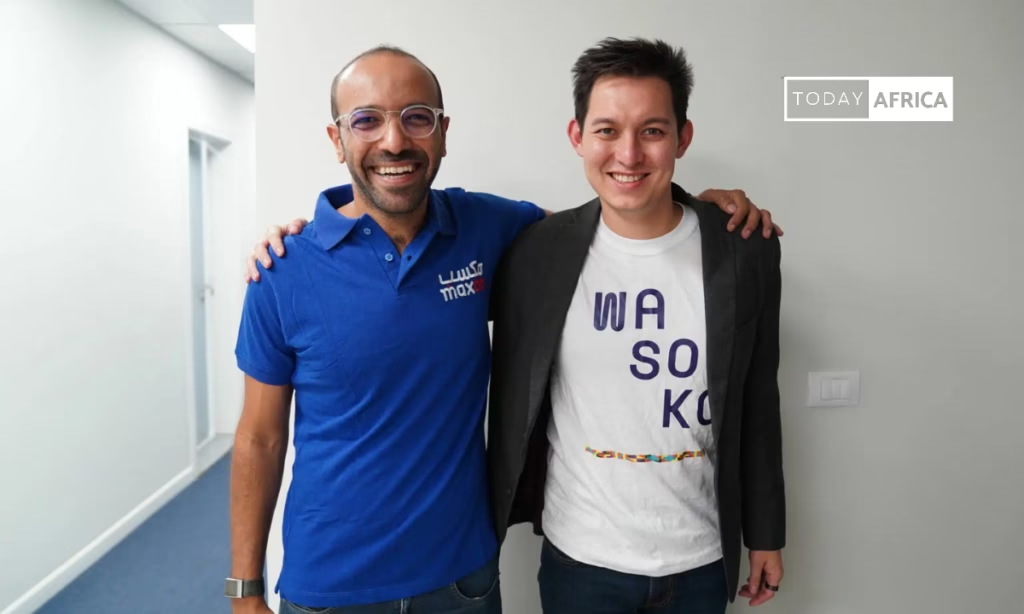
Management changes also underscored the turbulence. In September 2025, WeeTracker reported that founder Daniel Yu would step down from day‑to‑day duties (though remaining on the board), transitioning leadership solely to MaxAB’s co-founder Belal El‑Megharbel.
Competition and macro‑economic factors didn’t help. Wasoko found itself in “a race to the bottom” on pricing. WeeTracker noted that Wasoko and rivals had flooded markets with essentially identical products, igniting price wars that further squeezed margins.
Inflation, currency swings and high interest rates in East Africa added further pressure.
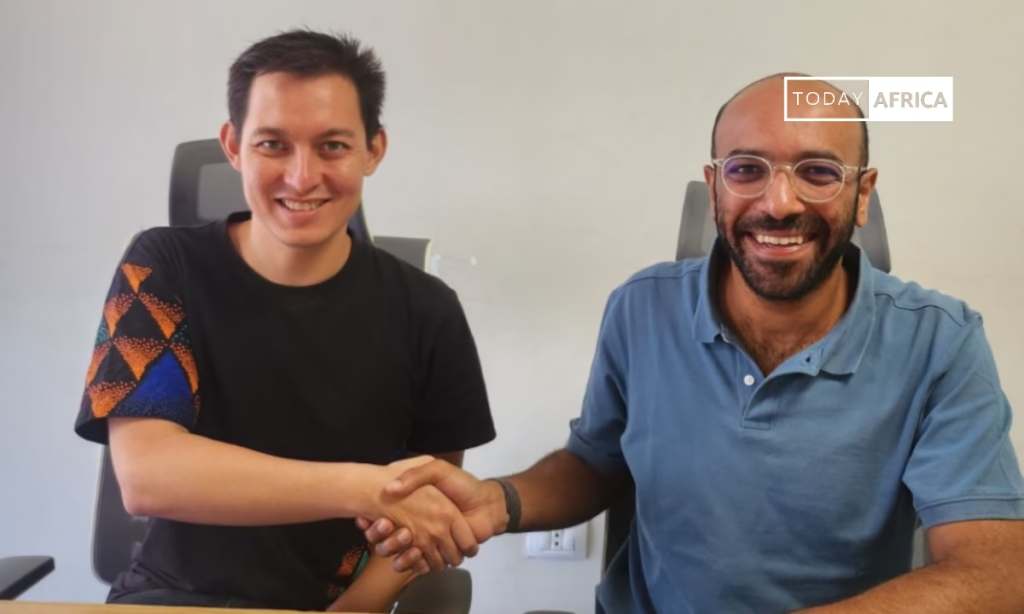
The merger process itself was complex: it was structured as an all-stock deal, meaning no fresh cash entered Wasoko/MaxAB, leaving the combined company to ‘triage’ costs while pursuing new revenue strategies.
In Morocco, for example, the company even paused its B2B marketplace and leaned into fintech instead, reflecting how ground realities dictated strategy shifts.
Wasoko faced almost every pitfall of the model it pioneered. From operational bottlenecks to funding slowdowns and hyper-competition, the challenges were stark.
As a Tech In Africa analyst observed, e-commerce was expanding rapidly but remained high-cost, low-margin, whereas fintech (loans, payments) offered “significantly higher margin potential”.
In mid-2025, Wasoko-MaxAB was essentially overhauling its approach: winding down some logistics activities and doubling down on financial services.
Why Wasoko struggled and lessons learned
Wasoko’s turbulence ultimately reflects the harsh economics of its chosen arena. Selling fast-moving consumer goods through decentralized shops is inherently unit‑economics-challenged.
The wide dispersion of thousands of small buyers means a high customer acquisition and delivery cost per unit. As one tech observer noted, any startup with this “asset-heavy model” is vulnerable, because the upkeep of warehouses and trucks can easily eat into margins.
Even innovative credit and data services could not fully offset those costs.
In retrospect, Wasoko’s aggressive multi-country expansion, entering East and West African markets in a span of years, appears to have outpaced its ability to sustain operations profitably.
Key lessons for entrepreneurs and investors
- First, disciplined growth is crucial. Watched with caution by investors after early 2023, Wasoko’s model suggests the need to tightly control burn and test profitability before scaling to new geographies.
- Second, the limits of fintech must be understood: extending inventory loans can boost volume, but also tie up working capital and introduce credit risk. Wasoko’s very high repayment rates in Egypt (over 99%) are impressive, but they required sophisticated data models and still demanded a shift in customer trust and regulation (e.g. securing a banking license in Egypt). Not every market will yield the same outcomes.
- Third, local adaptation matters. The experience in Morocco shows that a one-size-fits-all approach falters, consumer habits, banking rules and competitive landscapes differ country by country. For instance, Wasoko has since slowed its Moroccan marketplace operations and focused on fintech there. Future startups must build local expertise in regulations and logistics networks instead of assuming rapid replication.
Wasoko’s story underscores the importance of sustainable unit economics. As investor VNV pointed out, Wasoko’s valuation had to be modelled on trading multiples rather than lofty funding valuations.
The most viable path forward has become embedding higher-margin services like digital credit and payments into the supply chain.
Indeed, the merged MaxAB-Wasoko’s pivot to a “fintech-driven ecosystem”, complete with its own banking license, highlights a lesson: in informal retail distribution, fintech may be the real moat.
Wasoko taught the tech community that bold tech solutions can reach underserved markets, but only if paired with disciplined economics and flexibility.
Investors, for their part, have also learned caution, pushing startups toward profitability and sustainable models before piling on capital.
Read Also: Inside Twiga Foods’ Journey: From Rural Farms to Cities
Conclusion
Wasoko’s journey is a vivid chapter in Africa’s startup narrative, one that blends daring ambition with sobering realities. The company sprinted to scale in informal retail where few had trodden, showing how cellphone apps and tuk‑tuk deliveries could transform dusty neighbourhood shops.
Along the way, it innovated, sprouting credit lines and data tools that turned analogue merchants into digital customers. Its story also illustrates how market dreams collide with hard constraints: thin margins, fierce competition and complex operations can unravel even the most well‑funded venture.
For African entrepreneurs, Wasoko is both an inspiration and a cautionary tale. It shows the power of first‑mover advantage and an integrated strategy, but also the need for measured expansion and an eye on the bottom line.
Ultimately, Wasoko’s rise and recalibration speak to a broader truth: innovation in Africa’s retail ecosystem can flourish, but only by marrying big visions with rigorous economics.
Its legacy will be the lessons it left behind, in ambition, experimentation and the persistent pursuit of solutions for everyday markets.
Sources: TechCrunch, WeeTracker, and Tech In Africa.
Leave a comment and follow us on social media for more tips:
- Facebook: Today Africa
- Instagram: Today Africa
- Twitter: Today Africa
- LinkedIn: Today Africa
- YouTube: Today Africa Studio