
Nigeria’s remittance and digital payments market has entered a more mature phase, where scale, regulatory alignment, and infrastructure depth matter as much as customer growth.
As global payment companies reassess exposure to complex markets and local fintechs move up the value chain, partnerships, rather than standalone market entries, are increasingly shaping outcomes.
Against this backdrop, Paga’s evolution from an early agent banking pioneer into a multi-layered financial infrastructure provider offers a useful lens for understanding recent developments, including PayPal’s renewed engagement with Nigeria.
Founded in 2009, Paga entered the market during a period of acute financial exclusion, building agency banking rails well before the arrival of later players such as OPay and Moniepoint in 2019.
While competitive pressure compressed its early advantage, the company has since reoriented structurally and strategically.
Today, operations sit under UK-registered Paga Group Ltd, which houses three distinct units: Paga (consumer payments), Doroki (direct-to-business services), and Paga Engine, its Banking-as-a-Service platform.
Through Paga Remit, the group now operates with an International Money Transfer Operator (IMTO) licence, enabling it to serve global remittance firms seeking naira issuance and local payout capabilities.
This repositioning has coincided with measurable scale. Over the past four years, Paga Group reports 17x growth. In 2024, it processed ₦17 trillion ($12 billion) across 169 million transactions, representing 95% year-on-year growth.
A notable driver has been the increase in average transaction value, from ₦34,000 in 2021 to ₦100,000 in 2025, suggesting a shift toward higher-value use cases and more affluent users across both its consumer and BaaS businesses.
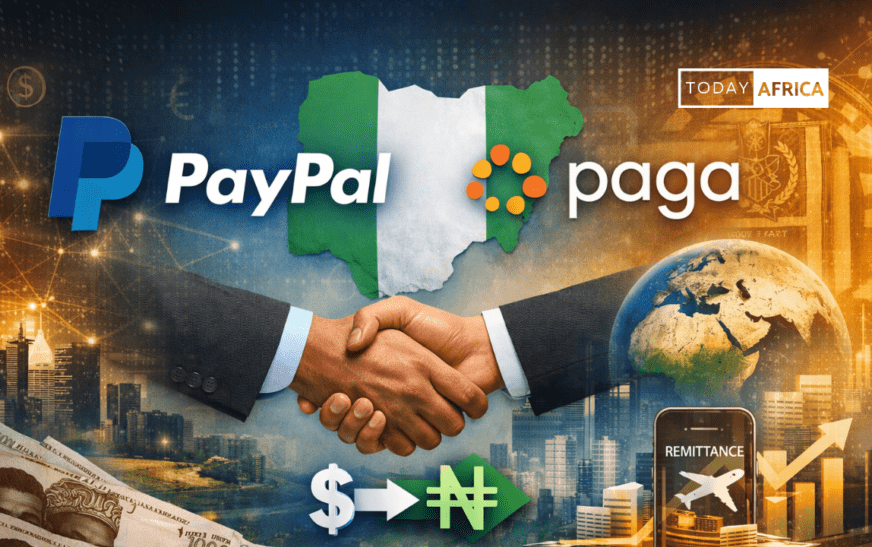
The newly announced PayPal–Paga partnership sits squarely within this infrastructure-led strategy. Rather than re-enter Nigeria directly, PayPal is leveraging Paga Remit as its local IMTO partner, consistent with how many global payment firms now approach regulated African markets.
While PayPal previously held an IMTO licence in Nigeria, it no longer appears on recent Central Bank of Nigeria listings, implying a strategic withdrawal rather than regulatory exclusion.
Under the current arrangement, Paga Remit will manage FX conversion, local settlement, compliance reporting, and onward disbursement through authorised dealer banks, while PayPal retains origination in its licensed markets.
Read Also: EFCC files ₦4.3bn forex fraud charges against UBA and others
This structure aligns with Nigerian IMTO rules but also raises open questions, particularly around the regulatory treatment of naira wallets for non-residents and how the CBN may apply emerging frameworks such as Non-Resident Nigerian Ordinary Accounts (NRNOA).
The partnership is also already influencing competitive dynamics.
Within 24 hours of the announcement, Raenest, a major multi-currency account provider, updated its pricing, reducing fees and expanding free deposit thresholds.
This response reflects a market where margins are tightening, and customer retention increasingly depends on cost efficiency rather than brand recognition alone.
Over the longer term, PayPal’s cautious re-engagement suggests a recalibration rather than a full return. For Paga, the partnership reinforces its position as a critical intermediary in Nigeria’s remittance stack.
For the broader ecosystem, the key variables to watch are regulatory clarity, fee compression sustainability, and whether partnerships can scale without reintroducing the frictions that previously limited global platforms in the Nigerian market.
Leave a comment and follow us on social media for more tips:
- Facebook: Today Africa
- Instagram: Today Africa
- Twitter: Today Africa
- LinkedIn: Today Africa
- YouTube: Today Africa Studio