
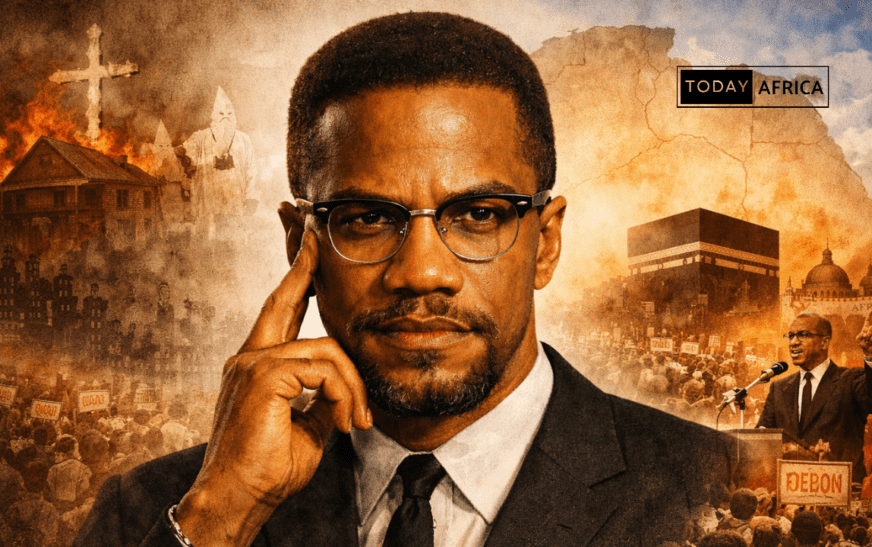
Malcolm X remains one of the most rigorously analyzed political figures of the twentieth century, not because of myth or martyrdom alone, but because his life traced the evolution of Black political thought in the United States with unusual clarity.
His biography intersects with mass incarceration, religious movements, urban poverty, Cold War geopolitics, Pan-Africanism, and the global struggle against racial domination.
Unlike many civil rights leaders whose public philosophy remained largely consistent, Malcolm X’s political identity transformed repeatedly, shaped by lived experience and global exposure.
Born Malcolm Little, he would later become Malcolm X, then El-Hajj Malik El-Shabazz, each name reflecting a distinct ideological phase.
His life offers more than a personal story; it provides a framework for understanding structural racism, Black nationalism, and the internationalization of the African American freedom struggle.
This biography examines Malcolm X not as a symbol, but as a political actor whose ideas evolved through confrontation with power, faith, and global Black movements.
Early life: Poverty and displacement (1925–1941)
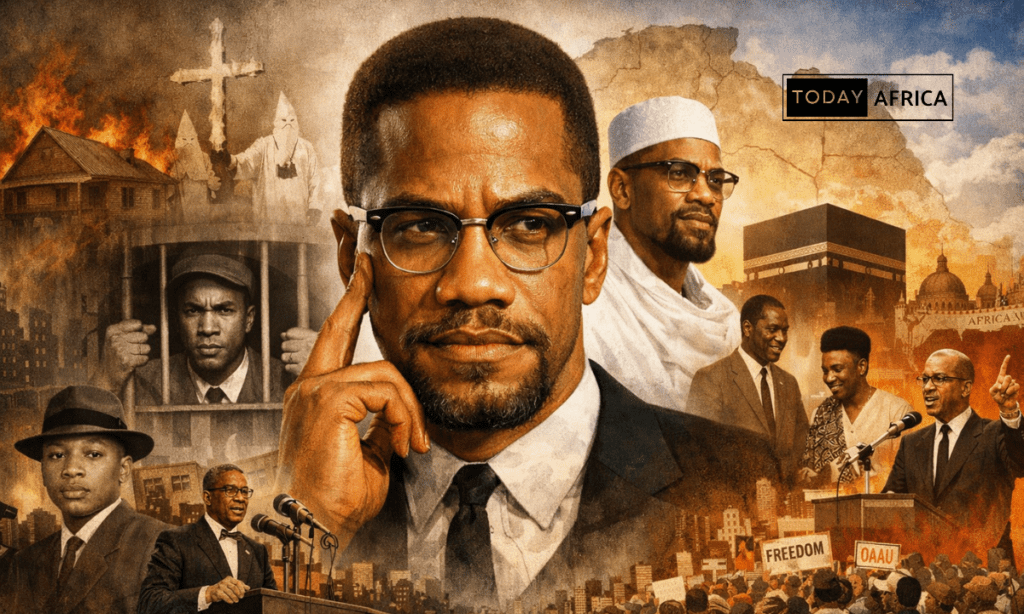
Malcolm X was born Malcolm Little on May 19, 1925, in Omaha, Nebraska. His parents, Earl Little and Louise Little, were active supporters of Marcus Garvey’s Universal Negro Improvement Association (UNIA), which promoted Black self-reliance and Pan-African unity.
This political alignment placed the family in direct conflict with white supremacist groups. Earl Little received repeated death threats from the Ku Klux Klan and similar organizations.
The family relocated multiple times, eventually settling in Lansing, Michigan. In 1929, their home was burned down under suspicious circumstances widely believed to involve white supremacists.
In 1931, Earl Little was found dead on railroad tracks. Although authorities ruled it an accident, the Black community viewed it as a racially motivated killing. Insurance companies refused to pay full benefits, citing suicide.
Louise Little, left to raise eight children in a racially hostile environment during the Great Depression, faced severe economic hardship. In 1939, she was committed to a state mental institution, and Malcolm and his siblings were placed in foster care.
These events formed Malcolm’s earliest understanding of systemic racial injustice, not as an abstraction, but as a lived condition enforced by state institutions, economic exclusion, and racial violence.
Read Also: 25 recommended biography books for the voracious reader in you
Education, alienation, and survival (1941–1946)
Malcolm excelled academically in his early years. At a predominantly white school in Michigan, he was elected class president and consistently ranked among top students.
However, when he expressed a desire to become a lawyer, a teacher reportedly told him that such a profession was “no realistic goal for a Negro.” This moment marked a decisive break between Malcolm and the American education system.
He dropped out of school shortly thereafter and moved to Boston, then Harlem.
In these urban centers, Malcolm became immersed in underground economies, working as a shoeshine boy, hustler, and eventually engaging in burglary and drug dealing.
His activities reflected the limited economic mobility available to young Black men in segregated cities during the 1940s.
In 1946, Malcolm was arrested and sentenced to eight to ten years in prison for burglary. He was 21 years old. This period would become the most intellectually formative phase of his life.
Prison and political awakening (1946–1952)
While incarcerated at Charlestown State Prison and later Norfolk Prison Colony, Malcolm underwent a profound transformation.
Influenced by fellow inmates and correspondence with family members, he was introduced to the Nation of Islam (NOI), a religious movement led by Elijah Muhammad that fused Islam with Black nationalist ideology.
Malcolm immersed himself in self-directed education, reading extensively on history, philosophy, religion, and political theory. He famously copied the dictionary to improve his vocabulary. By his own account, prison became his “university.”
The Nation of Islam taught that Black people were the original people of the world and that white supremacy was a product of historical exploitation.
While many of the movement’s theological claims were unorthodox, its political implications, economic self-sufficiency, discipline, and racial pride resonated deeply with Malcolm’s lived experience.
Upon his release in 1952, Malcolm rejected his surname “Little,” which he viewed as a legacy of slavery, and adopted “X” to signify a lost African name erased by enslavement.
Read Also: A Look at the Charlie Kirk Biography: Major Conservative Voice
Rise within the Nation of Islam (1952–1963)
Malcolm X quickly became the most prominent minister and public spokesperson for the Nation of Islam.
His rhetorical precision, disciplined logic, and media presence transformed the NOI from a marginal religious movement into a national political force.
By the early 1960s, Malcolm had established or revitalized dozens of NOI mosques across major U.S. cities. Membership reportedly grew from a few thousand to over 100,000 during this period, though exact figures vary.
His speeches challenged the moral authority of American liberalism, criticizing integration as insufficient and framing racial oppression as systemic rather than accidental.
Unlike civil rights leaders who emphasized nonviolence and interracial cooperation, Malcolm X argued that African Americans had the right to self-defense “by any means necessary.”
He rejected the framing of civil rights as a moral appeal to white conscience, instead viewing it as a struggle for political power and human rights.
His critique extended beyond domestic policy. Malcolm increasingly framed the Black American experience as part of a global system of colonialism, aligning African Americans with anti-imperialist struggles in Africa, Asia, and Latin America.
Break with the Nation of Islam (1964)
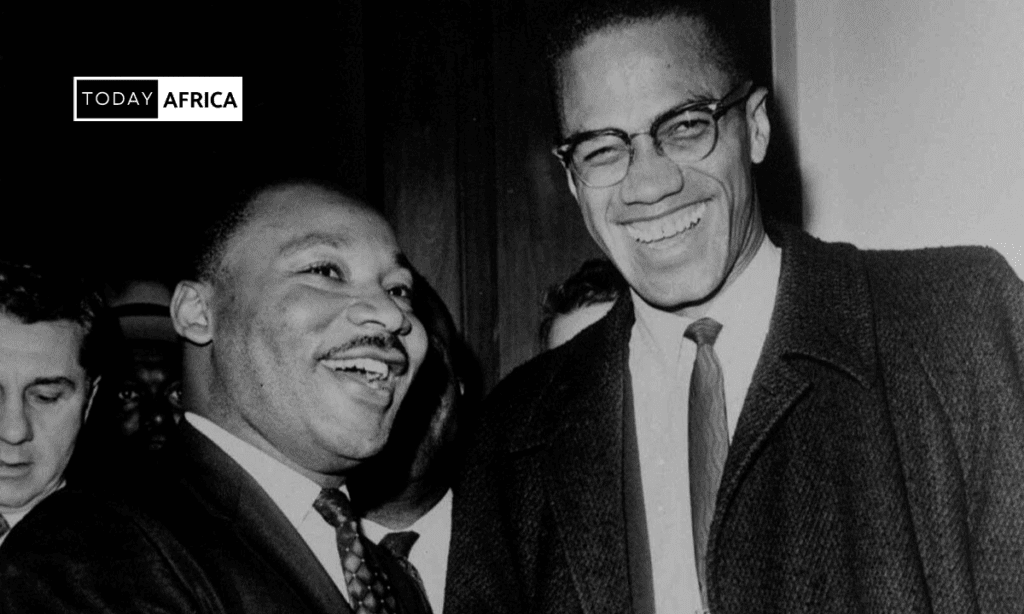
By 1963, tensions between Malcolm X and Elijah Muhammad became irreconcilable. Malcolm’s growing political independence, public visibility, and international ambitions clashed with the NOI’s internal hierarchy.
Additionally, Malcolm became disillusioned after learning of Elijah Muhammad’s extramarital relationships, which contradicted the movement’s moral teachings.
In March 1964, Malcolm X formally left the Nation of Islam.
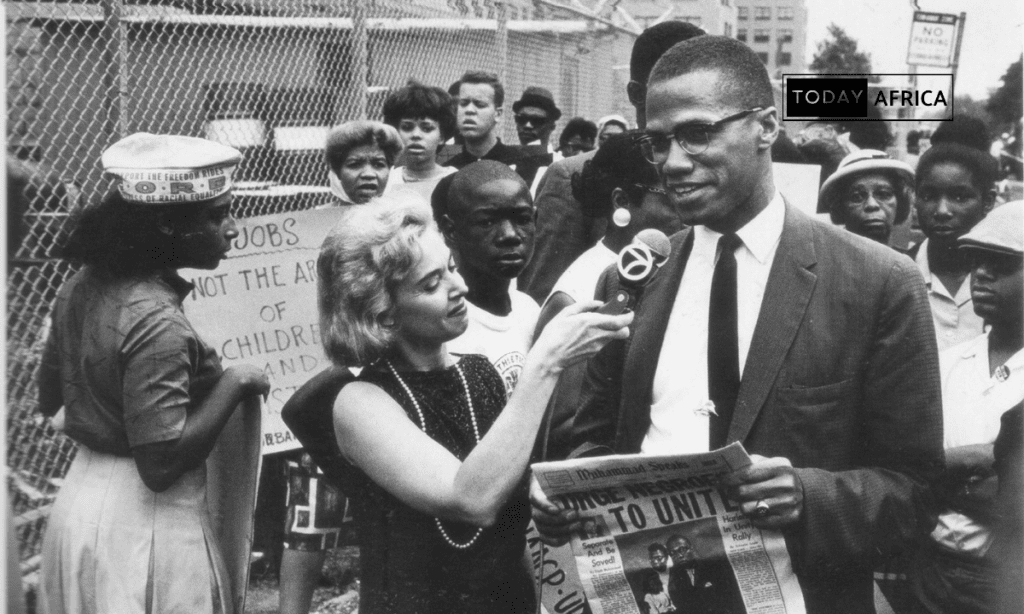
The split was both ideological and organizational. He founded Muslim Mosque, Inc., to continue religious work, and later the Organization of Afro-American Unity (OAAU), modeled in part on the Organization of African Unity (OAU).
This period marked the most significant ideological shift of Malcolm’s life.
Internationalism and ideological expansion (1964–1965)
In April 1964, Malcolm X undertook the Hajj pilgrimage to Mecca. There, he encountered Muslims of all races, including white Muslims, which fundamentally altered his views on race and religion.
In letters sent from Mecca, he acknowledged that racism was not inherent to all white people, but rather a product of specific social systems.
Following Mecca, Malcolm traveled extensively across Africa and the Middle East, visiting countries such as Egypt, Ghana, Nigeria, Algeria, and Tanzania. He met with heads of state, diplomats, and revolutionary leaders, including Kwame Nkrumah and Julius Nyerere.
These travels deepened his Pan-Africanist outlook. Malcolm began advocating for the internationalization of the African American struggle, urging that U.S. racial discrimination be brought before the United Nations as a human rights violation.
This marked a shift from religious nationalism toward secular revolutionary politics grounded in global solidarity.
Read Also: Captain Ibrahim Traoré: Transitional Leader Transforming Burkina Faso
Assassination and political aftermath (1965)
On February 21, 1965, Malcolm X was assassinated while delivering a speech at the Audubon Ballroom in Harlem.
He was 39 years old.
Three members of the Nation of Islam were convicted, though subsequent investigations and recent scholarship have raised serious questions about the completeness of the official account, including possible state surveillance and intelligence failures.
Malcolm’s death occurred at a moment when he was actively refining his political vision.
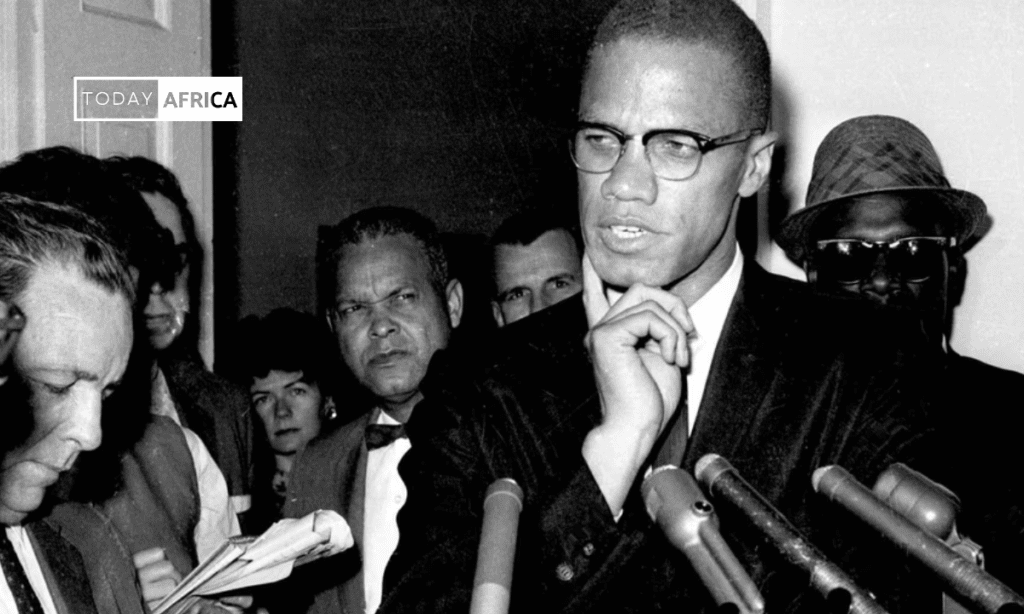
His final speeches indicate a move toward coalition-building across ideological lines, including dialogue with civil rights leaders he had previously criticized.
Intellectual and political legacy
Malcolm X’s legacy is not reducible to a single ideology. His life illustrates political evolution shaped by experience, travel, and confrontation with institutional power.
He influenced generations of activists, from the Black Power movement of the late 1960s to contemporary movements addressing mass incarceration and racial capitalism.
His autobiography, The Autobiography of Malcolm X, co-written with Alex Haley and published in 1965, remains one of the most widely read political biographies in modern history.
It is frequently cited in academic literature on race, political identity, and social movements.
Malcolm X’s enduring relevance lies in his analytical clarity: his insistence that racial inequality is structural, not incidental; that political power matters more than moral appeals; and that African American struggles are inseparable from global systems of domination and resistance.
Read Also: Ibukun Awosika: First Female Chairman of First Bank of Nigeria
Conclusion
The biography of Malcolm X is ultimately a study in transformation, personal, political, and ideological.
From a childhood shaped by racial terror to a global platform advocating human rights, Malcolm X’s life mirrors the complexities of Black political struggle in the twentieth century.
He challenged dominant narratives, confronted institutional hypocrisy, and refused intellectual stagnation.
Rather than offering comfort, Malcolm X offered analysis. Rather than seeking approval, he sought power and autonomy.
His biography remains essential not because it provides easy answers, but because it forces sustained engagement with the realities of race, justice, and political agency in a global context.
Leave a comment and follow us on social media for more tips:
- Facebook: Today Africa
- Instagram: Today Africa
- Twitter: Today Africa
- LinkedIn: Today Africa
- YouTube: Today Africa Studio





![Biography of Tony Elumelu [Investor, Entrepreneur, & Philanthropist]](https://todayafrica.co/wp-content/uploads/2023/12/Blue-Simple-Dad-Appreciation-Facebook-Post-1200-×-720-px-7-1.png)