
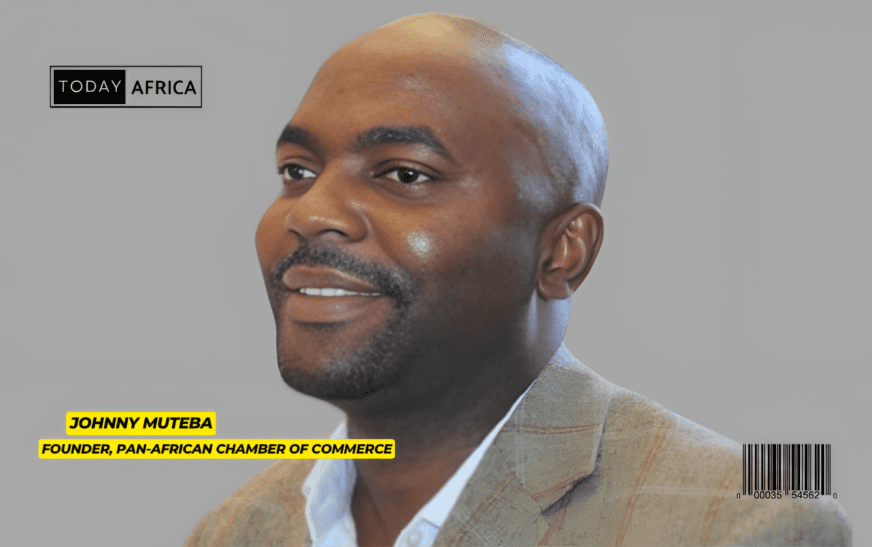
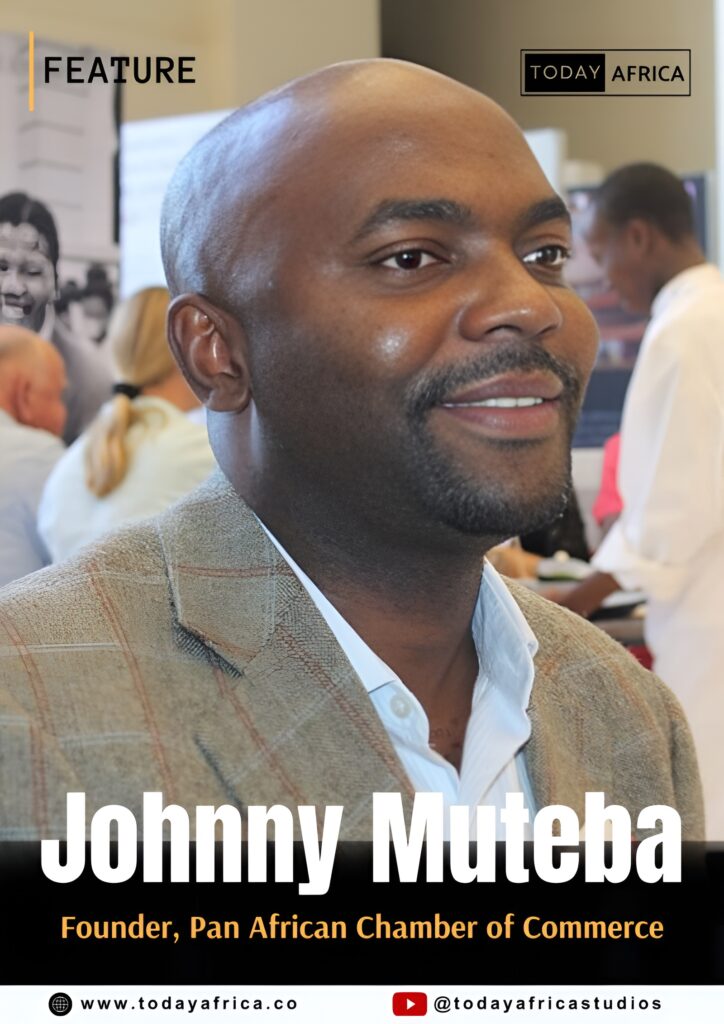
In an era where Africa is often discussed more than it is understood, Johnny Muteba is building institutions designed to shift the conversation, from dependency to ownership, and from political freedom to economic power.
Based in Johannesburg, Muteba operates at the intersection of commerce, technology, and culture, driven by a belief that Africa’s next liberation must be economic.
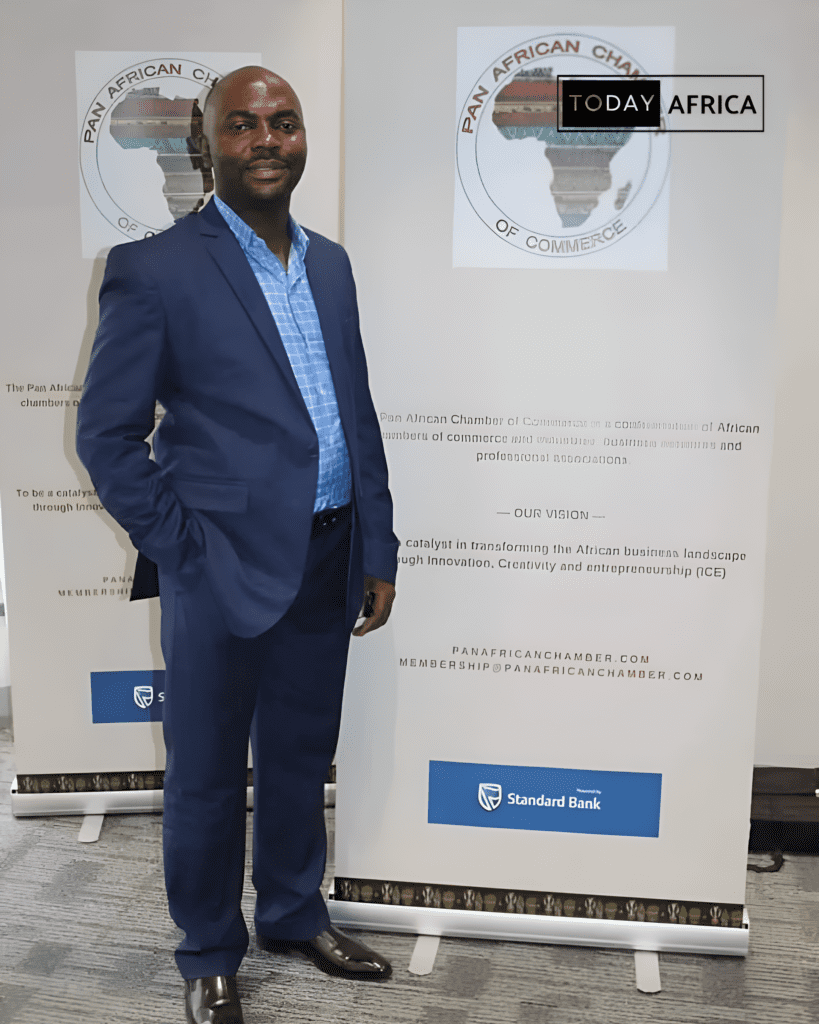
After a pivotal conversation with African students struggling to transition from the classroom to the workforce, he founded the Pan-African Chamber of Commerce. Years later, he launched Sankofa University, a digital-first, Afrocentric institution designed to prepare a new generation of African builders.
This is not just the story of an entrepreneur. It is the story of a builder attempting to stitch together a continent, and if Africa’s future will be shaped by those who dare to think beyond borders, he’s determined to help design it.
In this conversation, Johnny Muteba outlines a borderless education model, a technology ecosystem connecting Africa with its diaspora.
Tell us more about yourself
Johnny Muteba is an entrepreneur, a change maker, and a father. A man “driven to change the way the African continent is portrayed.”
He works at the intersection of commerce, technology, and culture, based primarily in Johannesburg, South Africa. But his mind stretches further.
“My mission is really to connect our continents socially, culturally, economically, politically, from Cape to Cairo.”
That idea did not arrive yesterday. He traces it back to childhood, to an early exposure to the stories of those who fought for freedom.
“At a very young age, I understood exactly how people before us fought to bring about the freedom that we’re enjoying today.”
The freedom they ushered in was political. He believes his generation has unfinished business.
“Our generation needs to step in to usher in economic freedom.”
That belief animates everything he builds. Not just connections within Africa, but bridges to “our brothers and sisters who are sitting in the diaspora.”
Unity, he says, is not sentimental. It is structural. “Unity is the foundation of every economic story.”
He speaks of uniting thoughts, cultures, and ideas. Of finishing what Kwame Nkrumah, Patrice Lumumba, and Julius Nyerere started. The names come easily. The ambition sits heavy.
This, he suggests, is not nostalgia. It is continuation.
What inspired you to start the Pan-African Chamber of Commerce?
In 2010, on Africa Day, I organized an event at a university in Johannesburg. Four hundred students gathered. They came from Nigeria, Kenya, Angola, Zimbabwe, Zambia, and South Africans too.
It began as a celebration. It turned into a reckoning.
“They then presented a problem.”
When they finished studying in South Africa, they said, it was very difficult to become employable. Even finding work experience was hard.
Muteba listened, and then he took action. “I went immediately after the event to speak to the ambassadors that I’d invited to the event to find a way to solve this problem.”
Some ambassadors did not commit. Others did. The Embassy of France offered to connect them with the business community. That moment became a hinge.
“That is basically how the idea of the Pan-African Chamber of Commerce started back in 2010.”
He began working with European chambers in South Africa, French, Spanish, German, and Italian, including the European Union chambers too. The problem had forced him into architecture.
“At the core, the foundation of the Pan-African Chamber of Commerce is a problem of students from across our continent who could not find opportunities for work experience in South Africa.”
The chamber expanded its logic. If a mining engineer trains in South Africa, why must he remain there? There are mines in Namibia, Botswana, Lesotho, and the DRC. But movement requires a value chain, a network, and people who can open doors.
“That’s basically what made us go further and set up the Pan-African Chamber of Commerce.”
Read Also: 100+ Entrepreneurs in Africa to Watch in 2026
Why are we struggling with intra-African trade?
Muteba does not hesitate.
“We are still living with the legacy of the past as a continent and our leaders, I have to say, are not serious.”
Intra-African trade hovers around 15 to 16%, he says. Movement is constrained. Visas multiply. He offers a comparison. To travel across Africa, Aliko Dangote, at least needs about 35 visas. “Now that’s a problem.”
Meanwhile, he points to iShowSpeed, who can board a plane and travel widely across the continent without the same restrictions. “Now that’s a problem.”
He is clear about responsibility. “We cannot in 2026 continue to blame Europe, the West for the bad decisions that the leaders of Africa today are making.”
The African Continental Free Trade Area has created openings for goods, he acknowledges. But goods cannot move without people. “Until people are able to move, Africans are able to move without needing a visa in Africa, we are not going to move this continent forward.”
He imagines making a film in Johannesburg or Cape Town and finishing it in Casablanca or Abuja, no months of waiting for a visa.
“The biggest challenge… is an old system that is in place that we have not actually been able to let go.”
For him, it returns to leadership, not Europe or history, but the problem of leadership.
What is Africa’s biggest barrier? Is it infrastructure or mindset?
“The biggest barrier is the mind.”
If the mind is not developed, he says, infrastructure will not be built. He recalls the words of Steve Biko, killed in 1977. “The mind of the oppressed is actually the weapon of the oppressor.”
“We are still thinking like we are in cages, even though we are free.”
Political freedom has come, but economic freedom has not. He tells his team that the problem is not that Africans think too much or too big. “The problem is that we don’t think at all in most instances.”
He speaks about decolonizing the mind. Reconstructing how Africans see themselves.
“Charity begins at home.” Before asking how the West sees Africa, Africans must ask how they see themselves.
He is blunt about leadership, not just presidents, pastors, CEOs, and civil society leaders. “Leadership is the art of leading people,” whether in a church, a company, or a country.
He remembers visiting Dubai for the first time. “I was actually very angry and sad. I saw love in action.” Leadership, he says, is loving. And in his view, many African leaders have failed in that regard.
“The mindset, number one, you need to love your people.”
As a member of the WTO and ICC on medium or small enterprises. Is Africa heard or tolerated?
He believes the world is shifting.
At the World Trade Organization, leadership sits with a Nigerian woman. At the World Health Organization, with an Ethiopian. “We are not there yet,” he says, “but I believe that the journey is long.”
He references Nelson Mandela and the long walk to freedom. Change is happening, slowly. Africa is being listened to, he says, “but not the way that we listen to people from other countries in the West.”
Hope, for him, lies in persistent advocacy and greater representation, particularly for African women.
“Things are happening, but at a very slow pace.”
Read Also: Adanna Ukabi, the Architect Shaping the Future of Nigerian Couture
If African founders understood trade policy better will it change the way they build businesses?
“Every single entrepreneur needs to understand policies.”
He points to startup policy movements across Nigeria, South Africa, Botswana, and Namibia. An entrepreneur entering South Africa must understand labour laws. The rules of the game.
“Knowledge is power and it’s only power when it is applied.”
Registering a company is not paperwork alone; it is alignment with national rules. Expansion across borders demands fluency in those rules. Understanding AfCFTA, he says, enables entrepreneurs to thrive in Ghana, Nigeria, Côte d’Ivoire, Benin, and beyond.
Tell us more about Sankofan University and what you hope to achieve with it
The idea dates back to 2010. To those students.
Universities, he says, are bureaucratic. Slow. He wanted something different.
Sankofa University is digital first and pan-African. It aims to empower young Africans with skills for employability, technology, and entrepreneurship. Built on three pillars, he calls ICE – Innovation, Creativity, and Entrepreneurship.
“You don’t have to be in South Africa to study at Sankofa.”
A student in Addis Ababa can learn through a local center. Or from home. The institution is Afrocentric, and unapologetically so.
Sankofa, in Akan, means going back to fetch what was lost. Learning from the past to shape the future.
He registered it in 2025 after the G20 in South Africa. Under it sit an Institute of Technology, a medical school, a business school, a center for women entrepreneurs. There will be an agency, a media platform, pan-African studios.
Programs for coding and women entrepreneurs. Conversations with Mauritius, Botswana, Guinea, and the Gambia. Bridges to the diaspora in Europe, Asia, Latin America, and North America.
“We will use the medium of film, television, radio to make sure that the university not only becomes visible, but becomes powerful and influential.”
Does Sankofa University offer degree courses?
He answers by describing scale.
One initiative aims to empower one million African women entrepreneurs. Another, one million coders across Africa. In the United States, a One Million Black Coders Initiative.
The scope is broader than the chamber of commerce. Programs in the creative and cultural sector, advancing Black Arts, funding films made on the continent, and extending efforts to Europe, so Africans in the diaspora are not left alone.
“The scope of the university is way broader than the scope of the Pan-African Chamber of Commerce.”
Read Also: The Research Disaster that Pushed Kamil-Bello Furqan to Build Tweakrr
What knowledge has Africa lost by copying foreign models instead of preserving its own systems?
“If you are studying in somebody else’s structure, you are not authentic.”
Education from the West, he argues, is not rooted in African culture. A film school in South Africa might teach film while divorcing it from heritage.
“We are not going to strip people of their culture. We are going to add.”
He says Africa has lost itself, dignity, pride, culture, which is Ubuntu, the idea that “I am because you are.”
But he insists all is not lost. He returns to iShowSpeed’s 28 days across 20 countries. One person, he says, shifting narratives that had calcified for decades.
He listens to his son, born in 2005, turning 21. Technology has altered the terrain. Education of the future, he believes, is borderless and digital. Young people must not be gatekept.
“We need to let them fly.”
Read Also: “Nobody Deserves Hunger.” The Purpose Driving Victoria Olabode
Tell us about your role as the president of Blacks in Tech South Africa
He joined Blacks in Tech in 2021. The organization is based in Ohio in the United States. His mandate was to connect Africa with Black people in tech in America.
He has set up chapters in Botswana, Ethiopia, Rwanda, Tanzania, and supports colleagues in Lagos. At its core, Blacks in Tech creates space.
In the US, only 2% of Black people are in senior management in tech, he notes, despite making up about 13% of the population.
They held conferences in 2022, 2023, and 2024. Johnny plans for a Blacks in Tech Academy to be under Sankofa University to be able to close the skills gap, empower women, support migrant women and refugees, and integrate Africa through tech.
“For the first time in a long time, all my ideas have found a home.”
How do Africans move from users to builders?
“We have a lot of Africans who are building,” he says. The issue is visibility and support.
He references companies like Flutterwave and M-Pesa as evidence of innovation. He mentions ZipLine’s drone-based blood delivery in Nigeria and Ugandan malaria-testing technologies that do not require drawing blood.
The problem, he says, is not absence of innovation but scarcity of capital, media, and internal support.
“When you build as an African, other Africans are not going to value what you’re building.”
Creators often leave for environments that are more conducive. Until Africans buy African products and support local innovation, he warns, progress will stall.

How do creativity and commerce intersect in leadership?
“Creativity alone without commerce is going to lead to frustration.”
Artists create without understanding contracts, intellectual property, and distribution. He recalls a film viewed by 18 million people in Nigeria that was demonetized for using music illegally.
“If they had a very good advisor at the beginning…”
Every creative, he says, should be an entrepreneur. Understand contracts. Understand intellectual property. Network. Communicate.
“I believe people are born creative.”
He teaches creatives what to say, how to say it, networking as a skill, and business principles. He plans to open the American Arts Academy in South Africa, an idea he has carried since 2017.
“Creativity without commerce will not change communities.”
Read Also: Meet Richard Afolabi, the Founder Using Tech to Preserve African History
How did you build your team to believe in your ideas and vision?
“Every dream starts with a dreamer.”
He looks for alignment, hunger, humility, and curiosity. He no longer searches only for qualifications.
“Right now, I’m not looking for a person who’s qualified, I’m looking for a person who’s available because I will qualify them, I have the vision.”
He has been in business for 25 years in healthcare and medical tourism. A decade-long television show in Congo, a security company, and I’m a serial entrepreneur, he says.
He also describes himself as a person of faith. “Kind of stubborn, mountain-moving kind of faith.” When he receives an idea, he believes provision already exists.
He builds diversity into leadership, including different cultures, young people, and people with disabilities.
“If you are building a Pan-African institution, you must not be surrounded only by people coming from the country where you are from.”
What lessons have you learned in your journey as an entrepreneur?
“Entrepreneurship, I believe, begins in the soul.”
It is about solving problems. He does not talk about products, but about problems.
“As long as you’ve got problems in Africa and you understand those problems, you are going to be successful as an entrepreneur.”
The world is full of problems, and inside every problem, he says, is an opportunity. The entrepreneur is the problem solver.
“You need to understand the problem very well,” he says. “Write that problem down.”
Then he adds, almost as a charge: “You are the solution that the continent has been waiting for.”
Contact or follow Adanna Ukabi:
Leave a comment and follow us on social media for more tips:
- Facebook: Today Africa
- Instagram: Today Africa
- Twitter: Today Africa
- LinkedIn: Today Africa
- YouTube: Today Africa Studio