

Most people think ideas are born in boardrooms or during some dramatic lightbulb moment. For Kamil-Bello Furqan, it began with a laptop, a deadline, and that sinking feeling you get when hours of careful work vanish in a blink.
One minute his research paper was neatly referenced. The next, the version he needed most simply disappeared, leaving him with a clock ticking down and no tool on the internet able to rescue him.
That tiny crisis, the kind every academic secretly fears, did something unexpected. It pushed a data scientist who never planned to be an entrepreneur into asking a simple question. Why hasn’t anyone solved this?
And maybe even more importantly, why shouldn’t I?
What started as a personal fix for a stressful night slowly grew into Tweakrr, an AI tool built to take the pain out of citations, referencing, and the long, exhausting rituals of academic writing.
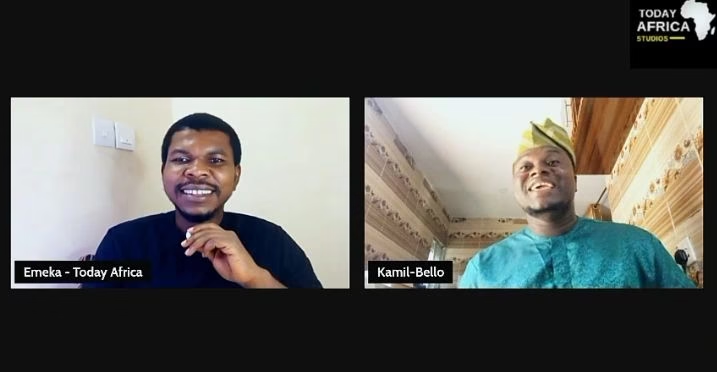
In this conversation with Today Africa, Kamil-Bello opens up about the moment that changed his path, the book that nudged him toward entrepreneurship, and the surprising global demand for a solution he once thought was just his own problem.
Tell us more about yourself
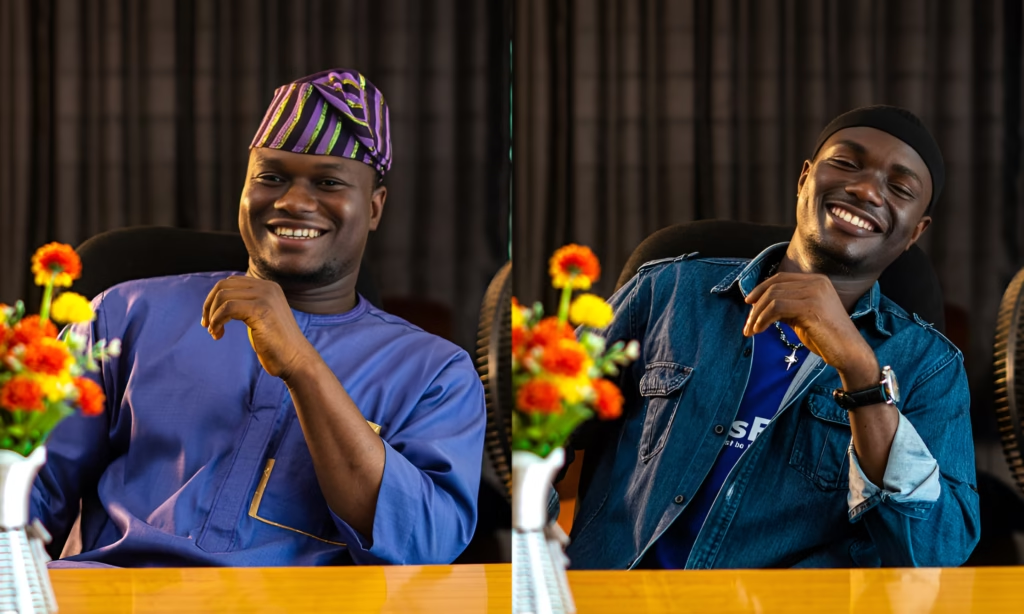
“My name is Kamil-Bello Furqan,” he says, steady and simple. “I’m the co-founder of Tweakrr.”
Then he tells you about the rest of his life with the same ease. Married. Kids. The sort of detail he drops in like it’s nothing, though it colors everything.
He says he has always been a data scientist, always been a researcher, and you can hear the quiet certainty in that. Seven years moving through different tech niches, drifting from web development to desktop development to research, then into data science.
What motivated you to become an entrepreneur?
He still insists he never wanted entrepreneurship. Not even a little. “To be very candid,” he says, “I never had the intention of being an entrepreneur.”
His dream looked almost predictable. Go to the office in the morning, come home at night, see his family, keep working as a data scientist, and stick to that rhythm.
But life nudges people in strange ways. And sometimes it does it quietly.
He stumbled on a problem that, at first, he meant to solve only for himself. While he was reading a book, one line rearranged something in his mind. Why build this tool for one person when it could help others?
That was the beginning. Or maybe the point where he realized he had already begun. “The problem chose me,” he likes to say.
And once it chose him, he decided to face it squarely. He started building, slowly stepping into a realm where creating something for the world actually made sense. Where people could use what he made and benefit from it.
Somewhere in that shift, he stopped holding onto the idea of a quiet office life.
Read Also: “Nobody Deserves Hunger.” The Purpose Driving Victoria Olabode
What problem led you into building Tweakrr?
The story starts with panic, the kind that sits in your stomach and refuses to move.
He had been working on a research document, well written, neatly cited, everything in place. As usual, he kept two versions. The one fully referenced and another without citations, just in case.
Twenty or thirty minutes before submission, the fully referenced version vanished.
Gone.
He didn’t have time. He didn’t have a solution. All he wanted was a tool that could read his document, understand it, and automatically add the right text citations. Something that would save him from the sinking feeling that the deadline was slipping away.
He searched everywhere online, hoping for magic. Nothing.
He didn’t submit the paper. And afterward, he found himself wondering how such a tool didn’t already exist. He says he always believed nothing in this world is truly new, so discovering a genuine gap felt strange.
He began building with Python. Slowly, the idea started working. But he knew he needed more help. At first, he reached out to someone more technical than him, hoping they’d collaborate. The timing wasn’t right. His friend wasn’t available.
Meanwhile, the book he had been reading by Steven Bartlett flipped to a page that felt almost pointed at him. It suggested that what you need isn’t always another technical person but an A-player who is more business savvy.
He took this as a sign. Instead of going back to the technical friend, he found someone grounded in business. And that’s how Tweakrr truly started.
Tell us more about Tweakrr
Nothing fancy, just honest. It’s an AI tool that reads a written document and adds citations and references. Whether your document has partial citations or none at all, it goes line by line, compares what you wrote to journals, identifies where the information likely originated, and references it accordingly.
At the end, it lists every reference. Clean. Organized. Academic.
He sees it simply. Without proper citations, an academic work “is more like nothing.”
Even if the idea came fully from your head, the academic world expects evidence that others have walked that path before. People forget that part. Or they dread it.
What was the point you knew Tweakrr is not just for you, but for others who are into academics?
Right after encountering the problem, he called a friend. Explained the idea. The validation was immediate, almost startling. That friend needed it too. And then another. And soon it felt like everyone around him had been struggling silently.
But the moment that really stayed with him happened at a conference. Professors, doctors, scholars everywhere. The room barely settled before everyone rose and started clapping when they heard what Tweakrr did.
People asked for the domain name before he even finished speaking. One of the speakers after him admitted he had written it down because his own paper still needed referencing.
That was when he realized this wasn’t a personal inconvenience. It was a collective one.
Related Story: Meet Richard Afolabi, the Founder Using Tech to Preserve African History
What made you believe referencing is one of the biggest barriers in academic writing?
He laughs a little when he talks about this part. Not out of humor, but recognition. “If I finish a work like this,” he says, “I’ll be like, oh my gosh, it remains referencing.”
He would finish research and force himself to leave the work untouched for two weeks because he dreaded adding citations. It wasn’t a small irritation. It was the thing that slowed him down every time.
His colleagues said the same. Everyone struggled with it. And he admits clearly: if he hadn’t been forced into that situation, he probably wouldn’t have built Tweakrr at all. He would have simply waited his usual weeks before touching references.

What marketing strategies are you using to grow Tweakrr?
He breaks this down almost like someone walking you through a kitchen he built himself.
First, Tweakrr lets you see results before you pay. You upload your document, Tweakrr cites it, you see the changes, and then you pay a small commitment fee to download. “It’s like someone bringing food to your face,” he says. You trust it because it’s already prepared.
Next, partnerships with schools. Universities in Nigeria. Institutions in Iceland. Ambassadors in both places. Meetings with deputy vice-chancellors. They’re pushing to make Tweakrr part of the academic workflow rather than something students stumble on by accident.
There’s licensing too. Schools can license it for a year so every student gets full access.
And of course, ads. Facebook, Instagram, everywhere students and researchers live online.
Four strategies. One goal: make sure both academia and the wider world know Tweakrr exists.
Don’t you think that AI-referencing tools could make students lazy or encourage plagiarism?
He answers this the way someone answers a question they’ve lived through.
“If you reference and cite a document well, it reduces plagiarism.” He says plagiarism thrives when people pick information and fail to acknowledge the source. Tweakrr does the opposite. It lowers plagiarism risk.
As for laziness, he compares it to letters. Long ago, people wrote letters to communicate. Now we use phones. Phones didn’t make people lazy. They made communication better, faster, more accessible. He believes AI works the same way. We shouldn’t avoid it simply because it’s new.
And students still learn. By seeing the references Tweakrr generates, they understand styles and formats.
He sees the tool as something that simplifies, not something that erodes discipline.
Read Also: Niza Aritha Zulu: From Student Idea to Patent-holding Agritech Innovator
What were the challenges you faced when you started Tweakrr, and how did you overcome them?
He sighs a bit when he talks about developers. Some gave excuses. Timelines stretched. Milestones dragged from two months to six. It was frustrating, draining.
Financing was another issue. People needed to be paid. Incentivized. Not everyone believes in delayed gratification. Some just want immediate returns.
Working with a lean team didn’t make anything easier. Two or three people trying to build what typically requires five or six.
Then marketing. The worst part, he says. Every founder assumes that if you build something good, people will use it. Then reality shows up. You launch, and nobody comes. You feel emotionally defeated. Even when you get two or three users, you wonder why it hasn’t grown faster.
He faced all of it at once.
Did you ever imagine that an idea you conceived in your house would one day go global?
“Never,” he says. It still surprises him.
Seeing users from the UK, Germany, the USA… it shifted something. It showed him that the problem wasn’t local. It was global. Anyone in academia needed this. And since almost everyone knows someone in school, Tweakrr’s relevance expands through personal networks.
“If you don’t need it,” he says, “your father will need it, your brother will need it, your friend will need it.” Someone, somewhere close.
How do you ensure that Tweakrr works reliably and inclusively?
There were breaches. Slow loading times. Heavy packages weighing the system down. So they tore it apart and rebuilt it. Lighter. Faster. Accessible even with weak internet. As long as you have a phone and a bit of data, Tweakrr should work.
A mobile version is coming, he says. For now, the web version is solid enough that you can simply type the name online and get started.
What’s your business model and how do you balance accessibility and sustainability?
He explains it cleanly. They run B2B and B2C, and they reach out to authorities in schools. They partner with individuals with networks and form relationships that help the tool spread.
Then there’s the 60 to 40 model. If you recommend Tweakrr, you earn forty percent. Institutions benefit. Students benefit. Partners benefit. Everyone involved gets value.
It’s a system built to grow while keeping access open.
Read Also: Why Joan Kembabazi Won’t Stop Fighting Child Marriage in Uganda
What has been your toughest day as a founder and what kept you going?
There was a stretch of days that broke something in him, or maybe built something.
They had just launched. Users were coming in. Numbers were rising. And then everything collapsed. One error. Then another. Then the whole system started crumbling.
He sat with the technical team, watching it unfold. First day, no fix. Second day, nothing. Third day, still broken. He felt crushed.
But two thoughts held him.
First, he already started and had to finish. Second, he believed deeply that everyone needed this tool. Even if things weren’t going well now, he was sure that if they kept building, people would use it.
He also saw Tweakrr as something bigger. Not just a tool but a shift. A new way of referencing. A departure from the old.
Those were the thoughts that steadied him.
Which user feedback convinced you that Tweakrr isn’t just a tool but a lifeline for researchers?
A woman reached out to him on Twitter, overwhelmed with relief. She had been searching for something like Tweakrr for days. Her message was so honest that he screenshot it and sent it to his co-founder.
She also suggested improvements. More local context. If a user is writing about Nigeria, the citations should lean Nigerian. If Brazil, then Brazilian context. Not everything global.
Her feedback was pivotal. And meaningful because she wasn’t someone he knew. Just a user who cared enough to reach out.
How do you plan to stay ahead when others start creating similar tools?
He talks about reading “The 22 Laws of Marketing.” The first law says to be the first in a category. Being first means understanding users early. Knowing what they want, what they hate. Even if others join later, you hold an advantage.
Though, he admits, sometimes newcomers overtake the pioneers. If you stop growing, you lose.
So Tweakrr improves constantly. They gather feedback. Implement it. Remove what doesn’t work. Add what does. Talk to users one-on-one. Never stay static.
Staying ahead, for him, is about staying alive and evolving.
Related Story: Meet Emmanuel Osemudiame, the Doctor Using Tech to Fight Mortality in Nigeria
Where do we see Tweakrr in the next 5 years?
He sees it standing beside giants like Turnitin. A global academic tool. Something every school uses. The standard for referencing and citation, the way Turnitin is for plagiarism.
What lesson have you learned in your journey as an entrepreneur?
He learned that building the product is not the hard part. The hardest part is marketing it. Getting people to use what you built.
Founders often believe the product will sell itself. It doesn’t. Both product development and market development have to move together. If one outruns the other, things fall apart.
He says this with the sort of calm that comes only after experience.
What advice would you give to others who want to start their business?
He calls entrepreneurship interesting. Hopeful. The idea that something you build could become a lifeline keeps you going.
His advice is simple. Be enthusiastic about what you’re building. Check yourself honestly. Are you interested in this thing? Do you actually care about the field?
Because the truth, he says, is that entrepreneurship is difficult. Really difficult. And the only thing that will keep you steady is understanding what you’re doing and caring about it enough to continue.
Contact or follow Kamil-Bello Furqan:
- Kamil-Bello Furqan on LinkedIn
- Website
- Tweakrr on LinkedIn
Leave a comment and follow us on social media for more tips:
- Facebook: Today Africa
- Instagram: Today Africa
- Twitter: Today Africa
- LinkedIn: Today Africa
- YouTube: Today Africa Studio