

Peter Obi’s defection to the African Democratic Congress is one of those moments in Nigerian politics that feels sudden on the surface, but a little inevitable once you sit with it.
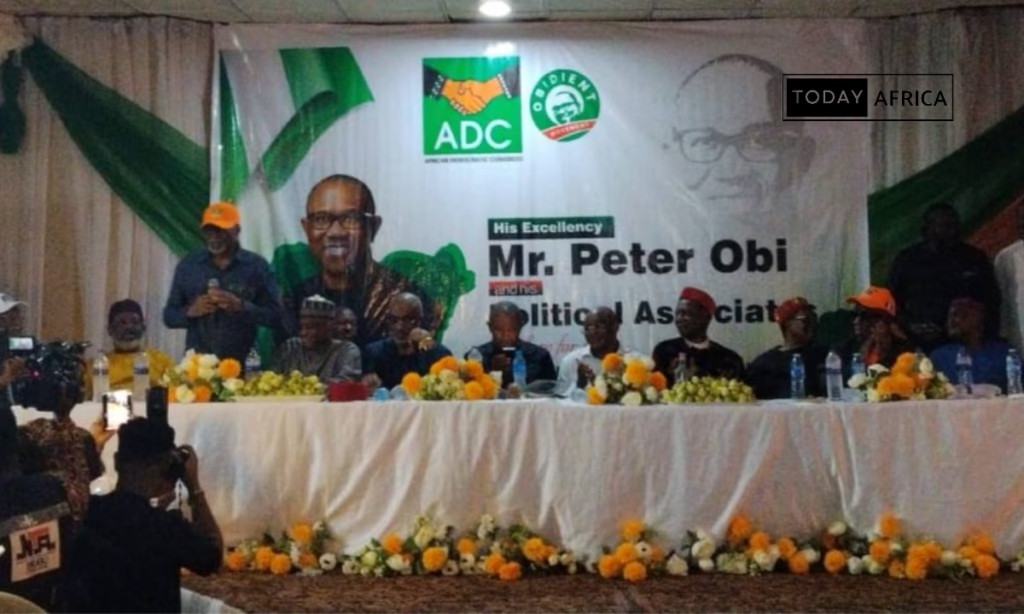
It happened in Enugu, at Nike Lake Resort. Symbolic enough. Home region, friendly crowd, familiar faces. And yet, the implications stretch far beyond that hall. This was not just a politician switching platforms.
It was the formal collapse of an arrangement that had been straining quietly since 2023, and the beginning of something that wants to present itself as a more disciplined opposition project.
I have watched Nigerian politics long enough to know that defections are rarely about ideology alone. They are about structure, control, timing, and fear. Peter Obi’s exit from the Labour Party touches all four.
What follows is not a celebration or a condemnation. It is an attempt to understand what really led to this moment, and what it does to everyone else still standing.
How the Labour Party became a temporary home
The Labour Party was never built for the weight it carried in 2023. That is not an insult. It is simply history.
Before Peter Obi arrived, LP was a fringe party with limited national structure, modest electoral experience, and internal processes that were often opaque.
Peter Obi’s entry transformed it overnight. Membership exploded. Funding increased. Young people who had never attended a rally suddenly felt invested in politics.
But here is the uncomfortable truth.
The Labour Party did not grow into that moment. It was dragged into it.
From early 2023, cracks began to show. Parallel leadership claims. Court cases. Public disagreements that should have been handled internally. For a movement that sold itself as different, the internal chaos felt depressingly familiar.
Obi, by temperament, is not a man who thrives in disarray. His politics is managerial. Controlled. Numbers driven. He tolerates dissent, but not confusion.
The LP increasingly offered him the latter.
By late 2024, it was obvious that the party structure was not aligning with the ambitions of a serious 2027 run. Candidate selection processes were unclear. State chapters were factionalised. Strategic decisions became public arguments.
At some point, loyalty stops being a virtue and becomes a liability. That point came quietly, then all at once.
Why Peter Obi says he did not defect
One of the most interesting parts of Obi’s announcement was his insistence that he was not defecting, only formalising his place in a coalition that had already chosen ADC as its platform.
This was not accidental language. It was legal and political positioning.
By framing it this way, Obi avoids looking restless or disloyal. He presents himself as consistent, principled, and already committed to a broader opposition project. It also subtly shifts responsibility away from him and onto the Labour Party. If he was already elsewhere in spirit, then LP simply failed to keep up.
There is also a practical angle. Coalitions matter in Nigeria, but parties win elections.
By stepping into ADC early, Obi and his allies get time to shape structures, influence candidate selection rules, and avoid the last minute scramble that doomed many third force experiments before.
The message was simple. We are planning early. We are not improvising.
The real triggers behind the exit
Several factors pushed this decision from contemplation to action.
First, internal litigation within the Labour Party became a strategic nightmare. You cannot plan primaries, fundraising, or alliances when court judgments can upend leadership overnight.
Second, Obi’s post 2023 national relevance needed protection. Remaining in a party perceived as unstable risked reducing him from a serious contender to a perpetual protest candidate.
Third, the opposition coalition talks changed the equation. Once heavyweights from different parties began converging around a single platform, staying outside it would have looked like indecision.
Finally, there was 2027. Every serious presidential project in Nigeria must answer one brutal question early. Who controls the party machinery. In LP, the answer was increasingly uncertain.
ADC offered clarity. Or at least the promise of it.
Read Also: Beyond the bombs: The hidden costs of US military strikes in Nigeria
What the move means for the Labour Party
For Labour Party, this is an existential moment.
Without Peter Obi, LP loses its most valuable political asset. Not just votes, but credibility. The party’s claim to national relevance was built almost entirely around him.
What remains is a weakened structure facing possible mass defections, reduced media attention, and a base that may fracture emotionally. Some supporters will stay out of loyalty.
Others will follow Obi quietly. Many will simply disengage.
This does not mean LP disappears. Nigerian parties are resilient that way. But its role shifts. From insurgent force to minor player unless it reinvents itself quickly.
The irony is painful. A party that became synonymous with political awakening now risks becoming a cautionary tale about organisational failure.
The symbolism of Enugu and the South East
Obi’s announcement in Enugu, surrounded by South East political figures defecting alongside him, was deliberate.
The region has long complained of marginalisation, but it also struggles with political fragmentation. What happened at Nike Lake was an attempt to reassert relevance through unity.
When senators like Enyinnaya Abaribe, Victor Umeh, and Tony Nwoye appear together under a new banner, it signals consolidation. Add former governors and PDP heavyweights, and the message sharpens.
The South East is repositioning itself as a bargaining bloc ahead of 2027 elections.
Whether this translates into electoral power depends on what happens next. Unity announced is not unity sustained.
David Mark and the choice of ADC
The presence of David Mark as ADC’s national chairman changes how this move is interpreted.
Mark is not a protest politician. He is establishment. Senate tested. Institutionally fluent. His involvement reassures older political actors who may admire Obi but fear disruption.
ADC, under Mark, is pitching itself as reformist but orderly. Opposition without chaos. Change without anarchy.
This combination may be more potent than many realise. Obi brings moral capital and youth appeal. Mark brings system knowledge and elite confidence.
On paper, it makes sense.
Implications for APC and President Bola Tinubu
For the APC, this development is both a warning and an opportunity.
On one hand, a more organised opposition coalition is bad news. The fragmentation that helped APC in 2023 may not repeat itself.
On the other hand, ADC’s emergence gives the ruling party a familiar opponent. A party led by known figures, with predictable instincts. That reduces uncertainty.
President Tinubu, in particular, will be watching Obi’s rhetoric closely. Obi’s criticism of the proposed tax regime was not random. It positioned him as policy focused rather than emotional. That is a deliberate contrast.
Still, APC retains structural advantages. Federal power. Incumbency. Resources. The question is whether it underestimates this coalition the way PDP underestimated the APC merger years ago.
History has a sense of humour that way.

The psychological shift in the political atmosphere
Beyond parties and personalities, something subtler is happening.
Obi’s move signals the end of pure outsider politics. The 2023 energy was emotional, idealistic, sometimes chaotic. This new phase feels colder. More strategic. Less romantic.
Supporters who wanted a total break from old politics may feel uneasy seeing familiar faces regroup under a new banner. But politics rarely rewards purity.
What ADC is offering is not revolution. It is reconfiguration.
Whether Nigerians accept that depends on how honestly the coalition communicates its intentions. Cynicism is high. Trust is fragile.
Read Also: NALA secures key licences from Bank of Uganda to operate in the country
2027 and the battle for narrative
The 2027 election will not be won on slogans alone. It will be about competence narratives versus hardship realities.
Peter Obi will present himself as the disciplined alternative to perceived excesses. Tinubu will argue for experience and continuity in difficult times.
ADC’s challenge is to prove it is more than a temporary shelter for ambition. It must survive internal negotiations, zoning debates, and ego management.
The Labour Party’s challenge is survival. APC’s challenge is complacency, and the electorate’s challenge, as always, is separating hope from hype.
Nothing is settled yet. But something important has shifted. In Nigerian politics, moments like this tend to echo longer than expected.
Leave a comment and follow us on social media for more tips:
- YouTube: Today Africa Studio
- Facebook: Today Africa
- Instagram: Today Africa
- Twitter: Today Africa
- LinkedIn: Today Africa