
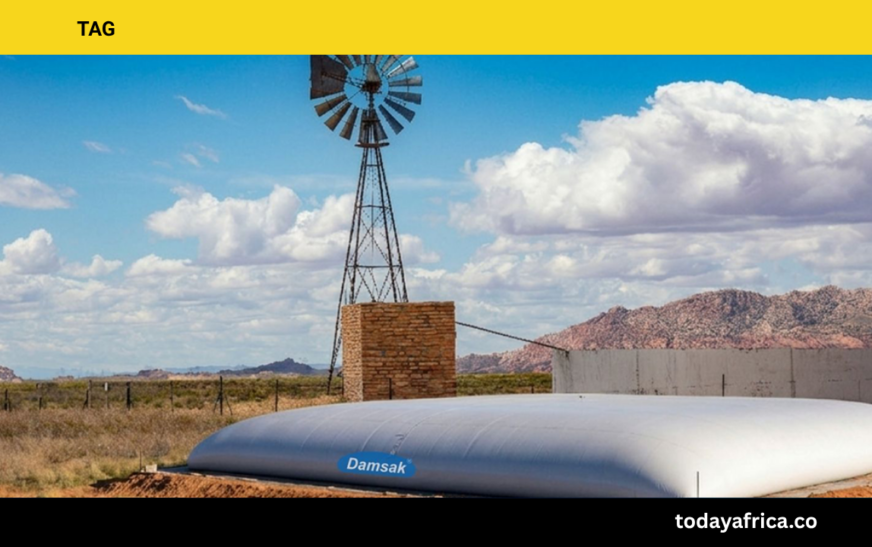
In 2007, a South African family’s own requirement for water storage led to a simple fix: a 200,000-litre water storage bag.
Professor Gordon Bredenkamp turned that need into a product, a sealed, portable water-storage bladder, unlike the open dams, mesh tanks and concrete reservoirs already on the market. He called it Damsak®.
Almost two decades later, that first solution has developed into a family manufacturing business, run today by Gordon and his son Dawid, that now distributes across Southern Africa and through established distribution partnerships into markets elsewhere across the world.
A family’s problem, solved with an engineer’s approach
The core idea was simple: water storage that didn’t leak, didn’t need any rigid structure and didn’t need heavy machinery to move.
A Damsak unit is a closed bladder made from polyester-reinforced, food-grade plasticised PVC, built with a patented corner design that gives it strength without rigid walls. It ships flat and can be carried, empty, on the back of a small pickup truck, then filled and be operational within hours.
That portability is the whole point. Dawid Bredenkamp, now co-founder and director, has explained that most rigid plastic tanks top out around 20,000litres, need a truck to be transported, even when empty, and become permanent once installed, difficult to move and expensive to scale.
A Damsak unit allows the opposite: that the site might change, that the business might grow, and that water storage shouldn’t be a construction project.
“A Damsak is a closed reservoir whereas the traditional solutions are open water storage with no, or poor, contamination prevention.”
The largest unit in the range now holds up to 500,000 litres in a single closed system, a scale the company reached without ever needing a permanent foundation or specialised installation crew.
That’s the real measure of how far this business has come: the same family that started with one 200,000-litre bag now manufactures a single unit 2,5 times that size and a whole range of smaller units, down to 500 litres
Built for a country where water can’t be taken for granted
South Africa’s water problems are structural as much as they are seasonal. Drought cycles are real; Cape Town moved into an official “Early Drought Caution” as recently as October 2025, but so is ageing infrastructure that loses water regardless of rainfall.
For farms, mines and food producers, that combination means water consumers can’t depend on the water utility or the weather alone.
That’s precisely the gap Gordon Bredenkamp’s own family experience with water scarcity turned around into a business. Every Damsak unit is designed to be filled when water is available and drawn down when it isn’t, a simple idea that started with a single 200,000-litre bag and turned out to have a much larger addressable market.
Related: How Karabo Motsamai started Walker Solar Bakery in Lesotho with just $842 and a solar cooker
From a father’s workshop to an African distribution network
Damsak’s growth beyond South Africa isn’t a plan on a slide deck; it’s already happening through various other agents, who are distributing the Damsak range across the wider African continent and several other countries, further afield.
That existing distribution relationship, built over years rather than announced as a single expansion event, is a more concrete growth story than most young export businesses can point to.
It also reframes what looks, on the surface, like a niche agricultural product story. A father-and-son manufacturing business built around one family’s own water storage needs has quietly become infrastructure for farms, mines, food processors and hospitality operators worldwide that share similar water problems as South Africa.
What makes this a business success story, not just a product story
The ingredients are genuinely there: a personal problem, a family without reliable water, that sparked the idea; a technical founder who solved it the way an engineer would, through design rather than marketing; a second generation who joined and is now running the business day to day; and a growth trajectory into new markets that happened because other people had the same problem, not because of an aggressive expansion strategy.
Damsak worked through many challenges, including corners that gave trouble. For years, we changed the corner design to improve the quality and reduce warranty claims.
Through many iterations of design as well as welding methods, we substantially increased the quality and reliability of our products. We have always honoured our warranty during times when we could not afford it, and that paid off.
At one stage, Damsak was replacing and fixing a lot of products under warranty, and it had the potential to bankrupt the business.
Fortunately, the news of our commitment to after-sales service, continuous improvement of the product and the positive word-of-mouth testimonies of our integrity bore fruit, and we believe that it gave the market a lot of trust in our products.
Leave a comment and follow us on social media for more tips:
- Facebook: Today Africa
- Instagram: Today Africa
- Twitter: Today Africa
- LinkedIn: Today Africa
- YouTube: Today Africa Studio