

Karabo Motsamai didn’t start Walker Solar Bakery in Lesotho with venture capital, a factory, or a polished business plan. He began with a simple idea: a solar cooker constructed from local materials, with a total cost of approximately $842 in savings and support.
What began as an experiment, using sunlight instead of fuel to bake bread, quickly turned into something more intentional: a small but growing clean-energy bakery designed to solve more than just hunger.
It was built to confront unemployment, rising energy costs, and the everyday reality of households still relying on firewood and other traditional cooking methods.
“I saw an opportunity,” Karabo says, reflecting on the moment the idea took shape after school. “If the sun can heat water, let me see if it can cook.”
That question became the foundation of Walker Solar Bakery, a startup now operating at the intersection of renewable energy, food production, and community empowerment.
“My name is Karabo Motsamai. I’m the founder of Walker Solar Bakery,” he says. “Walker Solar Bakery is a renewable energy company that promotes clean cooking, goods that are affordable for the community and creating jobs.”
The company sits at the intersection of clean energy, food production, and community development. It uses a solar parabolic cooker to bake bread, reducing the need for gas and other fuels while showing that renewable energy can serve basic daily needs.
Karabo’s idea began after he returned from school. At Better Business Development Center in Mohale’s Hoek, he studied four practical courses: solar technology, food science, metal work, and woodwork. Rather than treat them as separate skills, he saw a connection.
“I chose to combine the two, which is solar technology and food science,” he says. “I saw the opportunity, if the sun can heat water, let me see if it can cook.”
That question became the foundation of Walker Solar Bakery.
The problem he saw
The problem Karabo saw was not just about bread. It was about unemployment, energy costs, climate pressure, and the slow adoption of clean cooking in communities that need practical solutions.
Lesotho, as Karabo describes it, has natural resources that are often overlooked in business creation: the sun, the wind, and the water. For him, innovation did not have to begin with expensive infrastructure. It could begin with what was already available.
“We have like three resources, which are the sun, the wind, and the water,” he says. “I wanted to start small.”
His thinking was also shaped by the unemployment crisis around him. After graduation in 2023, he did not want to wait for someone to hire him. A life skills class opened his mind to the idea that he could create something for himself and others.
“I didn’t want to be part of the unemployment rate,” he says. “And for me to introduce a new way of doing business in Lesotho and not damaging the environment, but protecting the environment.”
The clean cooking angle matters because many rural households still rely on unhealthy cooking methods. Karabo says some people in rural areas use wood and cow dung to cook. To him, that is not only an environmental issue. It is also a health and quality-of-life issue.
“I started this project to help people in the rural areas because for them they are suffering a lot,” he says.
Walker Solar Bakery is therefore trying to solve several problems at once. It provides affordable fresh bread, demonstrates a cleaner way to cook, reduces fuel dependence, and creates a model that could eventually support jobs and training.
Read also: How Johnny Muteba is building a Pan-African economic movement from Johannesburg
The early struggle

Karabo did not begin with major funding. He began with savings, family support, and the confidence to build his own equipment.
He says it cost about 12,000 Maloti, roughly $722.49, to build the solar parabolic cooker. And he then spent about 1,000 Maloti, which is roughly $60.21, on baking pans, flour, and other early production items.
In total, he estimates the startup cost at about 14,000 Maloti, which is roughly $842.90.
That capital helped him begin, but it did not remove the hard parts.
The first major challenge was technical. A business that depends on the sun must deal with days when the sun does not cooperate. When it rains or when the sun is weak, the cooker cannot perform at full capacity.
“The biggest challenge is when the sun is not there or when it’s raining, the equipment can’t be used,” Karabo says.
For now, his backup is gas. But he is clear that gas is not the final vision. He wants to install solar panels and batteries so the business can move closer to full solar operation.
“My aim is still to use solar energy only,” he says.
Production also changes with the weather. On a hot sunny day, when temperatures reach about 30 to 35 degrees, Karabo can produce around 20 loaves of bread. When temperatures drop to around 18 or 19 degrees, output can fall to 10 or 15 loaves.
The baking time also varies. A loaf can take about 40 minutes when the sun is strong. On slower days, it can take up to an hour. Even the angle of the cooker matters.
“You have to set it accurately to know the exact angle,” he says.
Beyond the technical struggle, Karabo faced a market education problem. Clean cooking is still a new concept in Lesotho. Some people did not understand what he was doing. Others were unsure how the sun could bake bread at all.
“They just saw, okay, this guy’s baking the bread with the sun,” he says.
He also admits that he still needs mentorship. His business has customers, but he sees his mission as bigger than daily sales. He wants guidance on growth, sales, team management, and long-term structure.
“I wished I found somebody to mentor me before I started my business,” he says. “I wished I had gotten that guidance from the mentor to learn how to run the business, generate sales, and manage a team.”
For now, Walker Solar Bakery generates about 2,000 Maloti per month, or roughly $120.41. Karabo says the business sustains itself, but it has not yet paid him. He has one volunteer who helps, and he gives her something when he can.
“For me, I’m not getting paid right now,” he says. “The business hasn’t paid me right now. Let me say I’m still in the era of building it.”
That honesty is what makes the story important. Walker Solar Bakery is not a polished success story with everything solved. It is a young business still testing, learning, and proving that a local energy idea can become an enterprise.
Read also: 100+ Entrepreneurs in Africa to Watch in 2026
The turning point
The turning point in Karabo’s journey was not a large investment or a famous partnership. It was the decision to combine what he had learned and build something practical with his own hands.
He studied solar technology. He studied food science. Then he used metal work to build the parabolic cooker.
His lecturer, Nadeye Ivan, introduced solar technology and clean cooking promotion in Lesotho. That exposure gave Karabo a technical foundation. But the leap from classroom learning to real business came from Karabo’s own decision to connect the dots.
The solar parabolic cooker became the proof point. It is an oven-like device that reflects sunlight toward a tube. The tube absorbs heat, creating enough power to cook and bake.
“In simple terms, it turns sunlight into a powerful heat that is enough to cook and bake,” Karabo says.
Once he proved that bread could be baked with the sun, the business became more than an idea. It became something people could see, taste, and question.
Another important shift came when Karabo moved out of the house and bought a mobile kitchen. That step gave the business a more serious operating base and signaled that he was reinvesting in growth.
“This year, I bought myself a mobile kitchen,” he says. “I have moved out of the house. I’m using the mobile kitchen.”
He also added training as another initiative. Through training, he generates income while empowering people with knowledge. That matters because his mission is not only to sell bread. It is to spread a way of thinking.
“In simple terms, it turns sunlight into a powerful heat that is enough to cook and bake.”
“The important part is changing and empowering people and creating jobs for them,” he says. “My aim is to bring change to the communities and empower people.”
Read also: Adanna Ukabi, the Architect Shaping the Future of Nigerian Couture
What the startup story of Karabo Motsamai reveals
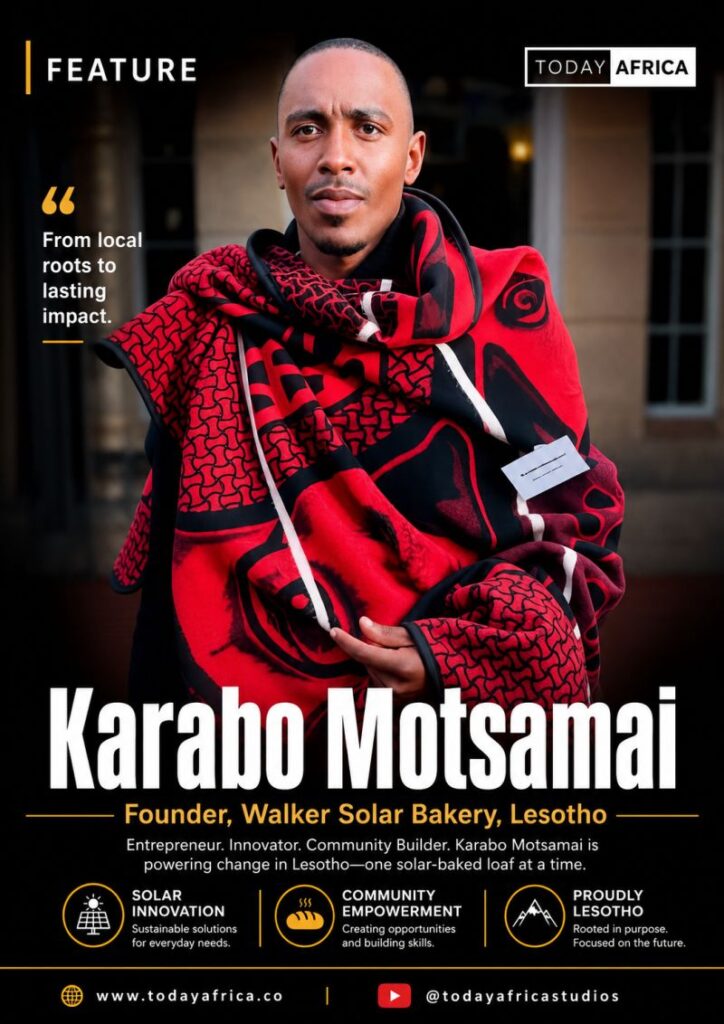
Karabo’s story reveals a powerful truth about African entrepreneurship: some of the continent’s most meaningful businesses may not begin with huge capital, formal research labs, or perfect market conditions. They may begin with a builder who understands a local problem and dares to test a practical solution.
Walker Solar Bakery also shows that renewable energy businesses in Africa do not have to focus only on large solar farms or household electricity. Clean energy can enter the economy through bread, cooking, training, mobile kitchens, and community services.
That makes the opportunity both exciting and difficult.
On one hand, Karabo is working with resources that Lesotho already has. The sun is not imported. The need for affordable food is not abstract. The unemployment problem is visible. The cooking challenge is real.
On the other hand, customer education is still a major barrier. When people do not understand clean cooking, they hesitate. When investors see a new concept, they may not know how to evaluate it. And when the technology depends on weather, the business must find backup systems and better storage.
Karabo’s monthly revenue also shows the reality of early-stage African businesses. A founder can have a strong idea, a working product, customer interest, and a social mission, yet still be far from personal income or scale.
This is why mentorship, patient capital, technical support, and market education matter. Walker Solar Bakery does not only need buyers. It needs an ecosystem that can help a climate-food business move from survival to scale.
Karabo’s perspective on African innovation is direct.
“It depends on creativity and innovation and the ability to solve local problems,” he says. “Africa doesn’t have to depend on unlimited resources.”
The deeper message is that African builders do not always need to copy models from elsewhere. They can build from the materials, climate, skills, and constraints around them.
Read also: The Research Disaster that Pushed Kamil-Bello Furqan to Build Tweakrr
The lesson for entrepreneurs
The first lesson from Karabo’s story is to start with the problem closest to you. He did not begin with a pitch deck about global climate technology. He began with unemployment, cooking fuel, affordable bread, and the resources available in Lesotho.
“We should not wait for the perfect condition to start.”
The second lesson is to combine skills. Walker Solar Bakery exists because Karabo did not separate solar technology from food science or metalwork. He merged them into one business idea. For many African founders, the opportunity may sit between sectors rather than within a single neat category.
The third lesson is to start before conditions are perfect. Karabo began with savings, family support, and a handmade cooker. He still needs mentorship, uses gas as backup, and wants better solar storage. Yet he has already built a functioning business.
“As Africans we have a lot of potential and we have a lot of resources,” he says. “We should not wait for the perfect condition to start.”
The fourth lesson is that education is part of the product. When a business introduces a new concept, selling is not enough. The founder must explain, demonstrate, train, and build trust.
The fifth lesson is to keep the mission practical. Karabo’s story is not only about clean energy. It is about bread, jobs, and helping rural communities cook in healthier ways. That is what gives the business its human weight.
His advice to other African builders is simple: understand the problem, use what you have, stay curious, and stay resilient.
For Walker Solar Bakery, the journey is still early. The business needs capital, mentorship, better solar backup, and broader customer understanding. But the signal is already clear. In Lesotho, one founder is proving that the sun can do more than shine. It can bake, employ, teach, and open a new path for clean cooking entrepreneurship.
Data summary
- Founder name: Karabo Motsamai
- Company: Walker Solar Bakery
- Country: Lesotho
- Sector: Renewable energy, clean cooking, food production
- Business model: Solar-baked bread sales, community training, clean cooking education
- Startup capital: 14,000 Maloti ($842.90)
- Monthly revenue: 2,000 Maloti ($120.41)
- Key challenge: Weather dependence, limited capital, low customer awareness, and need for mentorship
- Key insight: Local resources like the sun can power practical businesses that solve food, energy, and employment problems
- Opportunity signal: Clean cooking and renewable energy can become job-creating community businesses when paired with local production and training
Founder intelligence profile
| Section | Details |
|---|---|
| Name | Karabo Motsamai |
| Company | Walker Solar Bakery |
| Country | Lesotho |
| Sector | Renewable energy, clean cooking, food production, social enterprise, climate innovation |
| Problem they are solving | Youth unemployment, dependence on wood and cow dung for cooking, lack of affordable clean energy solutions, and limited access to fresh baked goods in rural communities. |
| How they are solving it | Using a solar parabolic cooker that converts sunlight into heat for baking bread. Combines solar technology, food science, and metalwork. Uses gas only as backup while moving toward full solar + battery system. |
| Stage (idea/early/growth/scaling) | Early stage |
| Funding status | Bootstrapped (14,000 Maloti, roughly $842 startup cost from savings and family support) |
| Key traction signals | Produces 10–20 loaves/day depending on sunlight; $120 monthly revenue; mobile kitchen in use; one volunteer; trains people; marketing via Facebook, LinkedIn, WhatsApp, and offline engagement. |
| Founder story (short narrative) | Karabo built Walker Solar Bakery after graduating in 2023, combining skills in solar tech, food science, and metalwork. Inspired by unemployment and climate challenges, he asked: “If the sun can heat water, can it cook?” He built a solar cooker and started baking bread using sunlight to create jobs, reduce energy costs, and promote clean cooking in his community. |
| Why it matters (your analysis) | The venture turns renewable energy into a practical local enterprise, not just theory. It shows how African founders can use local resources (sunlight) to solve unemployment, health, and energy challenges. While still early-stage and resource-constrained, it has strong potential as a scalable model for clean cooking and community-based innovation. |
Contact or follow Karabo Motsamai:
Leave a comment and follow us on social media for more tips:
- Facebook: Today Africa
- Instagram: Today Africa
- Twitter: Today Africa
- LinkedIn: Today Africa
- YouTube: Today Africa Studio