

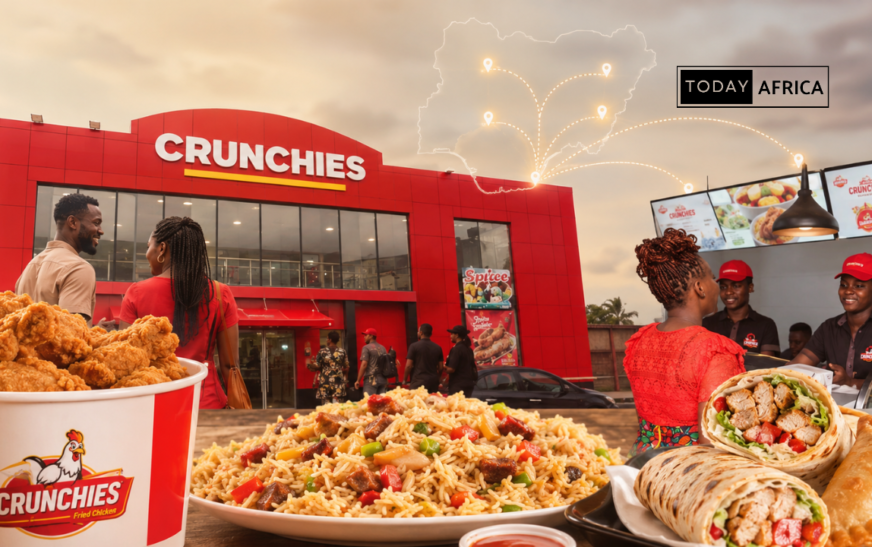
Crunchies Fried Chicken is a homegrown Nigerian quick-service restaurant (QSR) chain, founded in the early 2000s and today a major player in the country’s fast-food sector.
Launched in Aba, Abia State, in September 2003, the brand was built on a founding vision to blend high-quality meals with dependable service in a welcoming setting. Its promoters, local entrepreneurs from the bustling market city of Aba, saw a gap for a reliable, tasty fast-food option in South-Eastern Nigeria.
This entrepreneurial founding story is marked by vision, persistence and careful market research: the founders chose Aba strategically for its “bustling commercial activities” and focused immediately on quality ingredients, efficient service, and a family-friendly atmosphere.
As one report notes, turning the idea into reality “was not easy.” Still, the first outlet quickly found acceptance among Aba customers thanks to its food quality, prompt service and clean ambience.
This inside Crunchies Fried Chicken’s journey traces origin, growth strategies, the competitive landscape, and its wider impact on Nigeria’s food industry and economy.
Founding story of Crunchies Fried Chicken
Crunchies began as an Aba story. The company’s concept reportedly began to take shape around 2002, before its first outlet opened on Factory Road in Aba, Abia State in September 2003.
That location mattered. Aba is not just another Nigerian city. It is a commercial engine, famous for trading, manufacturing, artisanship, and a tough consumer culture where weak products do not survive for long.
For Crunchies, Aba became both a launchpad and a testing ground.
Today, Crunchies Fried Chicken operates as a Nigerian quick-service restaurant brand serving fast food, local meals, pastries, cakes, bread, shawarma, protein items, and newer traditional meal options.
Its footprint is concentrated across the South-East, South-South, and South-West regions of Nigeria.
Public reports in 2026 put the brand in 32 cities, while earlier reporting from 2016 placed it at 14 outlets in the South-East and South-South.
That comparison is not a perfect outlet-to-outlet growth metric, but it shows a clear strategic direction: Crunchies has moved from a regional chain into a broader multi-city food business.
The company’s current leadership is led by Mrs. Muka L. Ohaeji, listed by the company as Managing Director/Chief Executive Officer.
Public reports describe earlier leadership phases under P. C. Ejiogu from 2003 to 2013 and Jude Nwosu from 2014 to 2021.
One important detail is that publicly available sources do not clearly identify a single founder, unlike some Nigerian QSR competitors, which are tied to a single founder.
So, it’s safe to say that Crunchies was built by its early promoters and operating leadership, with the brand’s institutional identity becoming more visible than a single founder story.
Expansion journey
Starting from one shop in 2003, Crunchies grew steadily in the following decades. Key phases of expansion can be identified:
- 2003–2013 (Foundation and regional establishment): Over its first decade, Crunchies focused on building strong operations in Aba and later across South-Eastern Nigeria. By 2013, it was celebrating its 10th anniversary. During this period, the first Managing Director, P.C. Ejiogu, built the operational systems and service culture that would allow replication. The original outlet was followed by several more in Eastern cities; by 2015, Crunchies had at least 14 outlets.
- 2014–2021 (National growth): Under MD Jude Nwosu (2014–2021), Crunchies went on a major growth offensive. The chain opened new branches in additional states: in 2015 alone, it launched four “Crunchies Plus” outlets in Asaba (Delta State), Uyo (Akwa Ibom), Calabar (Cross River) and Onitsha (Anambra). This brought Crunchies’ footprint to 14 stores, with double the number of outlets in key cities. Nwosu emphasized that these expansions reflected confidence in underserved markets and in Crunchies’ appeal. He noted: “In every two years, we try to do something new in Crunchies,” including menu and service innovations. Over these years, Crunchies also became a fixture in the South-South region, opening locations in Rivers and Bayelsa, and extending into parts of the South-West (Lagos) for the first time.
- 2022–Present (Diversification and modernization): In 2022, Muka Ohaeji took over as Managing Director, ushering in a new era of innovation and digital transformation. The chain continued to target emerging towns, for example, opening outlets in places like Obudu, Ogoja and Ugep in Cross River, bringing organized fast food to secondary markets. It also diversified its brand portfolio: Crunchies launched subsidiary concepts such as Roots Restaurant & Café (a bistro-style café serving African and continental dishes) and Bistro23, often co-located in “multi-experience” venues. One creative format is the “3in1 Spot”, which houses Crunchies, Roots and other brands under one roof, offering fast food, casual dining, and bakery products in one complex. As of 2026, Crunchies and its affiliate brands operate dozens of outlets across three geopolitical zones (South-East, South-South, South-West) and employ over 2,000 staff nationwide.
Significant milestones
Over its two-decade journey, Crunchies has reached many milestones:
- First Outlet (2003): Launch of Crunchies in Aba, September 2003.
- First Decade (2013): Celebrated the 10th anniversary of the brand.
- Crunchies Plus (2015): Launched “Crunchies Plus” with Chinese cuisine, and opened four new outlets (Asaba, Uyo, Calabar, Onitsha). By this time, the chain had 14 stores.
- CSR Initiative (2016): Built a large water treatment plant for its Enugu branch, both as a community service and to secure water supply (reportedly a “huge sum” investment).
- Roots Café Launch (~2017): Began operating Roots Restaurant & Café in parallel with Crunchies (first Roots outlets appeared by 2017).
- Digital Platform (2024): Unveiled an online ordering website, mobile apps and WhatsApp chatbot to enable e-commerce ordering for all Crunchies outlets.
- Community Programs (Ongoing): Started annual community events, the Crunchies Spelling Bee Competition, Back-to-School parties, and a Crunchies Super Chef contest for youths, reinforcing the brand beyond restaurants.
Each of these steps – new concepts, new cities, new channels, has helped transform Crunchies from one small grill shop into a well-recognized fast-food chain across multiple regions.
Read also: Inside Chicken Republic’s Journey: A homegrown QSR phenomenon
Funding history, investments, and growth capital

Crunchies Fried Chicken is privately held and has not publicly disclosed detailed funding information.
No major investors or venture capital backing have been reported. Instead, the chain appears to have financed its growth through founder and management equity, reinvested earnings, and likely bank loans or lines of credit typical of Nigerian SMEs.
In a market where “only a few QSRs thrive while many struggle to survive”, Crunchies’ steady expansion suggests prudent use of capital rather than reliance on high-profile funding. (By contrast, some competitors like Chicken Republic have backing from a publicly traded company, and Mr Bigg’s used widespread franchising.)
Available resources were channeled into opening new outlets, equipping kitchens, and hiring staff. For example, the rollout of Crunchies Plus required investment in additional cooking equipment and staff training to handle Chinese menu items.
The company also invested in ancillary infrastructure: the 2016 water treatment project in Enugu (part CSR, part practical need) reportedly “cost the firm a huge sum”, illustrating major capital outlays beyond mere restaurant fit-outs.
Marketing and brand-building (advertising, signage) would also have consumed budget, as Crunchies increasingly advertised regionally and built its online ordering platform.
While specific revenue and profit figures are unpublished, Crunchies has remained profitable enough to keep expanding. The chain’s revenue generation relies on diversified income streams: dine-in sales at outlets, takeout/delivery (now on the new website and apps), and event catering.
Cost management has been crucial: Nigeria’s high inflation and operating costs (see below) mean that Crunchies must carefully control food costs, utilities and labor expenses. The company’s model appears to prioritize reinvesting cash flows into new stores and service innovations rather than distributing profits externally.
In essence, Crunchies has grown by bootstrapping, using the cash it earns to fund the next stage, supplemented by conventional financing where needed (local bank finance, vendor credit, etc.), rather than a one-time large external capital injection.
Strategies fueling growth
Crunchies’ rise can be attributed to a combination of strategic positioning, product focus, customer-centric operations, and savvy marketing. Its leadership has articulated clear strategies in each area:
Brand positioning
Crunchies positions itself as an affordable, first-grade fast-food brand tailored to Nigerian tastes. Its target customers include families, working professionals and youths seeking a quick, value-for-money meal in a clean environment.
The brand’s slogans, initially “Taste the Difference” and later “Step it Up”, emphasize reliability and constant improvement. Crunchies’ pricing strategy is generally mid-range: lower than imported franchises like KFC but reflective of good quality (for example, combo meals are typically a few thousand naira).
The company stresses value through portion size and consistency, and it often runs promotions (e.g. weekday deals) to appeal to cost-conscious diners. Importantly, Crunchies tailors its offerings to local preferences: it serves spicy jollof and fried rice with its chicken, and has even introduced Chinese menu items at customer request.
This blend of global fast-food format with Nigerian flavor has helped Crunchies stand out. As one executive put it, Crunchies aims to provide the “same thing every time” in a friendly atmosphere, reinforcing the brand’s promise of dependable quality.
Product strategy
Crunchies’ core menu revolves around fried chicken and rice dishes, but it has expanded over time. Signature products include its peppered and barbecue chicken platters (often served with jollof or fried rice), chicken wraps, burgers, and local favorites like moin-moin (bean cake) on the breakfast menu.
Over time, the menu has diversified: the Crunchies Plus concept added quick-service Chinese staples (e.g. spring rolls, fried rice, stir-fry noodles) to attract new customers.
The Roots Restaurant & Café sub-brand focuses on sit-down dining with broader menus, African cuisine, pastries, and café beverages, appealing to a slightly higher-end crowd. Crunchies continually rotates its offerings and tests new items; MD Jude Nwosu noted that the company tries “to do something new” every two years.
Seasonal items and promotional bundles keep regular customers engaged. Despite this variety, all products are prepared to a standardized recipe and quality level across outlets, ensuring the brand experience remains consistent from Lagos to Uyo.
Customer experience
Crunchies emphasizes a welcoming, customer-first experience. Outlets are designed for comfort (indoor seating with clean décor) and speed: the focus is on quick service without sacrificing freshness. Staff are trained to be courteous and attentive.
Crunchies leadership has said they want patrons to “feel goodness” when dining, and to know “the moment you step in… you are already family”. In practice, this means reliable wait times and order accuracy.
The chain has invested in staff training programs (often run by regional managers) to maintain uniform service standards. There are initiatives to recognize outstanding employees internally, as a way to motivate the workforce and reduce turnover (Crunchies’ growth to 2,000 employees suggests many have advanced within the company).
Convenience is also a priority. Crunchies has expanded beyond in-store dining to include takeout, drive-thru-like windows (in some outlets), and delivery. In late 2024, Crunchies launched a full e-commerce platform: a website, smartphone apps and even a WhatsApp chatbot so customers can browse the menu and order delivery or pickup from any outlet.
This digital push reflects changing consumer behavior: more Nigerians now expect online ordering and home delivery. Crunchies’ MD called the new website “a crucial step” towards delighting customers and meeting them “at every point”.
Regular customers also enjoy occasional loyalty incentives: social media contests (e.g. “Guess the Mystery Chicken”) and combo-deal vouchers drive repeat business.
Marketing and promotion
Crunchies uses a mix of traditional and digital marketing. Locally, the chain advertises on radio and roadside billboards in cities where it operates. In-store promotions (e.g. meal deals, family packs) and in-branch posters inform patrons of new menu items.
The company’s marketing tagline “When life’s not in your control, food can be” was launched in 2024, highlighting the brand’s ethos that a good meal is a comfort.
Crunchies maintains active social media profiles (Facebook, Instagram, TikTok) to engage younger audiences: it posts mouth-watering food photos, runs hashtag campaigns (e.g. #CrunchiesRewards), and announces contests like the Spelling Bee. Employee and customer testimonials are sometimes shared to build trust.
On the digital front, Crunchies has begun exploring online ads and partnerships with food bloggers. For example, local influencer features and “foodie reviews” have helped raise brand awareness in Lagos and Abuja.
However, there is no evidence of big celebrity endorsements; Crunchies tends to rely on grassroots word-of-mouth and its “quality speaks for itself” narrative. At events like food festivals and local fairs, Crunchies often provides free samples or kids’ meals, a community-oriented tactic that doubles as promotion.
Importantly, Crunchies’ community programs also serve a marketing purpose: sponsoring a Spelling Bee or back-to-school party gets the brand’s name out in the local media and social circles, reinforcing positive associations.
Operational excellence
Behind the scenes, Crunchies emphasizes efficient operations to maintain quality and control costs. It has established a semi-centralized supply chain: each region’s outlets share common suppliers for key inputs (such as poultry, flour and spices), leveraging bulk purchasing where possible.
Food safety is strictly enforced: all outlets follow standardized recipes and hygiene procedures.
To ensure consistency, the company circulates standard operating manuals and conducts periodic inspections. When ingredient costs rise (e.g. due to inflation), Crunchies occasionally adjusts suppliers or prices, but tries to absorb some costs through efficiency gains.
For instance, the Enugu location’s water plant project not only helped the community but also ensured a stable water supply for kitchen use, reducing dependency on costly bottled water.
Staffing systems have also been professionalized. Even in smaller towns, Crunchies outlets are set up with similar layouts and equipment, and managers are trained by headquarters before opening.
The company fosters a culture of employee involvement: staff are encouraged to suggest local menu ideas or service improvements, and outstanding employees are promoted.
This focus on people pays off in operations: as one Crunchies report notes, the company “continues to put its customers in the center of its business, thinking up ways to deliver quality and exceptional service”.
No major joint ventures or investor partnerships have been reported. Crunchies remains essentially independent, which means it has full control over its strategy but also bears all the risk.
One notable collaboration is its agreement with the Abia State government in 2022 to build a training center for hospitality workers (part of the “Let’s Talk Industry” initiative).
This public-private partnership helps Crunchies train future staff and fosters goodwill. Overall, Crunchies’ partnerships are local and operational rather than global branding tie-ups.
Read also: Inside Glovo’s Journey: From Barcelona errand app to Pan-African delivery powerhouse
Competition in Nigeria’s fast-food industry
Crunchies operates in a crowded and growing Nigerian fast-food market. Organized QSR chains now account for the majority of foodservice patronage, but the industry also includes countless independent vendors. Key facts and competitive context include:
Market size & trends
Nigeria’s foodservice market is large and expanding. A 2021 industry report estimated the organized fast-food sector at about ₦250 billion ($600 million), with 10% annual growth. By 2025, quick-service restaurants alone held roughly 56% of Nigeria’s foodservice market.
Growth is fueled by rapid urbanization, a young population (median age 18), and a rising middle class. Digital ordering and delivery platforms are on the rise: food delivery volumes doubled recently, indicating changing consumption patterns.
However, the industry faces heavy pressures: double-digit inflation (41% in 2024), currency volatility, and weak infrastructure (power outages, poor roads) keep costs high. These factors squeeze margins and test the resilience of chains like Crunchies.
Major domestic competitors
Several homegrown chains compete directly or indirectly with Crunchies:
- Chicken Republic: A subsidiary of Food Concepts PLC, Chicken Republic is Nigeria’s largest chicken-focused chain, with 190 outlets nationwide (mostly in the South-West and Lagos). It also operates in Ghana. Chicken Republic is a stronger national brand with corporate backing; it emphasizes value meals and ice cream desserts in addition to chicken. Its scale gives it bulk purchasing power, for example, CR posted ₦66.2 billion sales in 2023.
- Mr Bigg’s: Nigeria’s pioneering fast-food chain (first outlet 1986), run by UAC Foods. At its peak, it grew to about 170 outlets across the country. Mr Bigg’s grew largely through franchising and is best known for its meat pies, pastries, and fried chicken. Though still widely recognized, Mr Bigg’s has faced management challenges and more limited innovation in recent years. (Notably, Mr Bigg’s was one of the first to franchise extensively, a model Crunchies has eschewed.)
- Tantalizers: A Lagos-based chain with roughly 50 outlets. Founded in 1997 by the Ayeni family, Tantalizers offers a mix of burgers, local dishes (jollof rice, pepper soup), and snacks. Its Tanta-pies and grills are popular. Crunchies competes with Tantalizers mainly in South-West markets (e.g. both have Lagos branches) and in similar price segments.
- Sweet Sensation: A largely Lagos-area chain (20 outlets), Sweet Sensation focuses on Nigerian local menus (jollof, asun pepper, pastries). It targets price-sensitive customers with low margins.
- Mega Chicken: A small Lagos-only competitor (4 outlets) catering mainly in south-west Lagos suburbs. It offers a similar fried-chicken and grill menu, but on a much smaller scale.
- International brands: KFC (Yum! Brands) operates in major cities (dozens of outlets nationwide) and targets a more affluent segment with a global fried-chicken product. Chicken Licken (South African brand) and various burger chains (Burger King opened its first Nigeria outlet in 2023) are also part of the landscape. These foreign brands have higher overhead and prices, so their competitive overlap with Crunchies is mostly at the higher-income end of the market.
Crunchies occupies a solid mid-market niche: stronger brand promise and wider menu than cheap independents, but more affordable and local-feeling than international franchises. It must continually reinforce its competitive advantages (quality, value, regional loyalty) to counter industry pressures like inflation and stiff competition.
Read also: Inside Spiro’s journey: Electrifying Africa, one motorcycle at a time
Impact on society and the economy
Crunchies’ growth has had a notable socio-economic impact, especially in its home regions.
Employment generation
Crunchies directly employs over 2,000 people across Nigeria. These jobs range from store staff and cooks to delivery drivers and corporate office roles. In areas like Abia State, where industrial employment is limited, Crunchies outlets have become important local employers.
Indirectly, the chain supports employment for suppliers (poultry farmers, bakers, cleaners, construction workers) and transporters. Crunchies also emphasizes staff development: recruits receive on-the-job training, and many workers have advanced from entry-level positions to supervisory roles over time.
This career growth reflects in employee testimonials describing Crunchies as “a good place to start and build a career” (per internal surveys). By injecting wages into local economies, Crunchies contributes to community wealth.
Economic contribution
As a consumer business, Crunchies contributes via taxes (payroll taxes, value-added taxes on sales, etc.) and by stimulating local commerce. It sources ingredients from Nigerian suppliers; for example, its chicken likely comes from regional poultry farms and its rice from domestic rice mills, helping those sectors grow.
In smaller cities (Ugep, Ikom, Afikpo, etc.) Crunchies was often one of the first organized fast-food outlets, creating demand for local agriculture and transport services. The chain’s investments (build-outs of new outlets, kitchens, cold rooms) have also fed the construction, equipment and utilities industries.
While Crunchies’ exact revenue figures are private, market context suggests that a chain of its size (dozens of outlets at $5M annual revenue, per industry estimates) meaningfully adds to the hospitality sector’s output. Industry data notes Nigeria’s QSR sector is roughly ₦250 billion and growing, and Crunchies is a visible participant in that ecosystem.
Community engagement
Beyond pure business, Crunchies has actively engaged in social programs, especially in education and youth. Its flagship initiative is the “Crunchies Spelling Bee Competition”, held annually in partnership with schools, which rewards academic excellence for primary and secondary students in Aba and surrounding towns.
These spelling bees (now in their 3rd edition) have drawn media coverage and featured local dignitaries, reflecting Crunchies’ commitment to community literacy. The company also hosts Back-to-School parties, providing school supplies and free meals to underprivileged children.
Another program, the Crunchies Super Chef Competition, invites youth to learn cooking skills and compete in a friendly contest. Collectively, these events have placed Crunchies in the public eye as a community-minded brand, not just a restaurant chain.
Internally, Crunchies promotes staff volunteering and occasionally partners with local NGOs for charity drives (e.g. sponsoring orphanage outreach, although details are private).
Consumer impact
For ordinary Nigerians, Crunchies expanded the accessibility of organized, affordable fast food. It helped normalize eating out of home in secondary cities where that wasn’t always an option.
Families in Asaba or Onitsha, for instance, now have a mainstream fried-chicken option with consistent quality and cleanliness, instead of relying solely on small local eateries. Crunchies also introduced convenience to work-day lunches: many offices and schools now enjoy lunch catering from Crunchies.
Customer testimonials on social media often mention Crunchies as a reliable option for feeding groups or celebrating birthdays, indicating it has become embedded in the local dining culture.
In one customer forum, a teacher commented, “We can count on Crunchies for a nice meal when our students do well on exams,” illustrating how the brand has become part of social rituals.
Challenges faced

Throughout its history, Crunchies has navigated numerous internal and external challenges characteristic of Nigeria’s fast-food industry:
Operational challenges
Maintaining consistent quality and service across all outlets is a constant task. With over 2,000 staff, Crunchies must continuously train employees to follow the same recipes and service protocols.
The first MD emphasized this by instituting a service culture from day one, but lapses can happen (leading to customer complaints or uneven experiences). Supply chain disruptions are another operational hurdle: for example, Nigeria’s poor roads and intermittent utility services can cause delivery delays or stock outages.
To mitigate this, Crunchies built additional capacity like the Enugu water-treatment plant, but the need for backup generators remains. Staffing is also a challenge: high employee turnover in the QSR sector means Crunchies must regularly hire and train new workers, which is costly and can lead to service inconsistencies during transitions.
Food safety compliance is an ongoing challenge. Nigeria’s regulatory environment is stringent: NAFDAC requires regular inspections of cooking and storage, and Crunchies must ensure every kitchen meets standards for hygiene and health.
Violations (even minor ones) would attract fines or forced closures, so Crunchies invests in training and in occasional internal audits. Given media sensitivity around food safety, especially after incidents in other chains, Crunchies must guard its reputation carefully.
Economic challenges
Nigeria’s macroeconomic conditions heavily impact Crunchies’ costs and customer spending:
- Inflation and food costs: As noted above, Nigeria’s inflation rate has been extremely high (nearly 41% at end-2024). This rapidly raises the price of chicken, rice, oil, and other core inputs. For example, when poultry feed and grain prices spike, Crunchies must pay more for chicken, directly cutting into margins. The management has had to adjust menu prices periodically; however, price hikes risk driving away poorer customers or pushing them to cheaper alternatives. Crunchies has tried to absorb some costs through efficiency (e.g. bulk purchasing, reducing waste) but the inflationary pressure remains its biggest economic challenge.
- Currency fluctuations: The naira’s volatility makes budgeting difficult. Since some ingredients or equipment (e.g. spices, freezers) are imported, a weaker naira quickly boosts import costs. This uncertainty can stall Crunchies’ plans for new outlets if capital suddenly seems pricier. The finance team must constantly revise forecasts and possibly switch suppliers to local alternatives if import costs rise.
- Fuel and energy costs: Diesel for generators and fuel for supply trucks account for a substantial fraction of operating expenses. When international oil prices rise or local fuel subsidies change, Crunchies sees its energy bill climb. This has led the chain to occasionally close outlets during national fuel shortages (as many businesses do) or to implement narrow operating hours to save costs, disruptions which hurt sales and customer loyalty.
- Consumer spending: During economic downturns, Nigerians cut back on eating out. Crunchies felt this during the 2016–2017 recession and again in some mid-2020s shocks. Sales volumes can dip when people prioritize groceries over dining. Crunchies tries to counter this with promotions (discounted family packs, for instance) and by emphasizing value, but overall reduced footfall is a risk during any economic slowdown.
Industry challenges
Beyond broader economics, Crunchies faces sector-specific challenges:
- Intense competition: The Nigerian QSR market is fragmented and competitive. New local chains constantly emerge, and existing ones (like Chicken Republic) keep expanding aggressively. The rise of cloud kitchens and online-only brands adds pressure: these outfits have lower overhead and can price aggressively for delivery. Crunchies must continually innovate its menu and service to retain customers who have many options.
- Changing consumer preferences: Younger Nigerians increasingly value convenience, digital interaction and novel experiences. Crunchies must adapt by developing its mobile ordering platform and by refreshing its brand image to stay trendy. If it lags on digital (compared to app-first competitors) or on new cuisine trends, it could lose ground. For example, if plant-based or ultra-spicy food trends take off, Crunchies will need to incorporate these to stay relevant.
- Regulatory environment: Foodservice businesses must navigate layers of regulation. This includes renewing operating licenses, paying city taxes and complying with health codes. Occasionally, local governments may increase levies on fast food businesses. For Crunchies, staying compliant means dedicating resources to legal and accounting functions. A notable regulatory challenge in recent years was the switching of Lagos State to a new tax code, which briefly disrupted many businesses’ finances. Crunchies, like its peers, had to adapt its billing systems and menus accordingly.
Crunchies’ management credits its proactive culture, emphasizing “persistence and strategic leadership”, for navigating crises. By continually reinvesting in the business and keeping a close eye on costs, the company has managed to survive Nigeria’s economic turbulence better than many smaller food outfits.
Read also: Inside Wasoko’s Journey: Transforming Access to Essential Goods and Services
The playbook for African entrepreneurs
Start with a market that teaches discipline
Aba was not a glamour launch market. It was a practical one. Founders building in Africa should not always chase the biggest city first. Sometimes the best launch market is the one where customers are demanding, costs are more manageable, and word of mouth can travel quickly.
Build around repeated use
A food business cannot survive on first-time excitement alone. Crunchies’ broader menu gives customers multiple reasons to return. Builders should ask: What can a customer buy from us on Monday morning, Wednesday afternoon, Friday evening, and Sunday after church? The more use cases a brand owns, the stronger the revenue base becomes.
Localize without becoming chaotic
Crunchies’ move into traditional meals is smart because it reflects real demand in Nigeria. But founders should avoid adding products just because customers ask for them. Every new item must pass a margin test, a supply test, a kitchen test, and a speed test.
Treat digital ordering as infrastructure, not decoration
A website, mobile app, WhatsApp ordering line, and loyalty system can improve convenience, but only if the kitchen, dispatch, payment, and customer support systems are ready. Bad digital ordering does not make a brand modern. It makes customers angry faster.
Expand into underserved cities before competitors fully wake up
Crunchies’ move into emerging towns suggests a smart whitespace strategy. Many African cities are too small for global chains but big enough for strong regional brands. That is where the next generation of African QSR winners may be built.
The mistake to avoid is overexpansion. Food businesses often look healthy from the outside because outlets are visible. But visibility is not profitability.
Each new branch adds rent, staff, power, inventory, management pressure, and quality-control risk. Expansion should follow operating strength, not ego.
Crunchies Fried Chicken’s journey is not just a restaurant story. It is a case study in African business adaptation.
The company started in Aba, built regional trust, expanded into multiple Nigerian cities, broadened its menu beyond fried chicken, and entered the digital ordering race without losing the local-food logic that makes it relevant.
Its next challenge is clear: can Crunchies keep scaling while protecting quality, affordability, and operational discipline?
If it can, the brand has room to become more than a Southern Nigerian QSR name.
It can become one of the clearest examples of how African food brands grow: not by blindly copying foreign chains, but by building modern systems around local tastes.
Leave a comment and follow us on social media for more tips:
- Facebook: Today Africa
- Instagram: Today Africa
- Twitter: Today Africa
- LinkedIn: Today Africa
- YouTube: Today Africa Studio