
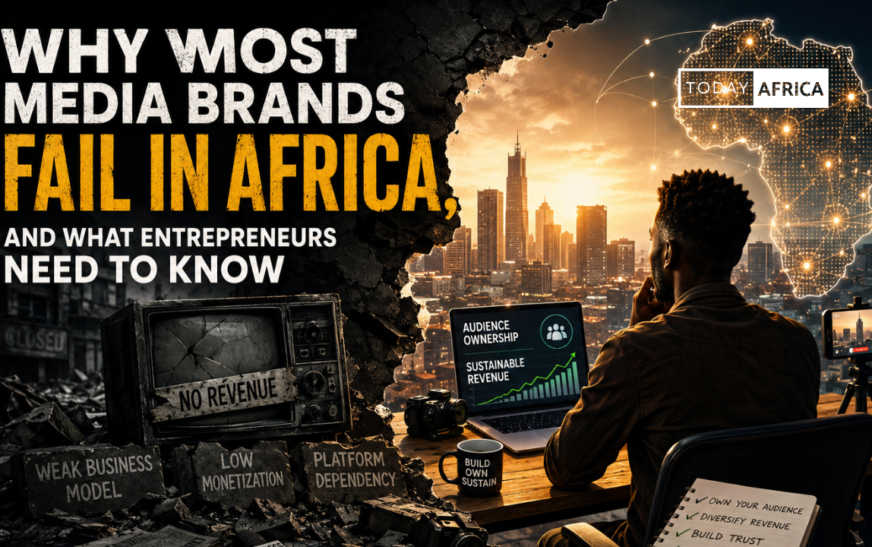
Africa does not have a content problem. It has a media business model problem.
Every year, new digital publishers, creator-led newsrooms, lifestyle platforms, business newsletters, podcasts, YouTube channels, and social-first media brands enter the market with confidence.
Many start with sharp branding, energetic founders, and a clear sense that Africa’s young population is hungry for stories about itself. On the surface, the opportunity looks obvious.
The continent is young, mobile-first, culturally influential, and increasingly connected.
Yet most media brands still struggle to survive beyond their first few years. Some disappear quietly, become inactive Instagram pages, and pivot into PR agencies, influencer marketing shops, or event companies.
Others keep publishing but never build enough revenue to pay reporters, editors, designers, videographers, sales staff, and distribution teams at the same time.
The failure is often blamed on weak execution. That is only partly true. The deeper issue is structural.
African media sits at the intersection of four hard forces: uneven internet access, weak consumer payment habits, platform-controlled distribution, and advertising markets that are growing digitally but not always flowing to local publishers.
That is the shift entrepreneurs need to understand. In Africa, attention is growing faster than media revenue.
Content consumption is expanding, but the money tied to that attention is being captured more easily by global platforms, telecom-linked ecosystems, banks, agencies, and influencers than by independent media companies.
The new attention economy is not built for publishers
The old media business was simpler. A newspaper, radio station, or television network controlled access to an audience. Advertisers paid because those channels had reach.
Readers and viewers had fewer alternatives. Distribution was expensive, but once a media company owned it, that distribution became a moat.
Digital media destroyed that moat.
Today, a media brand in Lagos, Nairobi, Johannesburg, Accra, Cairo, or Kigali may produce the story, but Facebook, Instagram, TikTok, YouTube, WhatsApp, Google Search, Google Discover, and now AI platforms often control whether audiences see it.
That changes the economics completely. The publisher covers the cost of producing the content, but the platform controls the traffic, data, ad system, and often the monetization rules.
This is not just an African problem, but Africa feels it more sharply.
Reuters Institute’s 2026 media trends report found that publishers expect search traffic to fall by more than 40% over the next three years, while referral traffic from Facebook and X has already dropped heavily over the past three years.
For African media brands that never built strong direct audiences, that is a serious warning.
The rise of AI search makes the problem even more urgent. When users ask Google, ChatGPT, Perplexity, Gemini, or other AI tools for information, the answer may come from publisher reporting, but the reader may never click through to the original site.
In practical terms, the media brand becomes invisible infrastructure. It helps power the answer, but it does not always capture the reader, the data, the ad impression, or the subscription.
That is why a media brand can be influential and still broke. Visibility is not the same as ownership. Virality is not the same as revenue. Reach is not the same as a business model.
Read also: Top 10 fastest-growing companies in Africa, according to the Financial Times and Statista
Africa’s digital growth is real, but uneven
The optimistic case for African media is still strong. The audience is expanding.
PwC’s Africa Entertainment and Media Outlook says digital advertising and streaming are reshaping the market, with Nigeria expected to reach 84% digital ad spend by 2029.
South Africa and Kenya are also moving heavily toward digital ad formats, while Kenya is projected to have the fastest-growing internet advertising market globally, with a 16% compound annual growth rate through 2029.
That sounds like a gold rush. But the ground is uneven.
The International Telecommunication Union reported that Africa’s average internet use was only 36% in 2025, compared with 74% globally.
GSMA’s 2026 Mobile Economy Africa report adds another hard number: almost 1 billion people in Africa are still not using mobile internet, representing 63% of the population.
This matters because a media company cannot monetize an audience that is not consistently online, cannot afford data, or does not consume long-form digital content.
Even in Africa’s larger markets, the gap between potential and monetizable audience is wide.
DataReportal’s Digital 2026 report counted 47.8 million active social media user identities in Nigeria in October 2025, equal to 20% of the population. South Africa had 29.1 million, equal to 44.9% of its population. Kenya had 18.4 million social media user identities, equal to 31.8% of its population, with internet penetration at 40.5%.
These numbers show opportunity, but they also expose the trap.
A founder may say, “Nigeria has more than 200 million people.” But advertisers do not pay for population. They pay for reachable, measurable, segmented, brand-safe, purchase-ready audiences.
A market can be huge in demographic terms and still difficult in revenue terms.
The advertising money is moving, but not equally
African advertising is becoming more digital, but digital does not automatically mean local publishers win.
Most small media brands rely on some mix of display ads, sponsored posts, branded content, events, grants, subscriptions, affiliate links, and social video monetization.
Each has limits. Display ads require large traffic volumes. Sponsored posts depend on brand relationships. Events require operational muscle. Grants can distort editorial priorities.
Subscriptions are hard in markets where many consumers already face pressure from food, fuel, rent, school fees, and transport costs.
The broader macroeconomic climate makes this harder.
The World Bank’s April 2026 Africa Economic Update said Sub-Saharan Africa’s growth was projected to hold at 4.1% in 2026, the same as 2025, but warned that downside risks were rising because of geopolitical shocks, high debt-service burdens, tighter financial conditions, and food, fuel, and fertilizer price pressures.
For media companies, this filters down quickly. When inflation bites, consumers cut discretionary spending. When companies face currency volatility, they cut experimental advertising.
And when SMEs are under pressure, marketing budgets become short-term and performance-driven.
That favors Google Ads, Meta Ads, TikTok creators, WhatsApp Commerce, and influencer campaigns with visible conversion paths. It does not favor a young publisher seeking a large-brand campaign based mainly on “awareness.”
This is why many African media brands hit the same wall. They build an audience, then discover that audience alone is not enough.
The market rewards measurable commerce, direct response, community trust, and niche authority more than broad publishing.
The platform problem has become a policy problem
The clearest signal that the economy is broken came from South Africa.
After a competition inquiry into digital platforms and media, global tech platforms agreed to a series of concessions, including a 688 million rand, or about $40 million, support package from Google and YouTube for South African media.
The package is designed to support national, community, and non-English-language media through licensing, innovation grants, and capacity building.
The case matters beyond South Africa because it confirms what publishers across the continent already know: digital platforms are not neutral pipes. They are market gatekeepers.
Reuters reported that South Africa’s inquiry highlighted how Google, YouTube, Meta, Microsoft, TikTok, X, and AI companies dominate access to news and monetization channels.
Google responded by saying, “Helping the news industry adapt to the digital age is a shared responsibility.”
That quote is important because it captures the debate over the new policy. African media is no longer just a journalism issue. It is now a competition issue, an AI issue, a language issue, a democracy issue, and an economic development issue.
If African governments follow South Africa’s lead, more countries may begin asking whether global platforms should contribute more directly to local media sustainability.
But entrepreneurs should not build their companies by waiting for regulation. Policy may help. It will not save weak business models.
Read also: How currency instability shapes startup survival in Africa
Why the “general media brand” is the riskiest bet
The most fragile African media startup is the general-interest platform that tries to cover everything: politics, entertainment, business, lifestyle, celebrity news, sports, tech, culture, and opinion.
That model looks attractive because it allows the publisher to chase every trending topic. But it creates shallow positioning. The audience may visit once, but they do not form a habit.
Advertisers may recognize the name, but they do not know exactly what audience the brand owns. Search engines may rank a few posts, but authority remains scattered.
Social platforms may reward occasional virality, but the brand becomes dependent on algorithms.
The stronger model is narrower and deeper.
A media brand focused on African capital markets, women-led SMEs, Francophone startup funding, West African food systems, climate adaptation, diaspora investing, African fashion supply chains, local-language explainers, or youth employment can build clearer commercial value.
It can sell research, events, newsletters, community access, talent databases, sponsorships, training, and premium intelligence. It can become infrastructure for a specific audience.
This is where many entrepreneurs misunderstand media. They think the product is content.
In reality, the product is trust, attention, data, community, and market access. Content is the engine, but the business is built around what that engine makes possible.
The opportunity window is still open
The opportunity in African media is not disappearing. It is becoming more specialized.
Business-to-business media
As African banking, fintech, energy, logistics, agriculture, healthcare, and retail sectors become more formal and data-driven, decision-makers need trusted information.
Reuters reported in 2026 that African banking revenues topped $100 billion for the first time, with SMEs expected to become the fastest-growing customer segment.
That kind of market creates demand for newsletters, research products, executive briefings, events, and sector-specific intelligence.
Local-language and community media
Global platforms are powerful, but they still struggle with Africa’s language depth, cultural nuance, and offline-to-online realities. Media brands that serve audiences in Yoruba, Hausa, Swahili, Zulu, Amharic, Wolof, Arabic dialects, Pidgin, and other widely used languages can build trust where generic English-language content cannot.
Creator-media hybrids
In many African markets, audiences trust people before institutions. A founder-led media brand, built around a credible analyst, journalist, operator, or creator, can grow faster than a faceless publication. The risk is overdependence on one personality. The advantage is a lower trust-building cost.
Service-backed media
A publication that also offers training, market reports, job boards, SME toolkits, investor databases, conferences, and advisory products has greater revenue resilience than one that relies solely on ads. The future African media company may look less like a newspaper and more like a knowledge, commerce, and community platform.
Read also: Why African economies are quietly rewiring through SMEs
What entrepreneurs need to know before they start
Do not build on rented land alone
Social media is useful for discovery, but entrepreneurs need owned channels: newsletters, websites, apps, WhatsApp communities, membership lists, events, databases, and direct relationships.
Audience size is not enough
A small, valuable audience can beat a large, casual one. Ten thousand founders, CFOs, farmers, investors, doctors, students, or exporters may be worth more than one million random page views.
Monetization must start early
Many founders wait until they “grow first.” That can become a trap. Revenue experiments should begin from the start, even if small: paid reports, sponsored newsletters, live sessions, community memberships, brand partnerships, classifieds, or training products.
AI changes both production and distribution
AI can help small teams write summaries, translate content, analyze data, package reports, and repurpose stories. But it also increases content supply and reduces search traffic. The winning media brands will not be the ones that simply publish more. They will be the ones who become more trusted, more useful, and harder to replace.
African media must be built for African constraints
Data costs matter. Payment friction matters. Language matters. Trust matters. Informal commerce matters. Weak postal systems, uneven broadband access, currency volatility, and regulatory uncertainty all shape the business model.
The next generation of African media winners will not succeed by copying BuzzFeed, Vice, Business Insider, or old newspaper models.
They will win because they understand the continent’s real systems: mobile-first behavior, fragmented markets, platform dependence, SME growth, youth culture, diaspora capital, local languages, and the rising demand for practical intelligence.
Most media brands fail in Africa because they mistake attention for ownership and publishing for business. The entrepreneurs who survive will think differently.
They will build media companies that not only report on African markets but also become part of the infrastructure those markets use to make decisions.
Comment and follow us on social media for more tips:
- Facebook: Today Africa
- Instagram: Today Africa
- Twitter: Today Africa
- LinkedIn: Today Africa
- YouTube: Today Africa Studio