
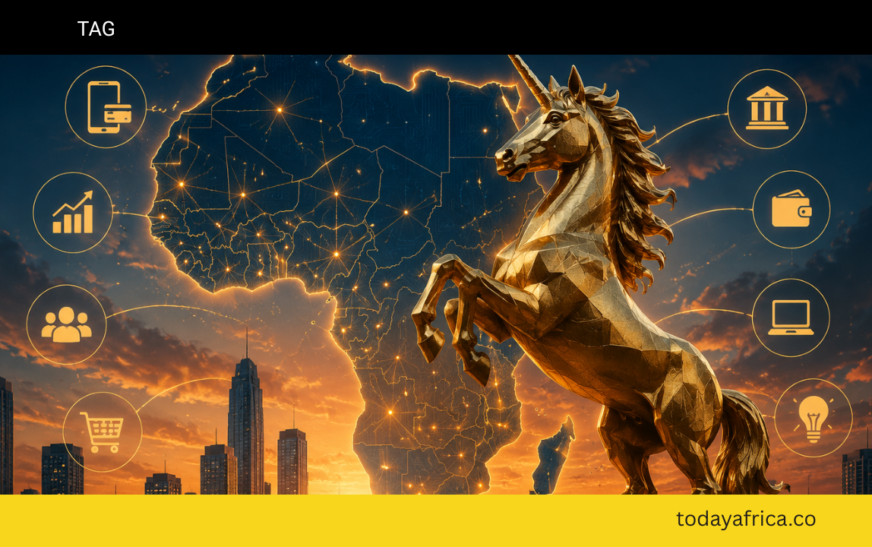
Africa’s unicorn story is no longer simply about counting startups valued above $1 billion.
It is becoming a test of which companies can defend those valuations through revenue, profitability, regulatory strength, and regional expansion.
By the strictest definition, Africa currently has eight private technology companies with defensible billion-dollar valuations.
A ninth company, Chipper Cash, regularly appears on historical lists because it reached a $2.2 billion valuation in 2021, but more recent estimates place it between $250 million and $500 million.
That makes Africa’s current unicorn club smaller than many popular rankings suggest.
This distinction matters because private company valuations are not permanent market prices. They are usually based on the last funding round, an investor transaction, or an internal valuation estimate.
When a company has not raised a priced round for several years, its published value may say more about the market conditions at the time than its present financial position.
Africa’s unicorn club is entering a more demanding era
The African technology market recovered in 2025, but it did not return to the speculative conditions that produced several unicorns between 2019 and 2021.
Instead, investors directed more capital toward companies with visible revenues, stronger margins, operational infrastructure, and credible routes to profitability.
African technology companies raised $4.1 billion in equity and debt financing during 2025, up 25% from $3.25 billion in 2024. Equity funding increased by 8% to $2.41 billion, while debt financing jumped by 63% to a record $1.64 billion.
The number of transactions rose by only 7%, from 534 to 570.
Funding therefore increased mainly because larger amounts were allocated to selected companies, rather than because capital became widely available across the startup ecosystem.
This is the structural shift behind the current African unicorn list. The market is moving from rewarding growth narratives to rewarding companies that control important economic infrastructure.
Moniepoint and Tyme Group, the newest additions, illustrate that change.
Both crossed the billion-dollar threshold in late 2024 after building large customer bases and combining digital products with physical distribution systems.
They became unicorns during a difficult funding cycle, not during the low-interest-rate boom that inflated many earlier valuations.
The African unicorn list in 2026
The table below uses the latest credible publicly available valuation for private, technology-enabled companies that originated in Africa or built their core businesses around African markets.
| Company | Market of origin | Core sector | Latest known valuation | Valuation marker |
| Flutterwave | Nigeria | Payments infrastructure | More than $3 billion | February 2022 funding round |
| OPay | Nigeria | Mobile payments and digital finance | About $2.7 billion to $3 billion | Implied by investor filing |
| Wave | Senegal | Mobile money | About $1.7 billion | September 2021 funding round |
| Tyme Group | South Africa | Digital banking | $1.5 billion | December 2024 funding round |
| Andela | Nigeria | Global technology talent | $1.5 billion | September 2021 funding round |
| MNT Halan | Egypt | Lending and digital finance | More than $1 billion | February 2023 transaction |
| Moniepoint | Nigeria | Business banking and payments | More than $1 billion | October 2024 funding round |
| Interswitch | Nigeria | Payment switching and card infrastructure | About $1 billion | November 2019 Visa investment |
Flutterwave
- Founded: 2016
- Founders: Olugbenga “GB” Agboola and Iyinoluwa “Iyin” Aboyeji
- Base: Nigeria
- Sector: Payments infrastructure
Flutterwave was founded in Lagos, Nigeria, in 2016 by Olugbenga Agboola, a former technology executive with experience in banking and payments, and Iyinoluwa Aboyeji, who previously co-founded Andela.
The company was created to solve one of Africa’s biggest business challenges: helping companies accept and process payments across multiple countries with different banking systems and regulations.
Flutterwave provides payment infrastructure that allows businesses to accept card payments, bank transfers, and other digital payment methods across African markets and internationally. Its customers include global companies, startups, and small businesses looking to access African consumers.
The company reached unicorn status in 2021 after a $170 million funding round and later surpassed a $3 billion valuation following its 2022 investment round. Its growth reflects the increasing importance of digital payment infrastructure as African commerce moves online.
Read also: Inside Flutterwave’s Journey: From Bright Idea to an African Unicorn
OPay
- Founded: 2018
- Founders: Zhou Yahui and Opera Group team
- Base: Nigeria
- Sector: Mobile payments and digital financial services
OPay launched in Nigeria in 2018 as part of the broader Opera ecosystem. Although the company was initially connected to Opera’s technology operations, it evolved into a major financial services platform focused on payments, mobile wallets, agent banking and merchant services.
The company expanded rapidly by building a large network of agents and merchants, particularly in areas where traditional banking infrastructure was limited. Its approach combined mobile technology with physical financial access points, allowing customers to deposit, withdraw, and transfer money more easily.
OPay became one of Africa’s fastest-growing fintech companies and reached unicorn status after raising significant investment from global investors, including SoftBank and Sequoia China.
Its growth demonstrates a recurring theme across African unicorns: successful companies often combine digital platforms with real-world distribution networks.
Wave
- Founded: 2018
- Founders: Drew Durbin and Lincoln Quirk
- Base: Senegal
- Sector: Mobile money
Wave was founded by Drew Durbin and Lincoln Quirk, entrepreneurs who previously built technology solutions focused on emerging markets.
The company launched in Senegal with a mission to make financial services cheaper and more accessible. Its mobile money model challenged traditional operators by offering simple pricing, lower transaction fees, and a user-friendly experience.
Wave became Senegal’s first major technology unicorn after raising $200 million in 2021 at a valuation of approximately $1.7 billion.
The company expanded into other Francophone African markets, proving that billion-dollar technology companies can emerge outside the continent’s largest economies.
Wave’s success also highlighted the opportunity in markets where millions of people use mobile phones but remain underserved by traditional banks.
Read also: Inside Wave’s Journey: Francophone Africa’s First Unicorn
Andela
- Founded: 2014
- Founders: Jeremy Johnson, Iyinoluwa Aboyeji, Christina Sass, and Nadayar Enechi
- Base: Nigeria
- Sector: Technology talent marketplace
Andela was founded in Lagos in 2014 by Jeremy Johnson, Iyinoluwa Aboyeji, Christina Sass, and Nadayar Enechi.
The company started with a different approach from most African startups. Instead of building a consumer product, Andela focused on solving the global shortage of skilled technology workers by identifying and training talented African developers.
The company originally operated a fellowship model that trained engineers before connecting them with international employers. Over time, it evolved into a global talent marketplace that helps companies hire remote engineering professionals.
Andela became Africa’s first major technology talent unicorn after reaching a $1.5 billion valuation in 2021.
Its journey shows that Africa’s competitive advantage is not only its consumer market. The continent’s young population and growing technology workforce represent a major opportunity in the global digital economy.
Read also: Inside Andela’s Journey: How Six People Rewrote Africa’s Tech Future
MNT Halan
- Founded: 2018
- Founders: Mounir Nakhla and Ahmed Mohsen
- Base: Egypt
- Sector: Digital finance, lending and mobility
MNT Halan was created by Egyptian entrepreneurs Mounir Nakhla and Ahmed Mohsen. The company grew from Egypt’s transportation and technology ecosystem before becoming a broader digital financial services platform.
Today, MNT Halan provides digital payments, lending, merchant services, and financial tools for consumers and small businesses.
The company reached unicorn status in 2023 after raising investment from global funds, including Chimera Abu Dhabi, at a valuation exceeding $1 billion.
Its strategy reflects a broader African fintech trend: moving beyond payments into credit and business services. For millions of small businesses, access to affordable financing remains one of the biggest barriers to growth.
Moniepoint
- Founded: 2015
- Founders: Tosin Eniolorunda and Felix Ike
- Base: Nigeria
- Sector: Business banking and payments
Moniepoint was founded in Nigeria in 2015 by Tosin Eniolorunda and Felix Ike. The company originally operated as TeamApt, providing financial technology solutions for banks before expanding directly into business banking.
The company built its reputation by providing payment terminals and financial services to small businesses across Nigeria. It focused heavily on merchants, agents, and informal businesses that were often ignored by traditional financial institutions.
Moniepoint became a unicorn in 2024 after raising more than $100 million in funding.
Its rise represents a major shift in African fintech. Instead of focusing only on individual consumers, Moniepoint built infrastructure to power everyday economic activity for millions of small businesses.
Read also: Inside Moniepoint’s Journey: From POS Terminals to Africa’s Fintech Powerhouse
Tyme Group
- Founded: 2012
- Founders: Coenraad Jonker and Peter Moyo
- Base: South Africa
- Sector: Digital banking
Tyme Group was founded in South Africa in 2012 by Coenraad Jonker and Peter Moyo. The company originally focused on using technology to improve banking access before developing a digital banking model.
Its flagship businesses, TymeBank in South Africa and GoTyme Bank in the Philippines, combine mobile banking with physical customer access points inside retail locations.
Tyme Group reached a valuation of $1.5 billion in 2024 after securing major investment from global financial technology investors.
The company demonstrates how digital banks can grow by combining technology with physical trust points, especially in markets where customers still value face-to-face financial interactions.
Interswitch
- Founded: 2002
- Founder: Mitchell Elegbe
- Base: Nigeria
- Sector: Payment switching and financial infrastructure
Interswitch is one of Africa’s oldest fintech success stories. Founded in Nigeria in 2002 by Mitchell Elegbe, the company built the infrastructure that allows banks and financial institutions to process electronic payments.
Before many consumer fintech companies existed, Interswitch was already solving a fundamental problem: connecting banks, card networks and payment systems across Nigeria.
The company operates payment platforms, including Verve, Africa’s first indigenous payment card scheme.
Visa’s investment in Interswitch in 2019 valued the company at about $1 billion, making it one of Africa’s earliest unicorns.
Its story shows that some of Africa’s most valuable technology companies are not consumer apps. They are the invisible infrastructure powering millions of transactions every day.
Read also: Inside Interswitch’s Journey: From Pioneering Payments to Shaping Africa’s Fintech Future
The common thread connecting Africa’s unicorn founders
Although these companies operate in different markets, their founders share a similar approach. They built around infrastructure gaps rather than short-term consumer trends.
The strongest African unicorns have created systems that make other businesses work better. They move money faster, connect talent globally, provide access to finance, and help small businesses participate in the formal economy.
The next generation of African unicorn founders will likely follow the same path. The biggest opportunities may come from solving fundamental economic problems in energy, logistics, healthcare, agriculture, and industrial technology.
Africa’s unicorn story is still young, but the foundations are becoming clearer. The companies that create lasting value will be those that become essential parts of everyday economic activity.
Why financial infrastructure dominates the list
Seven of Africa’s eight current unicorns operate in payments, banking, lending or related financial services. This concentration is not accidental.
It reflects the size of the continent’s financial access gap and the economic value created when companies reduce the cost of moving, storing and managing money.
Account ownership among adults in Sub-Saharan Africa increased from 49 percent in 2021 to 58 percent in 2024. About 40 percent of adults in the region now have a mobile money account, the highest regional adoption rate in the world.
Mobile money has also moved beyond person-to-person transfers. Global mobile money transaction value surpassed $2 trillion in 2025, while merchant payments grew to $155 billion. Most of the new registered and active accounts came from Sub-Saharan Africa.
These numbers explain why payment infrastructure has produced more billion-dollar African companies than any other sector. Financial platforms benefit from network effects.
More merchants attract more customers, more customers attract more agents, and higher transaction volumes create additional opportunities in credit, insurance, foreign exchange, payroll, and business management.
The strongest companies have also learned that a mobile application alone is rarely sufficient. OPay and Moniepoint built extensive agent and point-of-sale networks.
Tyme placed banking kiosks inside retail stores. Wave used a simple fee structure and agent distribution to challenge established mobile money operators.
Africa’s fintech unicorns are therefore not purely digital companies. They are technology-enabled distribution systems built around the realities of cash-heavy, fragmented, and underbanked economies.
The system behind Africa’s billion-dollar startups
The African unicorn map is heavily concentrated. Five of the eight current companies originated in Nigeria, while Senegal, Egypt, and South Africa each account for one.
The same concentration appears across the wider investment market. Kenya, South Africa, Egypt and Nigeria attracted 72 percent of African technology funding in 2025 and generated 68 percent of the continent’s deals.
Nigeria recorded the highest number of transactions, with 102, while Kenya led in total capital raised, at $1.04 billion, largely due to major debt transactions.
These ecosystems have deeper pools of founders, investors, lawyers, technical talent, regulators, and potential corporate partners.
Once these networks become established, they attract more capital and create a cycle that smaller markets struggle to replicate.
Nigeria offers a particularly revealing example. Its large population gives startups access to a substantial domestic market, while weaknesses in conventional financial services create room for alternative providers.
Currency volatility and low household purchasing power make the market difficult, but companies that achieve national scale can build transaction volumes that few other African economies can match.
Moniepoint chief executive Tosin Eniolorunda captured the logic behind regional expansion when he said, “The opportunities that exist in Nigeria also exist in multiple countries.”
The challenge is that those opportunities appear at different levels of market maturity and require different regulatory, pricing, and distribution strategies.
The concentration also exposes a weakness in the ecosystem. Most African countries still lack enough late-stage investors, acquisition markets, and public listing routes to support large technology companies.
Partech described the path to liquidity for founders and investors as an “open and essential question.”
A billion-dollar paper valuation creates attention, but an acquisition, a profitable dividend stream, or a successful public offering creates actual investor returns.
What the unicorn economy means for SMEs
Africa’s unicorns matter to small and medium-sized businesses because many of them provide the infrastructure SMEs need to operate.
Payment companies allow merchants to accept card, transfer, mobile money, and digital wallet payments. Digital banks provide accounts without the cost of maintaining traditional branch networks.
Agent platforms bring deposits, withdrawals, and transaction support closer to informal businesses.
The next layer is becoming even more important. Companies such as Moniepoint and MNT Halan are expanding from payments into working capital, credit, payroll, foreign exchange, and business management tools.
This allows them to earn revenue from multiple aspects of an SME’s financial activities rather than from a single payment.
The benefits are significant, but concentration creates new risks. When thousands of merchants depend on a single platform, outages, regulatory restrictions, fraud incidents, or pricing changes can affect economic activity far beyond the technology sector.
SMEs also need greater interoperability. A merchant should not require several terminals, wallets, and bank accounts simply because different providers operate closed systems.
The next stage of competition will therefore involve connecting payment networks, improving consumer protection, and reducing the cost of cross-border transactions.
What founders and investors should read between the lines
The African unicorn list shows that large outcomes are possible, but it also reveals how narrow the path remains.
A company is more likely to attract late-stage capital when it solves a widespread problem, generates recurring transaction volume, and controls a valuable distribution channel.
Investors are increasingly skeptical of businesses that grow mainly through discounts, subsidies, or continual fundraising.
The fall in Chipper Cash’s estimated valuation illustrates the danger of treating a funding round as a permanent achievement.
The company was valued at $2.2 billion during the 2021 technology boom, but subsequent estimates put it well below the unicorn threshold.
Several current unicorn valuations are also based on transactions completed between 2019 and 2022.
Flutterwave, Wave, Andela, and Interswitch have not publicly announced newer priced rounds that confirm their previous values.
They remain unicorns based on the latest available transaction, but investors should not treat those figures as real-time market prices.
This is why market intelligence matters more as the ecosystem matures.
The headline valuation must be examined alongside revenue quality, market share, customer activity, debt exposure, regulatory licenses, and currency risk.
The Today Africa Atlas is designed for this kind of analysis.
It tracks African startups, founders, funding activity, countries, sectors, and opportunity flows, helping decision makers distinguish durable market signals from publicity-driven numbers.
Where the next African unicorns could emerge
Fintech remains Africa’s largest technology funding sector, attracting $1.49 billion in 2025. However, the fastest-changing investment story is happening beyond conventional payments.
Cleantech funding increased by 99 percent to $1.18 billion, supported by debt financing for energy, mobility, and asset-backed business models.
Enterprise technology attracted $274 million, commerce and marketplace businesses raised $312 million, and health technology funding reached $224 million after increasing by 232 percent.
These sectors may produce a different kind of unicorn. Instead of scaling through consumer wallet downloads, the next generation could own energy assets, finance productive equipment, digitize supply chains, or provide software to businesses across several markets.
Kenya’s ability to attract large debt rounds gives it an advantage in climate finance, mobility and asset financing.
South Africa’s deeper equity market and corporate base support enterprise software, digital banking and business services.
Egypt’s combination of a large domestic market and structured financing creates room for lending, commerce and logistics platforms.
Francophone West Africa also deserves attention. Senegal attracted $223 million in 2025, an increase of 449 percent, although the capital was concentrated in a small number of transactions.
Wave has already proved that language and market size do not prevent a regional company from crossing the billion-dollar threshold.
Partech argues that Africa is not “missing” the global artificial intelligence wave.
Its opportunity lies in applying AI to real-economy problems, including financial risk, healthcare delivery, agriculture, logistics, and enterprise productivity, rather than competing directly in the capital-intensive foundation model race.
Valuation is not the finish line
Africa’s unicorn club reflects genuine entrepreneurial achievement.
These companies have built financial rails, banking networks and digital services in markets where infrastructure gaps, regulatory fragmentation and economic volatility make scaling unusually difficult.
Yet the list also shows that valuation alone is a weak measure of economic transformation. Eight private billion-dollar companies across a continent of more than 50 countries are evidence of potential, but not of a complete technology economy.
The more important question is what these companies leave behind.
- Do they lower transaction costs for businesses?
- Do they create dependable infrastructure?
- Do they deepen local capital markets, develop talent, and expand across borders without abandoning their original ecosystems?
Africa’s next phase will not be defined by how quickly it produces another unicorn.
It will be defined by whether billion-dollar companies become durable institutions that create opportunities for thousands of smaller businesses around them.
Leave a comment and follow us on social media for more tips:
- Facebook: Today Africa
- Instagram: Today Africa
- Twitter: Today Africa
- LinkedIn: Today Africa
- YouTube: Today Africa Studio