
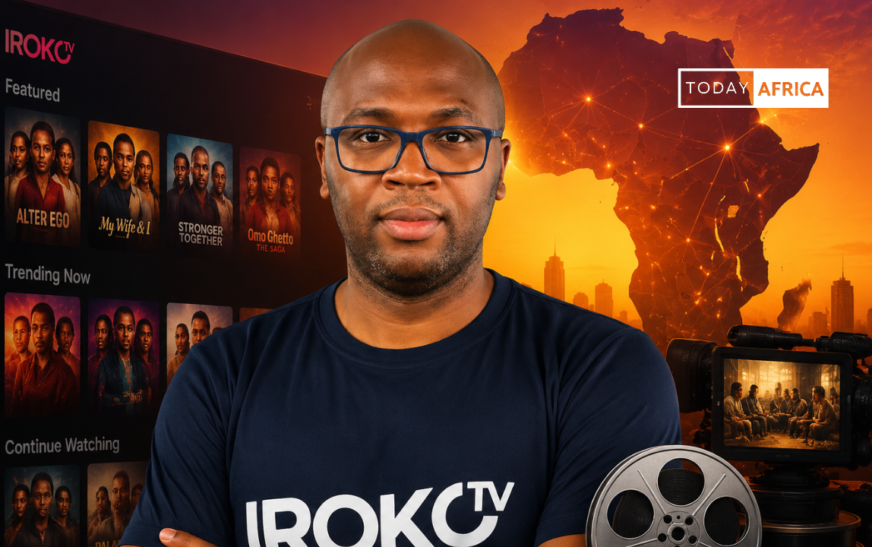
Jason Njoku’s story does not begin with the glamour of venture capital, media headlines, or the convenient myth of a founder who saw the future before everyone else.
It begins in Deptford, South-East London, where he was born in 1980, raised by a hardworking Nigerian mother who supported five children while working in the United Kingdom’s National Health Service.
His early life was shaped by two powerful forces that would later shape his entrepreneurial mind: the discipline of immigrant survival and the cultural pull of Nigeria.
Between the ages of 12 and 15, he lived in Nigeria before returning to the UK, where he later studied Chemistry at the University of Manchester and graduated in 2005.
That background matters because Njoku’s journey is not simply a “from failure to success” story.
It is a story about market gaps, cultural memory, African consumer behavior, and the brutal discipline required to build amid weak infrastructure.
He did not come from a polished business dynasty. He came from the borderland many Africans know well: one foot in the diaspora, one foot in the continent, carrying both distance and belonging.
That position allowed him to see something others missed. Nollywood was huge, emotional, addictive, and deeply loved, but its distribution was broken.
Before iROKOtv, Njoku failed repeatedly. He tried multiple ventures, including publishing and other internet businesses, and, by his own public account, iROKOtv was his 11th startup attempt.
The easy version of the story is that persistence finally paid off. The deeper lesson is sharper: failure gave him pattern recognition.
It taught him what weak demand looked like, what bad timing felt like, and what it meant to build without illusion. By the time the Nollywood opportunity appeared, he had already paid tuition in disappointment.
Building iROKOtv and unlocking Nollywood’s digital frontier
The spark came from a simple family problem. Njoku’s mother wanted Nollywood films in London, but finding them legally and conveniently was difficult.
In a 2012 interview, he explained that coming from a Nigerian family gave him a sense of Nollywood’s power, and his struggle to get films for his mother helped him see a market gap: the movies were mostly trapped in DVD distribution and hard to access in the West.
That was the insight. Not “Africa needs Netflix” as a slogan, but “African stories already have demand; the pipe is broken.” Builders should pause there.
Many entrepreneurs search for ideas by copying Silicon Valley products. Njoku looked at existing behavior. People were already watching.
The hunger was already there. The business opportunity was not to invent demand, but to organize it.
With backing from his friend and co-founder Bastian Gotter, Njoku flew to Lagos and began acquiring online licenses for Nollywood films.
This was not glamorous work. It meant negotiating with producers, understanding informal distribution, and entering a market where piracy, fragmented rights, and low trust shaped the industry.
He started with NollywoodLove on YouTube before iROKOtv became a standalone video-on-demand platform in 2011.
The early model worked because it solved a real pain: it made Nigerian films visible, accessible, and monetizable for audiences scattered across the world.
The rise of iROKO was significant because it placed Nollywood inside the global digital economy.
Njoku and his team attracted major international investors, including Tiger Global, Kinnevik, RISE Capital, and Canal+.
TechCabal reported in 2016 that iROKO had raised $19 million in a round that brought total funding to about $40 million.
For African tech at the time, this was not just fundraising. It was proof that African content, African audiences, and African internet businesses could command serious global capital.
Read also: Inside the mind of the founder of Ingressive Capital, Maya Horgan Famodu
Risks, pivots, and hard truths about the market
But the most important part of Njoku’s biography is not that he raised money. It is what he learned after raising it.
For years, iROKO chased the dream of paid streaming in Nigeria. The logic seemed obvious: Nigeria was Nollywood’s home, the population was massive, mobile adoption was rising, and the cultural connection was strong.
But business is not built on population alone. It is built on purchasing power, payment habits, distribution costs, infrastructure, trust, pricing, and timing.
In a 2025 essay, Njoku wrote that between revenue and venture capital, iROKO spent about $100 million trying to win, yet remained in “full survival mode” under difficult operating conditions.
He said the company eventually accepted in 2023 that paid premium streaming in Nigeria was not working and exited the local market.
That admission is one of the most valuable parts of his legacy. Many founders only publicize victory. Njoku publicly documented the cost of being wrong. That honesty turns his story from inspiration into instruction.
The mistake was not that Nollywood lacked value. The mistake was believing the direct-to-consumer streaming model would mature fast enough in Nigeria to justify the burn.
The content was valuable, and the audience was real. But the model struggled.
This is a lesson African builders must take seriously: a big market is not always a ready market. Love is not always monetized. Attention is not always subscription revenue.
Culture can be powerful, even as the business model around it remains fragile. Njoku’s defining decisions reveal a founder willing to act before the market looked clean.
- First, he chose a real African problem rather than a fashionable foreign template.
- Second, he entered the messy middle of Nollywood distribution instead of waiting for perfect systems.
- Third, he raised global capital without abandoning an African thesis.
- Fourth, he learned, painfully, that capital cannot force a market to mature.
- And fifth, he kept adjusting.
One of the strongest pivots was ROK Studios, founded by Mary Remmy Njoku in 2013 and incubated within the iROKO ecosystem.
ROK proved that content production and channel distribution could create real value even when pure streaming economics were difficult.
In 2019, Canal+ acquired ROK Studios from iROKO; TechCabal reported that the studio had produced more than 550 movies and TV series by the time of the acquisition.
Orrick, which advised Canal+ on the transaction, described ROK as a major Nigerian production house with hundreds of movies and dozens of TV series, and said the deal included ROK’s content library and distribution business.
Read also: Fred Swaniker: Building Africa’s leadership pipeline
What Jason Njoku’s journey reveals
This is where Jason Njoku’s story becomes bigger than one company. It reveals a truth about African business: the winning model is often hidden inside the failing model.
iROKO’s streaming struggle did not mean Nollywood was weak.
It meant the value chain had to be read more carefully. The durable money was not only in the app; it was in rights, production, libraries, channels, syndication, and international distribution.
For African founders, this is a blueprint.
Do not worship your first model. Worship the problem. If the problem is real, the business may survive by changing shape.
The founder’s job is not to defend the original pitch deck forever. The founder’s job is to keep moving toward value, even when ego wants to stay loyal to the old plan.
Njoku’s journey also teaches the importance of founder toughness.
Not motivational toughness, but operational toughness. The kind that watches cash flow closely, and the kind that shuts down what is not working.
The kind that admits when the macro environment is stronger than personal ambition.
In African markets, founders often build amid currency volatility, weak infrastructure, limited consumer purchasing power, fragmented regulation, expensive logistics, and unreliable data.
Optimism is useful, but only when disciplined by reality.
Read also: Kwame Nkrumah biography – A teacher who became Ghana’s first leader
Lessons for African founders, creators, and investors
His career also challenges a lazy view of African innovation. African success is not always about inventing something new. Sometimes it is about formalizing what already exists.
Nollywood existed before iROKO. Demand existed before iROKO. Diaspora nostalgia existed before iROKO.
What Njoku did was package, license, digitize, and distribute. He turned scattered cultural energy into an investable company. That is institution-building.
For creators, his lesson is clear: ownership matters.
Content is not just art; it is an asset. Rights are infrastructure. Libraries are balance-sheet power. Distribution determines who gets paid. African creators who ignore ownership may become famous and remain economically weak.
For entrepreneurs, his lesson is even harder: do not confuse visibility with viability.
A product can be loved and still fail commercially. A market can be large and still be difficult to monetize. And a founder can raise millions and still be forced to retreat.
The discipline is to test willingness to pay early, understand the full cost of delivery, and build around real behavior rather than imagined behavior.
For investors, Njoku’s journey is a warning against shallow narratives about Africa.
“Africa has a young population” is not a strategy. “Nigeria has 200 million people” is not a business model.
The real questions are:
- What can customers afford?
- How often will they pay?
- What infrastructure supports the product?
- How expensive is acquisition?
- What happens when currency weakens?
- What part of the value chain captures the profit?
And for young African builders, his story offers a powerful encouragement: failure is not a final identity.
Njoku failed many times before iROKO. But those failures did not disappear; they became preparation.
His story says that the continent needs more than just dreamers. It needs stubborn learners. People who can observe culture, build pipes, raise capital, lose money, tell the truth, pivot, and keep building.
Jason Njoku’s legacy is not that he created the “Netflix of Africa.” That phrase is too small for the lesson.
His real legacy is that he showed how African culture could become digital infrastructure, how local stories could attract global capital, and how even painful business mistakes could become public knowledge for the next generation.
The blueprint is simple but not easy: find existing demand, organize it better than anyone else, respect the market more than your ego, control rights where possible, watch the economics brutally, and be willing to change the model without abandoning the mission.
That is the Jason Njoku lesson, not perfection, not mythology, but building.
Leave a comment and follow us on social media for more tips:
- Facebook: Today Africa
- Instagram: Today Africa
- Twitter: Today Africa
- LinkedIn: Today Africa
- YouTube: Today Africa Studio






![Biography of Tony Elumelu [Investor, Entrepreneur, & Philanthropist]](https://todayafrica.co/wp-content/uploads/2023/12/Blue-Simple-Dad-Appreciation-Facebook-Post-1200-×-720-px-7-1.png)