
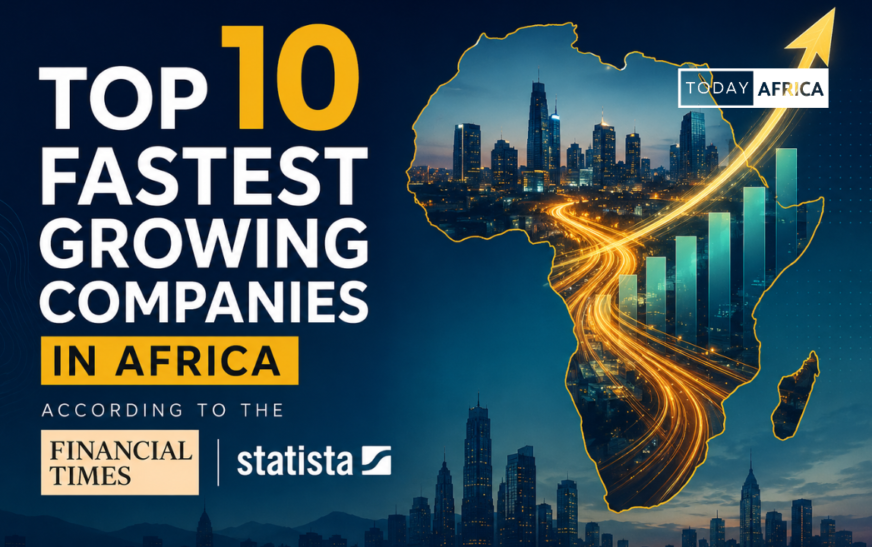
Africa’s fastest growing companies are telling a bigger story than numbers alone can explain. They are showing where money is moving, where customers are changing their habits, and where businesses are solving the continent’s most stubborn problems with unusual speed.
The latest Financial Times and Statista annual ranking of Africa’s fastest growing companies places a new generation of businesses at the center of the continent’s growth story. These are not just large corporations with deep balance sheets. Many are young, focused, fast moving companies that found pressure points in the African economy and built around them.
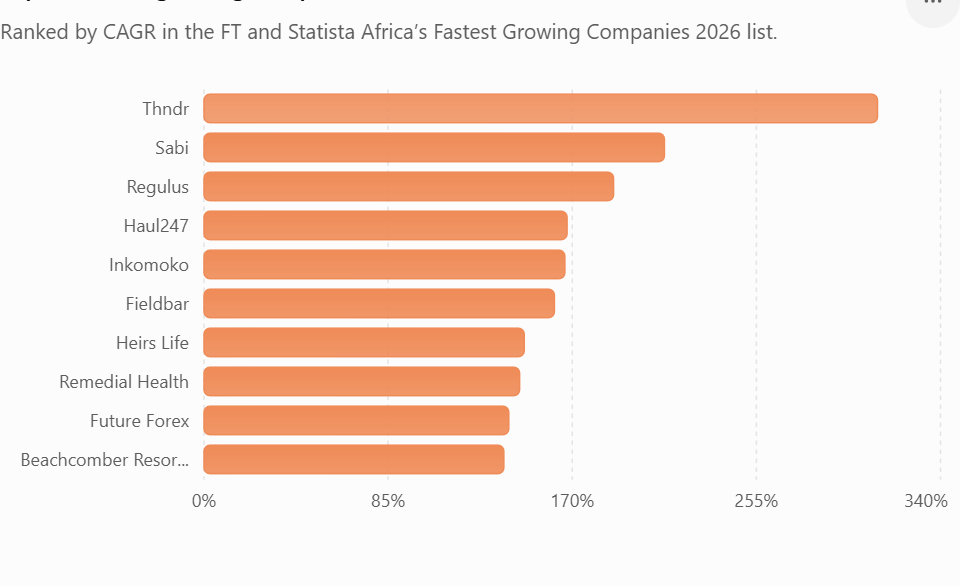
The ranking is based on compound annual growth rate between 2021 and 2024, which makes it different from a list of the biggest companies by revenue. A company does not need to be the largest in its sector to appear here. It needs to have grown quickly and consistently over the measured period.
That distinction matters. Africa’s economy is often discussed through the lens of natural resources, population growth and infrastructure gaps. But this ranking shows another side of the story. It reveals companies turning those gaps into commercial opportunities, from digital investing and commodity trade to logistics, insurance, healthcare supply chains, manufacturing and tourism.
Thndr, Egypt
At the top of the ranking is Thndr, an Egyptian fintech company that has become one of the clearest symbols of North Africa’s digital investment boom. With a reported CAGR of 311.17%, Thndr did not simply grow quickly. It grew at a pace that placed it far ahead of every other company on the list.
Thndr’s rise reflects a major shift in how younger and digitally connected Africans are thinking about money. Investing was once seen as something distant, complex and reserved for people with specialized knowledge or access to traditional brokers. Thndr entered that space with a simpler proposition: make investing easier, more accessible and more mobile friendly.
That is why its growth matters beyond Egypt. Across Africa, millions of young people are looking for new ways to save, invest and build wealth outside the old banking model. A platform that gives people easier access to capital markets can grow quickly when trust, usability and timing come together.
Thndr’s position at number one also marks a broader moment for Egypt’s startup ecosystem. For years, conversations about African tech were often dominated by Nigeria, Kenya and South Africa. Thndr’s rise shows that Egypt is now firmly inside the continent’s most competitive innovation map.
Sabi, Nigeria
Sabi ranks second, with a reported CAGR of 212.56%. The Nigerian company has become one of the most important examples of how African trade is being reorganized through technology and better market infrastructure.
Sabi’s story is powerful because it touches one of the biggest realities of African commerce: fragmentation. Across many markets, traders, wholesalers, manufacturers and retailers often operate through informal networks. These networks are resilient, but they can also be inefficient, expensive and difficult to scale.
Sabi grew by helping bring more structure to that world. Its platform connects different parts of the trade chain and helps businesses move goods, access markets and manage transactions more effectively. In a continent where informal trade is enormous, even small improvements in coordination can create major value.
Its growth also shows that African technology is not only about consumer apps. Some of the most important companies are building behind the scenes. They are working inside supply chains, trade networks and business systems that ordinary consumers may never see, but that affect prices, availability and business survival every day.
Regulus, Ghana
Regulus, based in Ghana, ranks third with a reported CAGR of 189.08%. Its presence near the top of the list is especially interesting because it shows that Africa’s fastest growth is not only coming from the continent’s largest startup markets.
Ghana has a strong business environment and a growing fintech scene, but it often receives less global attention than Nigeria, Egypt, Kenya and South Africa. Regulus breaks through that noise. Its ranking suggests that focused financial services companies can scale quickly even outside the most heavily funded ecosystems.
The company sits in the fintech, financial services and insurance category, one of the strongest themes across the ranking. That is not surprising. Africa’s financial infrastructure is still evolving, and many businesses and consumers remain underserved by traditional financial institutions.
Regulus reflects a broader opportunity. When companies can make payments, financial services or digital access easier, they are not just competing with banks. They are helping build the rails for future commerce. That is why fintech remains one of the loudest growth engines on the continent.
Haul247, Nigeria
Haul247 ranks fourth, with a reported CAGR of 167.62%. The Nigerian logistics and transportation company represents one of Africa’s most practical growth stories: fixing how goods move.
Logistics is one of the most difficult parts of doing business in Africa. Roads, warehousing, trucking, inventory visibility and delivery coordination can all affect whether a business makes money or loses it. In a market like Nigeria, where demand is huge but infrastructure pressure is constant, logistics companies that solve real bottlenecks can become very valuable very quickly.
Haul247’s rise shows why transport and logistics are no longer just support services. They are becoming central to Africa’s commercial future. Every retailer, manufacturer, distributor and online seller depends on the ability to move goods reliably.
The company’s growth also speaks to a deeper truth about African innovation. Not every high growth business needs to look glamorous. Some of the most powerful companies are the ones solving hard, unsexy problems: trucks, storage, delivery routes, warehousing and supply chain visibility.
Inkomoko, Rwanda
Inkomoko ranks fifth, with a reported CAGR of 166.6%. Based in Rwanda, the company stands out for its focus on entrepreneurs and small businesses.
That gives Inkomoko a different character from many companies on the list. It is not just riding one fast consumer trend. It is tied to the broader growth of small and medium sized enterprises, which remain the backbone of many African economies.
Small businesses often face the same painful problems: limited financing, weak advisory support, poor market access and difficulty scaling beyond survival mode. Inkomoko’s growth suggests that companies helping entrepreneurs become more stable and investable can scale alongside the businesses they support.
Rwanda’s presence in the top five also matters. The country has worked hard to position itself as a serious business and innovation hub. Inkomoko’s ranking reinforces the idea that smaller African markets can still produce companies with continental relevance when the business model is focused and the ecosystem is supportive.
Fieldbar, South Africa
Fieldbar ranks sixth, with a reported CAGR of 161.77%. The South African company is listed under manufacturing, making it one of the most interesting names in the top 10.
Its presence is important because many conversations about Africa’s fastest growing companies focus heavily on fintech and software. Fieldbar shows that physical products still have room to scale rapidly when design, branding and market demand align.
Manufacturing is often treated as one of Africa’s missing economic pieces. The continent has a large consumer base, but many finished goods are still imported. Companies that can manufacture locally, build strong brands and reach higher value customers are important because they create more than revenue. They can create jobs, production capacity and export potential.
Fieldbar’s growth suggests that African consumer brands can compete when they understand lifestyle, quality and identity. It is a reminder that the next wave of African growth will not be built only in code. It will also be built in factories, workshops and production lines.
Heirs Life, Nigeria
Heirs Life ranks seventh, with a reported CAGR of 147.85%. The Nigerian insurance sector is one of the most underdeveloped yet promising in Africa.
Insurance penetration remains low in many African markets. Millions of individuals and businesses still face major risks without strong financial protection. That includes health emergencies, death, business interruption, property loss and other shocks that can push families or companies into crisis.
Heirs Life’s growth shows what can happen when insurance becomes easier to understand, easier to access and better connected to modern distribution. In Nigeria, where the population is large and the middle class remains financially stretched, the need for protection is enormous.
The company’s rise also points to a wider shift in African financial services. The first wave of fintech focused heavily on payments and wallets. The next wave is moving deeper into credit, savings, investments and insurance. Heirs Life is part of that broader expansion.
Remedial Health, Nigeria
Remedial Health ranks eighth, with a reported CAGR of 145.71%. The Nigerian company operates in healthcare and pharmaceutical supply chains, a sector where growth is not only commercial but deeply human.
Medicine distribution is one of the most important problems in African healthcare. Pharmacies, hospitals and clinics need reliable access to genuine, affordable products. When supply chains are weak, patients suffer through higher prices, delays, shortages or unsafe alternatives.
Remedial Health’s rapid growth shows how much demand exists for better healthcare infrastructure. By improving how pharmaceutical products move through the system, the company is operating at the intersection of business, public health and trust.
This is what makes its ranking so significant. It is not just another startup scaling in a large market. It is part of a bigger effort to make healthcare delivery more reliable. In a continent where healthcare access remains uneven, companies fixing the supply chain can have an impact far beyond their revenue figures.
Future Forex, South Africa
Future Forex ranks ninth, with a reported CAGR of 140.71%. The South African fintech company operates in foreign exchange and cross-border payments, a space that is vital for trade, investment and global business.
Currency movement is a major issue for African companies. Businesses that import, export, pay international suppliers or receive foreign income need faster, cheaper and more transparent ways to manage foreign exchange. Delays and high fees can quietly drain profitability.
Future Forex has grown by addressing that pain point. Its rise shows that African fintech is becoming more specialized. Instead of only building broad consumer payment tools, some companies are focusing on narrower but highly valuable financial problems.
South Africa’s place in this story is also important. The country has one of the continent’s most mature financial systems, but that does not mean innovation has slowed. Future Forex shows that even developed financial markets still have space for agile companies that improve speed, cost and user experience.
Beachcomber Resorts & Hotels, Mauritius
Beachcomber Resorts & Hotels closes the top 10, with a reported CAGR of 138.43%. Its presence on the list adds a different kind of story because it is not a young fintech or logistics startup. It is a long-established hospitality company from Mauritius.
That makes its growth especially notable. Beachcomber’s rise reflects the recovery and renewed strength of African tourism after the severe disruption of the early 2020s. Travel and hospitality were among the hardest hit sectors during the pandemic period, and companies that recovered strongly benefited from returning demand.
Mauritius has long been one of Africa’s strongest tourism brands, known for beaches, resorts and high value travel. Beachcomber’s performance shows how quickly established hospitality players can rebound when international travel returns and destination demand strengthens.
Its inclusion also gives the ranking more balance. Africa’s growth story is not only about tech startups. It is also about tourism, services, consumer confidence and the return of industries that depend on movement, leisure and global demand.
The bigger pattern behind the ranking
The most important takeaway from this list is that Africa’s growth is becoming more layered. Fintech remains powerful, but it is no longer the only story. Logistics, healthcare, manufacturing, insurance, hospitality and trade infrastructure are all represented in the top 10.
This matters because it shows a maturing business environment. Early startup excitement often focused on payments because payments were an obvious problem. Now, companies are moving deeper into the economy. They are solving problems around medicine distribution, freight, insurance, foreign exchange, commodity trade and small business growth.
The ranking also shows that Africa’s fastest growing companies are often built around friction. They grow because something in the economy is difficult, slow, expensive or underdeveloped. The company that reduces that friction can capture demand quickly.
Another pattern is the strength of Nigeria. Several of the top 10 companies are Nigerian, which reflects the country’s scale, entrepreneurial energy and huge market demand. But the list is not only Nigerian. Egypt, Ghana, Rwanda, South Africa and Mauritius also appear, proving that growth is spreading across different regions and business models.
Why these companies grew so quickly
There are several reasons these companies expanded at such speed. The first is market size. Many African sectors remain underpenetrated, which means a company with the right product can grow from a small base very quickly.
The second reason is technology. Even companies outside pure software are using digital tools to organize markets, manage transactions, improve visibility and reach customers more efficiently. Technology is no longer a separate sector. It is becoming the operating system for logistics, healthcare, finance and trade.
The third reason is necessity. Many of these companies are not selling luxury solutions to imaginary problems. They are solving daily business pain points. People need medicine. Traders need markets. Companies need logistics. Families need insurance. Investors need access. Businesses need foreign exchange.
The fourth reason is timing. The period from 2021 to 2024 was unusual. Many sectors were recovering from pandemic disruptions, while digital adoption accelerated. Companies that positioned themselves well during that period had room to grow sharply.
What this means for Africa’s future
The top 10 fastest growing companies in Africa offer a useful picture of where the continent may be heading. The future will likely be shaped by companies that connect fragmented markets, digitize essential services, improve supply chains and make financial tools more accessible.
This does not mean growth will be easy. Many of these companies still face major risks, including inflation, currency instability, infrastructure gaps, regulation, funding pressure and competition. Fast growth can create attention, but it can also create strain.
Still, the ranking is a strong signal. Africa’s most dynamic companies are not waiting for perfect conditions. They are building inside complexity. They are finding opportunity in the exact places where older systems have failed to keep up.
That is why this list matters. It is not just a scoreboard of business performance. It is a map of Africa’s changing economy. The companies growing fastest are the ones helping the continent move money, goods, medicine, services and opportunity with more speed and structure.
In the end, Africa’s fastest growing companies are not only growing because they are ambitious. They are growing because they are useful. They are stepping into the gaps that millions of people and businesses feel every day. That is where the real momentum is, and that is why this ranking deserves attention.
Leave a comment and follow us on social media for more tips:
- Facebook: Today Africa
- Instagram: Today Africa
- Twitter: Today Africa
- LinkedIn: Today Africa
- YouTube: Today Africa Studio