

Africa’s technology ecosystem is entering a new chapter. The conversation is no longer only about how many startups are launching or how much venture capital is being raised.
The focus is shifting toward a more important question: which companies are building solutions strong enough to survive, scale, and transform African markets?
The week of July 13th to July 19th, 2026, highlighted this transition.
Across the continent, investors, founders and ecosystem builders continued to focus on practical innovation, from financial inclusion and artificial intelligence to founder development and digital infrastructure.
The message from the market is becoming clearer: Africa’s next generation of technology companies will be built on strong fundamentals, not just ambitious ideas.
Key moves last week
One of the week’s major developments came from Renew Capital, which selected 15 African technology startups for its inaugural Renew Venture Lab: EmFi Series.
The program was chosen from more than 500 applications across 48 African countries and includes companies from markets such as Nigeria, Kenya, Ghana, Ethiopia, Morocco, Senegal, South Africa, Uganda, Zambia, and Togo.
The selection highlights a growing investor interest in startups solving practical business challenges.
Many of the chosen companies focus on areas such as financial access, agriculture, commerce, logistics, and small-business enablement, reflecting a shift toward technology that directly improves productivity and economic participation.
Another important move came around improving access to capital for women founders.
The Office for Nigerian Digital Innovation, Wetech and the UK-Nigeria Tech Hub launched the PitchHer investment readiness program, designed to prepare 25 women-led startups to become more investor-ready.
The eight-week program will focus on fundraising skills, financial preparation, and investor engagement before a live pitch event.
The initiative addresses a persistent challenge in Africa’s venture ecosystem.
Although African startups continue to attract billions in funding, women founders remain significantly underrepresented in venture capital allocations, creating pressure for more targeted programmes that improve access and visibility.
The week also reinforced the growing role of artificial intelligence in African technology development.
This continued momentum in AI businesses, including enterprise applications and education-focused solutions, shows that AI adoption is moving beyond experimentation into commercial use cases.
Africa’s tech market is becoming more strategic
The biggest pattern emerging from the week is a stronger focus on sustainable businesses rather than short-term growth stories.
Investors appear increasingly interested in startups that demonstrate clear revenue paths, strong market understanding, and the ability to solve specific problems for African consumers and businesses.
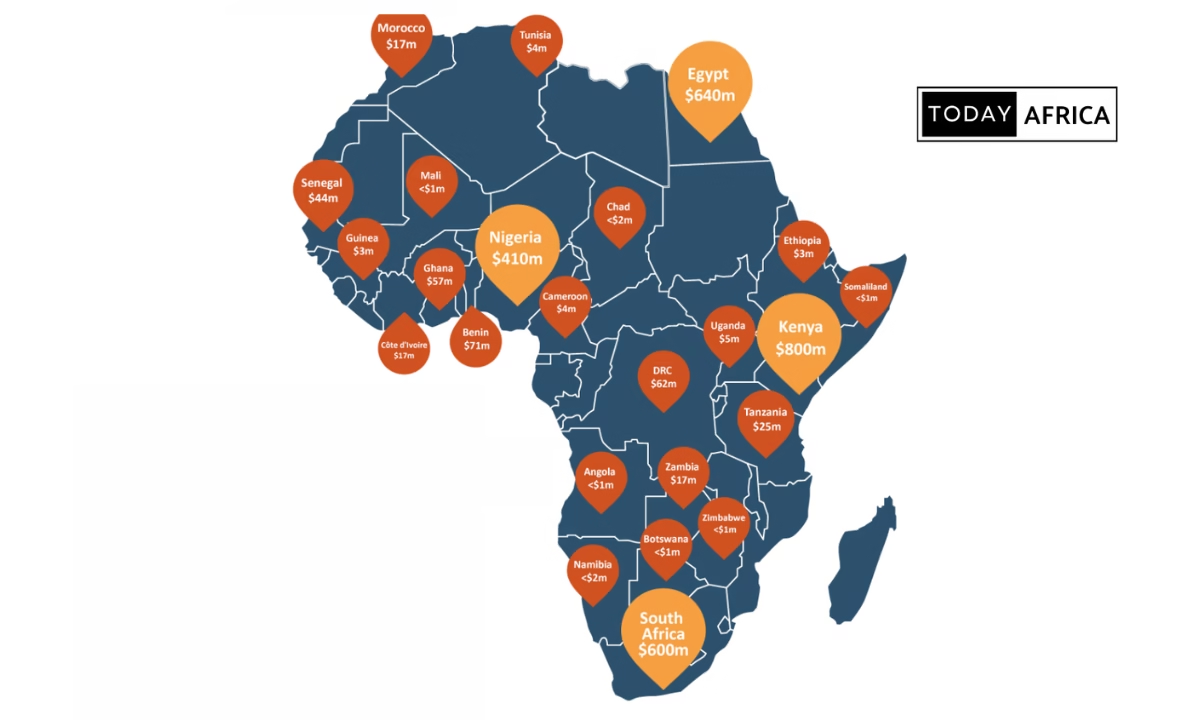
This follows a broader funding trend visible in 2026. African startups raised $1.44 billion in the first half of the year, slightly above the same period in 2025, but the structure of investment has changed.
Larger, more carefully evaluated deals are becoming more common as investors demand stronger fundamentals.
Fintech remains a central pillar of the ecosystem, but its definition is expanding.
Investors are increasingly looking beyond payment platforms toward companies building financial tools for merchants, small businesses, cross-border trade and underserved communities.
At the same time, artificial intelligence is becoming a major investment theme.
African startups are exploring AI applications in education, enterprise operations, customer service and local-language technology, suggesting that the continent may become an important testing ground for AI solutions adapted to emerging markets.
Another clear trend is the rise of ecosystem-building programs.
Rather than relying only on venture funding, more organizations are creating structured pathways that help founders improve operations, prepare for investment, and connect with global networks.
Last week signaled a more mature African innovation economy
The week’s developments suggest that Africa’s technology sector is entering a more mature phase.
The early years of the startup boom were dominated by rapid expansion and market capture, but today’s environment rewards companies that can prove efficiency, resilience and measurable impact.
For investors, this means that opportunity remains abundant, but patience and selectivity are becoming increasingly important.
Companies addressing fundamental challenges in finance, commerce, agriculture, energy, and infrastructure are likely to remain attractive, as these sectors represent some of Africa’s largest unmet needs.
For founders, the message is equally clear. Access to capital is not disappearing, but expectations are rising. Startups must demonstrate stronger business models, deeper customer understanding, and clearer paths toward profitability.
The continued growth of founder support programs also signals that Africa’s innovation ecosystem is becoming more interconnected.
Governments, private investors, international partners, and local technology communities are increasingly working together to strengthen the pipeline of companies capable of scaling across borders.
What to watch next
The next phase of African technology growth will likely be shaped by three major forces: the adoption of artificial intelligence, improved access to growth capital, and expansion into new markets.
AI will remain one of the most closely watched sectors. The key question will be whether African startups can move from building impressive technology demonstrations to creating profitable products that businesses and consumers use at scale.
Funding conditions will also require close attention. While investment remains strong, the era of easy capital has shifted toward a more demanding environment where startups must prove value before securing major rounds.
Regional expansion will become another important indicator. Companies that successfully navigate Africa’s complex regulatory environments and build solutions that work across multiple countries could become the next generation of continental technology leaders.
The week of July 13th to July 19th offered a snapshot of a changing African tech landscape.
The continent is no longer simply chasing startup growth numbers; it is building companies designed to solve structural problems, attract smarter capital and compete in a rapidly changing global economy.
Leave a comment and follow us on social media for more tips:
- Facebook: Today Africa
- Instagram: Today Africa
- Twitter: Today Africa
- LinkedIn: Today Africa
- YouTube: Today Africa Studio