
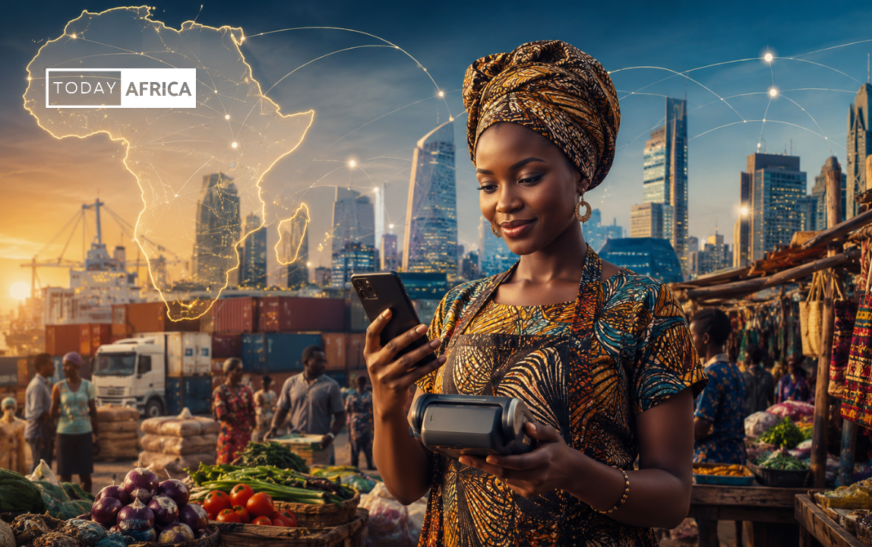
For more than a decade, “banking the unbanked” has been one of the most repeated promises in African finance. It has appeared in fintech pitch decks, banking strategies, development programs, government policies, and investor presentations.
The phrase once captured a genuine structural challenge. Millions of Africans lived far from bank branches, lacked the documents required to open accounts, operated almost entirely in cash, and paid high costs to move or store money.
That reality is changing. Sub-Saharan Africa’s account ownership rate rose from 49% of adults in 2021 to 58% in 2024, according to the World Bank’s Global Findex 2025. Mobile money usage in the region also remains the highest in the world.
The continent has therefore made measurable progress. But opening more accounts is no longer a sufficiently ambitious definition of financial inclusion.
The real question is no longer whether Africans can access an account. It is whether that account helps a trader finance inventory, enables a farmer to manage climate risk, allows an employee to save against inflation, gives a small business an affordable payment channel, or helps a household survive an emergency.
If it does none of those things, the customer may be banked on paper while remaining financially excluded in practice.
Africa has moved beyond the account-opening race
The first phase of Africa’s financial inclusion story focused on physical access. Banks expanded their branches, microfinance institutions entered underserved communities, telecom operators built agent networks, and fintech companies enabled the opening of wallets on basic mobile phones.
That phase delivered significant results. Mobile money has grown from a simple transfer service into what GSMA Director General Vivek Badrinath described as “a global financial ecosystem.” Globally, mobile money services processed about $2.1 trillion in transactions during 2025, while registered accounts reached 2.3 billion.
Africa’s formal banking industry is also growing and becoming more profitable. Banking revenues across the continent were estimated at $107 billion in 2025, up from about $99 billion in 2024. Returns on equity were estimated at 17%, compared with a global banking average of roughly 10 percent.
“African banking has moved decisively from a story of potential to one of performance,” McKinsey Africa financial services head Mayowa Kuyoro said in March 2026.
That performance, however, remains concentrated. Egypt, Kenya, Morocco, Nigeria, and South Africa account for approximately 70 percent of African banking revenues. The concentration shows that rapid growth in a few major markets can coexist with shallow financial systems across much of the continent.
This is why the old inclusion narrative now feels incomplete. Africa has created more entry points into finance, but access has not automatically led to affordable credit, reliable insurance, productive savings, or stronger financial resilience.
Read also: The real impact of AfCFTA on small businesses
Access is growing, but meaningful usage remains shallow

The gap between account ownership and account usage is now one of the most important signals in African finance.
GSMA reported 593 million active 30-day mobile money accounts worldwide in 2025. Yet the monthly activity rate was only 25.7%, meaning that almost three-quarters of registered mobile money accounts were inactive during a typical month.
Most of the growth in registered and active accounts came from Sub-Saharan Africa.
This distinction matters. A person may own several wallets but continue using cash for most purchases. A merchant may accept digital payments but immediately withdraw the balance because suppliers, landlords, transport operators, and informal workers still demand cash.
An account can therefore function as a narrow transfer channel without becoming part of a broader financial life. It receives money, holds it briefly, and returns it to the cash economy.
The next phase must focus on the quality of activity inside financial accounts. That includes merchant payments, recurring savings, working capital, pensions, insurance, investments, cross-border commerce, and emergency liquidity.
There are already signs of that transition. Mobile money merchant payments grew by almost half to approximately $155 billion globally in 2025, making merchant payments the industry’s fastest-growing use case.
Mobile money providers are also expanding into credit, savings, and insurance, with the number offering insurance increasing by one-third during the year.
The market is moving from simply storing and transferring money toward embedding finance into everyday economic activity. That is the structural shift that matters.
Read also: Nigeria fintech H1 2026 report: The fintech market is moving beyond payments
The real inclusion problem sits beneath the financial app
Africa’s financial inclusion challenge is often presented as a banking problem. In reality, it is a problem of infrastructure, income, identity, trust, and productivity.
A financial product cannot become part of daily life when customers cannot afford smartphones, lack reliable internet access, struggle with digital literacy, or face repeated network failures.
It also cannot serve low-income users sustainably when transaction fees consume a meaningful share of small payments.
Africa had approximately 416 million mobile internet users in 2025. Yet almost three-quarters of the continent’s population remained unconnected, while 960 million people lived within mobile internet coverage but did not use it.
Device affordability, limited digital skills, and the shortage of relevant services remain major barriers.
This usage gap is more revealing than the coverage gap. The infrastructure may technically exist, but millions of people cannot afford it or use it confidently.
Identity creates another layer of exclusion. Earlier World Bank research found that 57% of unbanked adults surveyed in Sub-Saharan Africa identified insufficient documentation, including identification documents, as a barrier to opening an account.
Some financial institutions also request utility bills and additional records that informal workers or rural households may not possess.
Regulators are beginning to address these bottlenecks through digital identity systems, simplified customer verification, interoperability, open banking, consumer protection, and instant payment infrastructure.
Africa now has 36 instant payment systems operating across 31 countries. Collectively, these systems processed 64 billion transactions worth almost $2 trillion in 2024. Five new systems became operational within the following reporting period.
The policy conversation is therefore shifting away from licensing more standalone wallets.
Governments and central banks are increasingly focused on building shared infrastructure that allows banks, fintech companies, mobile money operators, merchants, and public institutions to exchange value across the same rails.
More than 60% of mobile money providers surveyed by the GSMA said rules covering interoperability, customer verification, and consumer protection had supported their operations. However, 24% said cross-border data transfer regulations had hindered them.
This captures the central policy challenge. Regulation must make financial markets safer without fragmenting them into isolated domestic systems.
Read also: African startups need data about African markets
SMEs remain banked but underserved
The weakness of the account ownership narrative becomes clearest when viewed through the lens of African SMEs.
A small business may operate a bank account, receive digital payments, and maintain transaction records. Yet it can still be denied credit because it lacks collateral, audited statements, formal registration, or a long borrowing history.
The IFC estimates that unmet demand for MSME finance in Sub-Saharan Africa is approximately $331 billion. Nigeria alone has an estimated MSME financing gap of $32.2 billion, while Ethiopia and Uganda have gaps of approximately $24.5 billion and $8.8 billion, respectively.
These figures show why account ownership cannot serve as the ultimate measure of inclusion. Businesses do not simply need places to hold money. They need finance that helps them purchase equipment, expand inventory, hire workers, manage foreign exchange exposure, and survive irregular cash flows.
For banks, the problem is partly informational. Many African businesses operate informally, mix household and business funds, and cannot produce the conventional records required by traditional credit models.
For fintech companies, transaction data offers an alternative. Payment histories, sales patterns, supplier relationships, mobile money activity, invoices, and inventory turnover can help lenders evaluate businesses that lack conventional collateral.
But technology does not automatically remove credit risk. Digital lenders still need appropriate debt capital, reliable data, strong underwriting systems, and patient investors.
A 2025 World Bank and CGAP study noted that inclusive credit fintechs could help address the global $4.9 trillion credit gap facing micro and small enterprises, but many struggle to secure suitable financing before becoming profitable.
The African fintech market must therefore move beyond building attractive consumer interfaces. The harder opportunity lies in creating financial infrastructure that understands informal commerce and converts economic activity into credible financial records.
Read also: Why Africa’s GDP growth doesn’t translate into jobs
Investors must measure depth, not downloads

For investors, the decline of the old “banking the unbanked” story does not mean the financial inclusion opportunity is disappearing. It means the investment thesis must become more disciplined.
Downloads, registrations, wallet openings, and transaction volume can create an impression of scale. They do not necessarily reveal customer retention, financial health, credit quality, merchant productivity, or unit economics.
The more valuable indicators are increasingly active account ratios, recurring merchant activity, customer balances, savings frequency, insurance adoption, loan repayment performance, payment acceptance density, and the cost of serving each customer.
Investors should also pay attention to how revenue is generated. High transaction fees can create short-term profitability while discouraging regular usage. Aggressive digital lending can increase loan volumes while producing overindebted customers and regulatory intervention.
The strongest platforms will be those that align commercial performance with customer productivity. When merchants grow sales, farmers reduce risk, and households build resilience, providers gain reasons to retain customers beyond promotions and subsidized transfers.
This is where structured market intelligence becomes essential. Today Africa Atlas tracks African startups, founders, funding activity, sectors, countries, and opportunity flows, helping investors and operators separate temporary visibility from deeper ecosystem movement.
In a market crowded with inclusion claims, understanding which companies are building sustainable infrastructure will matter more than counting how many describe themselves as fintechs.
Read also: Why Africa’s economy is growing but still struggling
The opportunity window is deeper finance
The next generation of African financial opportunity will not come from creating another wallet that performs the same basic transfer function. It will come from connecting payments to productive economic activity.
In East Africa, where mobile money adoption is already deeply established, the opportunity lies in merchant finance, agricultural insurance, digital savings, supply chain credit, and business management tools.
In West Africa, agent networks, instant payment systems, open banking infrastructure, and alternative credit data can bring informal enterprises into more useful financial relationships.
Nigeria’s updated agent banking rules, issued in October 2025, reflect the broader policy effort to improve the safety and reach of financial services in underserved and remote communities.
Across Southern and North Africa, banks have an opportunity to combine their balance sheets and customer bases with fintech distribution, faster payment infrastructure, and more flexible SME products.
Central Africa and several Francophone markets remain important frontier opportunities. Their lower levels of competition create room for interoperable payment rails, rural agent networks, local language financial products, digital identity services, and regional settlement platforms.
Cross-border finance may become one of the largest areas of opportunity.
In October 2025, COMESA launched a digital retail payment platform to enable businesses to settle transactions in local currencies, beginning with a trial between Malawi and Zambia.
The platform aims to reduce transaction costs to below 3% and remove some dependence on scarce foreign currency.
Similar systems could make regional trade more accessible to smaller businesses that cannot maintain foreign-currency accounts or absorb the high costs of correspondent banking fees.
The winning model will not simply put more Africans inside the formal financial system. It will make that system cheaper, more interoperable, more trusted, and more useful.
Read also: Why “Made in Aba” is still limited globally and what must change
Africa should expect better
“Banking the unbanked” is not entirely a cliché. Millions of Africans still lack basic financial accounts, especially in rural areas, low-income communities, and markets with weak identity and telecommunications infrastructure.
But the phrase becomes a cliché when account ownership is presented as the final achievement.
Africa should expect better than dormant wallets, costly transfers, rejected SME loan applications, fragmented payment systems, weak customer protection, and financial products that do little to increase resilience.
The next frontier is not basic inclusion. It is productive inclusion.
That means financial systems that help businesses grow, protect households from shocks, support regional trade, convert transaction histories into affordable credit, and allow customers to build assets over time.
The institutions that understand this shift will define the next decade of African finance. Those still celebrating account openings may discover that the market has already moved on.
Leave a comment and follow us on social media for more tips:
- YouTube: Today Africa Studio
- Facebook: Today Africa
- Instagram: Today Africa
- Twitter: Today Africa
- LinkedIn: Today Africa