
On a conference week in Kigali, the city does not announce itself with chaos. It moves with a kind of quiet precision.
At Kigali International Airport, the arrivals hall fills with visitors carrying branded conference bags, laptop cases, small suitcases, and the look of people who have come to work, not wander.
Some are founders from Lagos, Nairobi, Accra, and Johannesburg. Some are investors from Europe, the Gulf, and North America. And some are diaspora Rwandans returning with meetings already scheduled.
Others are consultants, policymakers, creators, development executives, and tech operators using Kigali as a place to meet Africa without being swallowed by the noise of Africa’s largest cities.
By the time they reach Kimihurura, Kacyiru, or the roads around the Kigali Convention Center, the travel story becomes clearer. This is not a city selling escape. Kigali is selling control, access, order, and proximity.
The movement is visible in hotel lobbies where conversations continue long after panels end. It is visible in restaurants where business cards move across tables between coffee, brochettes, wine, and quiet negotiations.
It is visible in ride-hailing pickups outside conference venues, in the polished corridors of Radisson Blu, Kigali Marriott, Serena, and newer boutique properties that are trying to capture a slice of the executive travel market.
Kigali’s rise as a business travel destination is no accident. It is designed.
A city built for the meeting before the meeting
Kigali is compact in a way many African capitals are not. A visitor can land, clear immigration, reach a hotel, attend a session, meet a minister, have dinner with a founder, and still return to their room without losing half the day in traffic.
That matters. In business travel, time is the real currency.
The city’s hills shape its rhythm. Roads bend through clean, planned districts. Office buildings sit near hotels. Conference venues are close enough to restaurants, embassies, coworking spaces, banks, and government institutions. Kigali does not overwhelm the traveler. It arranges the traveler.
That is part of its strategic power.
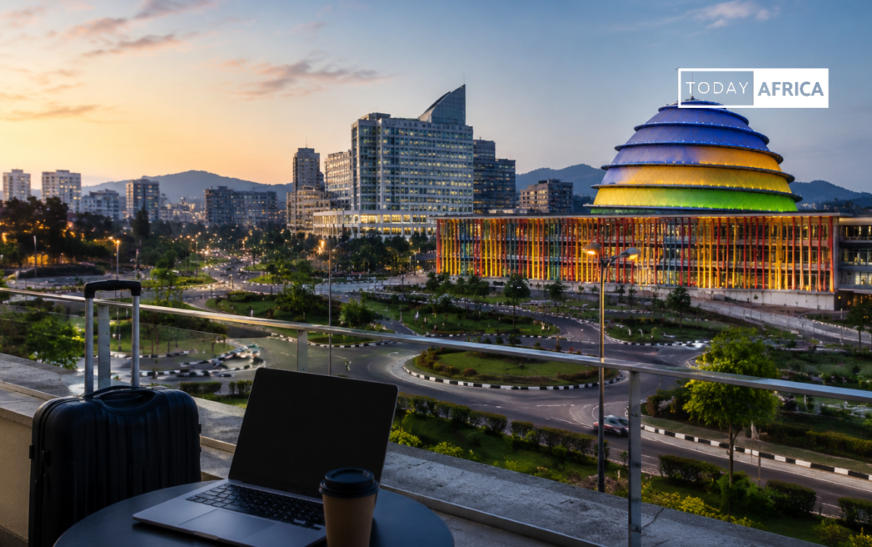
At the Kigali Convention Center, the city’s travel identity is almost architectural. The dome has become more than a landmark. It is a signal to the continent that Rwanda wants to host serious conversations. Summits, tech gatherings, policy forums, investment meetings, health conferences, sports events, and private-sector gatherings have turned Kigali into a calendar city.
People do not only come to Kigali to see Rwanda. They come to Kigali because other people will be there.
That is the deeper shift. A tourism city attracts visitors because of its scenery, leisure, culture, or heritage. A business travel city attracts visitors because of its concentration.
Kigali is building that concentration around conferences, government access, regional networks, hospitality infrastructure, and a reputation for order.
For entrepreneurs and executives, this changes the meaning of travel. A trip to Kigali can be a market visit, a networking opportunity, a policy briefing, an investor meeting, and a cultural experience all in one short itinerary.
This is why Kigali is becoming one of Africa’s most strategic business travel cities.
Read also: Moms are the most undervalued leadership asset in your organisation. Two new reports prove it
Kigali is winning the high-intent traveler

Kigali’s travel growth is not only about visitor numbers. It is about visitor intent. The city is attracting people who arrive with a purpose: to attend a summit, close a deal, explore a market, pitch a startup, meet government officials, host a workshop, build partnerships, or position themselves at the center of Africa’s next wave of business activity.
That is different from casual tourism. Business travelers spend differently.
They book better hotels, use airport transfers, and eat out. They pay for reliable Wi-Fi, translation, logistics, event production, private meeting rooms, branded experiences, and trusted local guidance. And they also influence future travel by creating networks.
A founder who attends a tech event in Kigali may return with a team. A diaspora investor attending a conference may explore property, agriculture, hospitality, or funding opportunities. And a regional executive who visits for one summit may begin using Kigali as a neutral meeting point for East, Central, and West African partners.
This is how business travel multiplies. Rwanda’s MICE strategy has become one of the clearest travel signals on the continent. Meetings, Incentives, Conferences, and Exhibitions are no longer a side activity within tourism. They are part of the country’s national positioning.
The logic is simple. If Rwanda cannot compete with Nigeria on population, Kenya on startup volume, Egypt on historical tourism, or South Africa on corporate scale, it can compete on efficiency. Kigali’s advantage is not size. It is manageability.
That manageability matters to global organizers. They want cities where delegates can move safely, venues can operate smoothly, hotels can coordinate with event teams, and the government understands the value of hosting international attention.
Kigali has come to understand that business travel is not just about putting people in rooms. It is about creating confidence.
The visa-on-arrival policy supports that confidence. The city’s hospitality infrastructure supports it. RwandAir’s regional connectivity supports it. The planned Bugesera airport is part of the same ambition: to make Rwanda easier to enter, easier to use, and easier to position as a continental meeting point.
This is why Kigali’s travel story is bigger than tourism. It is about reducing friction for African movement.
Read also: Best time to visit South Africa for safari: Essential 12-month guide
Economic and cultural insight
Kigali’s real value lies in turning travel into a platform
A platform city is not just a place people visit. It is a place people use. They use it to meet, launch, negotiate, announce, connect, retreat, and build legitimacy.
That is what Kigali is becoming. For Rwanda, business travel creates a chain reaction. Conferences fill hotels. Hotels support jobs. Delegates spend at restaurants. Restaurants create demand for suppliers.
Events need transport, media, staging, security, catering, printing, design, translation, photography, and digital production. International visitors create demand for better service standards. Better service standards raise expectations across the local economy.
The result is a hospitality ecosystem that becomes more professional because movement keeps testing it.
Discipline as destination branding
The city’s cleanliness, order, and controlled pace are not small details. They shape how visitors interpret Rwanda. In a region where many business travelers are used to unpredictable traffic, weak logistics, airport stress, and fragmented urban planning, Kigali’s calm becomes an economic asset.
That calm is part of the product. But the story needs a critical eye.
Kigali’s rise is not without tension. A city built around high-level conferences can become expensive for ordinary visitors and locals. Business travel can concentrate opportunity around polished districts while leaving smaller neighborhoods outside the main flow.
Hospitality growth can prioritize premium hotels while mid-market gaps remain. The city’s carefully managed image can also make it harder for outsiders to understand the full social and economic complexity beneath the surface.
That is why Kigali should not be read as a perfect model. It should be read as a strategic experiment.
The experiment is this: can a smaller African capital use trust, infrastructure, policy coordination, and hospitality discipline to become more influential than its market size suggests?
So far, Kigali is making a strong case. Its travel economy is connected to bigger systems: Rwanda’s push into finance, technology, sports, conservation, events, and regional diplomacy.
A conference in Kigali is rarely only a conference. It is part of Rwanda’s broader attempt to turn visibility into investment, movement into influence, and hospitality into national strategy. This is where culture enters the story.
Kigali is not trying to copy Dubai, Nairobi, or Johannesburg. It is building a travel identity around Rwandan order, restraint, design, memory, and ambition. The Kigali Genocide Memorial gives the city moral gravity. The coffee scene gives it texture.
Local fashion, art, food, and music scenes give younger visitors a reason to stay beyond the official agenda. New restaurants and boutique spaces give business travelers somewhere to turn for formal meetings to become softer conversations.
In Kigali, culture does not sit outside business travel. It completes it.
The city’s best travel experiences often happen after the panel ends: a late dinner with regional founders, a morning coffee before a site visit, a quiet drive through the hills, a conversation with a diaspora returnee building a company, a visit to a local concept store, or a weekend extension to Volcanoes National Park or Lake Kivu.
That is the new African travel pattern. Work brings people in. Culture persuades them to stay. Opportunity gives them a reason to return.
Read also: 12 grants for African entrepreneurs and students
Opportunities that Kigali unlocks

Kigali’s rise in business travel creates opportunities far beyond hotels.
Premium but practical hospitality
The city needs more than luxury rooms. It needs smart mid-market accommodation for founders, consultants, creators, NGO teams, and regional professionals who travel often but cannot always justify five-star pricing. Well-run boutique hotels, serviced apartments, extended-stay properties, and executive guesthouses can win by combining reliability, design, food, workspace, and transport support.
Business travel services
Kigali needs companies that understand the full delegate journey: airport pickup, fast check-in, SIM cards, mobile money support, restaurant bookings, meeting rooms, city orientation, translation, filming, photography, local protocol, and post-event excursions. The traveler who comes to Kigali for three days does not want confusion. They want a trusted operator who can turn the city into a usable business environment.
Event infrastructure
As Kigali attracts more summits and private-sector gatherings, demand will rise for production crews, AV companies, stage designers, exhibition builders, conference apps, registration systems, interpreters, moderators, media teams, and corporate gifting suppliers. The event economy is one of the most overlooked parts of travel. Every conference is a temporary city. Temporary cities need builders.
Food and after-hours culture
Business travelers do not only want formal hotel dining. They want places where deals can breathe. Kigali’s restaurant scene has room for more concepts centered on executive dining, African fine-casual, diaspora cuisine, private rooms, coffee meetings, chef-led experiences, and late-night but controlled social spaces. The opportunity is not nightlife in the loud sense. It is hospitality that understands conversation.
Diaspora travel
Diaspora Africans are not moving like ordinary tourists. They travel with emotion, memory, curiosity, capital, and questions. Kigali can become a strong base for diaspora retreats, investment tours, leadership gatherings, cultural return programs, and founder residencies. Rwanda’s advantage is that it can package access and order in a way that feels less intimidating to first-time return travelers.
Content and travel intelligence
Kigali needs better storytelling around business movement. Not postcard content. Not generic travel guides. The city needs sharp coverage of where executives stay, where founders meet, which events matter, which neighborhoods are changing, which restaurants shape the business scene, which investment conversations are happening, and how travel is changing local opportunity.
This is where creators, media brands, researchers, and travel platforms can build authority.
A business traveler visiting Kigali does not only ask, “What can I see?” They ask, “Who should I meet? Where should I stay? Which event matters? What is changing? What should I understand before I arrive?”
That is a different travel question. It requires a different kind of travel media.
Read also: Avoiding these 8 cheap travel destinations could be your biggest mistake
Takeaway
Kigali is not becoming strategic because it is Africa’s biggest city. It is becoming strategic because it is one of Africa’s clearest business travel propositions.
It offers a compact city, a growing conference economy, improving hospitality infrastructure, regional air links, government coordination, and a strong national brand. More importantly, it offers predictability in a continent where unpredictability often makes business travel harder than it should be.
The city’s rise shows where African travel is going next. Travel is no longer only about leisure. It is about movement with purpose. It is about cities becoming meeting points for capital, culture, policy, technology, and diaspora return.
And it is about hospitality becoming infrastructure. And it is about airports, hotels, restaurants, event venues, and cultural spaces working together to shape economic identity. Kigali understands this.
Its future in business travel will depend on whether it can broaden the benefits beyond elite conference corridors, deepen local participation, continue improving service quality, and build experiences that feel both globally competent and distinctly Rwandan.
For now, the signal is clear. Kigali is not trying to be the loudest city in Africa. It is trying to be one of the most usable. And in the new economy of African movement, usability is power.
Leave a comment and follow us on social media for more tips:
- YouTube: Today Africa Studio
- Facebook: Today Africa
- Instagram: Today Africa
- Twitter: Today Africa
- LinkedIn: Today Africa






![15 Best Beaches in Morocco to See This Year [& Essential Packing List]](https://todayafrica.co/wp-content/uploads/2023/12/Blue-Simple-Dad-Appreciation-Facebook-Post-1200-×-720-px-6-9.png)