

Africa’s economy is expanding again. The numbers are strong enough to attract global attention, restore investor interest, and strengthen the argument that the continent will become one of the most important growth markets of the next decade.
Yet the economic experience on the ground tells a more complicated story.
The African Development Bank projects that Africa’s economies will grow by 4.2% in 2026, following an estimated 4.4% in 2025. For sub-Saharan Africa, the International Monetary Fund forecasts 4.3% growth, while the World Bank expects a slightly lower 4.1%.
The differences reflect institutional methodologies and geographic coverage, but all three forecasts point in the same direction: Africa is growing faster than many mature markets, although the momentum remains fragile.
The central question is no longer whether Africa can produce economic growth. It can.
The deeper issue is why that growth still struggles to create enough productive jobs, profitable businesses, affordable infrastructure, and rising household incomes.
Africa’s challenge is not simply a lack of growth. It is a failure to transmit growth across the wider economy.
Africa is growing again, but the old financing model is breaking
The current expansion follows years of currency adjustments, subsidy reforms, tighter monetary policies, and fiscal consolidation across several major African economies.
Inflation has moderated in parts of the continent, exchange rates have become more flexible, and governments have begun correcting economic distortions that accumulated during years of cheap global financing.
These reforms have improved macroeconomic credibility in some markets.
They have also imposed painful short-term costs on households and businesses through higher fuel prices, more expensive imports, rising interest rates and weaker consumer demand.
At the same time, the external environment has become less supportive. Development assistance is declining, global borrowing costs remain elevated, and geopolitical tensions are increasing the price of fuel, food, fertilizer, and shipping.
The IMF expects sub-Saharan African growth to slow from an estimated 4.5% in 2025 to 4.3% in 2026, partly because of these pressures. This marks an important structural shift.
For much of the past two decades, many African governments relied on commodity revenues, external borrowing, foreign aid, and large public infrastructure projects to stimulate growth.
That model helped build roads, ports, power stations, and urban infrastructure, but it also increased debt exposure and left many economies vulnerable to commodity cycles and global financial conditions.
The African Development Bank’s 2026 outlook now calls for a “fundamental rethinking of Africa’s development financing and policy management.”
The urgency is visible in government budgets. The ratio of external public debt service to government revenue in sub-Saharan Africa doubled from 9% in 2017 to 18% in 2025.
Public capital investment remains approximately 20% below its 2014 level, meaning governments are spending more on past borrowing while investing less in the infrastructure required for future growth.
The form you have selected does not exist.
Africa is therefore entering a new economic phase.
Governments can no longer serve as the primary engine of investment. Private businesses, domestic capital markets and regional trade will have to carry a much larger share of the continent’s development burden.
Read also: The real impact of AfCFTA on small businesses
The real problem is how growth moves through the economy

Headline GDP measures the total value of economic activity. It does not reveal how that activity is distributed, how many quality jobs it creates, or how much income reaches ordinary households.
An economy can grow rapidly because oil production increases, mineral exports expand, or a major infrastructure project is completed. However, that growth may remain concentrated within a small number of industries with limited connections to local suppliers, workers, and communities.
This is one reason strong GDP growth can coexist with weak household purchasing power. The employment data exposes the gap.
Wage-paying jobs account for only 24% of employment in sub-Saharan Africa. The World Bank also estimates that every 1 percentage-point increase in GDP yields only a 0.04 percentage-point rise in wage employment.
Most new workers continue to enter informal, low-productivity activities with limited income security and few opportunities for advancement.
This weak connection between output and employment will become increasingly difficult to manage.
More than 620 million people are expected to enter Africa’s labor force by 2050. The continent must therefore create productive jobs at a scale never achieved in its modern economic history.
Infrastructure remains one of the biggest barriers.
Around 600 million Africans still live without access to electricity. Millions of businesses that are connected to national grids must also manage outages, voltage instability, and expensive backup generation.
For manufacturers, cold-chain operators, hospitals, data centers, and digital businesses, unreliable electricity is effectively a private tax on production.
Transport and trade networks present a similar problem. Poor roads, congested ports, fragmented customs systems, and inconsistent regulations make it expensive to move goods between neighboring countries.
Intra-African trade accounts for only about 16% of the continent’s exports, leaving African economies heavily dependent on markets and supply chains outside the region.
Growth is therefore passing through systems that remain too expensive, fragmented, and inefficient.
Until those systems improve, a significant share of Africa’s economic expansion will continue to disappear into energy costs, logistics expenses, financing charges and imported inputs.
Why SMEs feel the strain first
Small and medium-sized enterprises are at the center of African commerce, but they face the weakest protection against macroeconomic shocks.
Large companies may negotiate better electricity contracts, access foreign currency, purchase inputs in bulk, or borrow from international lenders. Smaller businesses rarely have these advantages.
When a currency depreciates, an SME importing equipment or raw materials immediately faces higher costs. And when governments increase interest rates to control inflation, bank credit becomes more expensive.
When fuel prices rise, transportation, electricity, and distribution costs increase across the business. The result is a cost structure that forces many SMEs to remain small.
A business may have strong customer demand and a viable product but still be unable to expand because it cannot secure affordable working capital, reliable power, or predictable logistics.
Government borrowing can intensify the problem when banks prefer lending to the public sector rather than to riskier businesses. Macroeconomic reform can initially increase this pressure.
Removing subsidies, widening the tax base, and adjusting exchange rates may improve national finances over time, but businesses face the immediate consequences of higher operating costs.
The danger is that governments may achieve fiscal stability while weakening the productive businesses expected to drive the next phase of growth.
Successful reform must therefore do more than reduce deficits. It must lower the cost of formal business activity.
That means simplifying tax administration, improving electricity supply, speeding up customs processes, expanding credit information systems, and reducing unnecessary licensing requirements.
Without those changes, economic growth will continue to produce more microenterprises, but too few medium-sized companies capable of generating stable employment at scale.
Read also: African startups need data about African markets
Startups have more capital, but less room for error
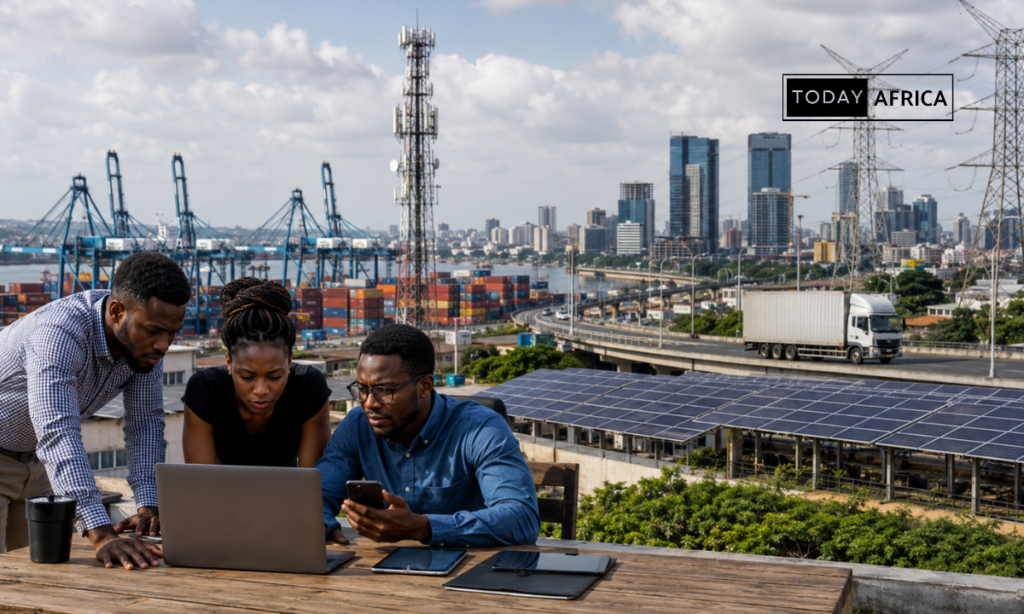
Africa’s technology ecosystem offers another example of growth that is real but increasingly selective.
African technology startups raised approximately $4.1 billion in equity and debt during 2025, an increase of about 25% from the previous year and the strongest funding performance since 2022.
However, the composition of that capital is important. Debt financing reached a record $1.6 billion, up 63%, while equity funding increased by a more modest 8% to $2.4 billion.
Capital has returned, but with stricter conditions.
Investors are placing greater emphasis on revenue quality, margins, governance, capital efficiency, and realistic paths to profitability. The era in which rapid customer acquisition could compensate for weak unit economics has largely ended.
The growing use of debt also creates new risks. Startups earning revenue in local currencies may struggle to service loans denominated in dollars or euros when exchange rates weaken.
Debt can accelerate the expansion of a proven company, but it can also magnify losses when revenue is volatile.
This environment favors startups solving essential economic problems.
Financial infrastructure, energy, logistics, agricultural technology, healthcare, enterprise software, and cross-border payments are increasingly attractive because they address bottlenecks faced by thousands of businesses.
They are not simply selling convenience. They are reducing the cost of participating in the economy.
The strongest African startups will increasingly look less like isolated technology companies and more like technology-powered infrastructure businesses.
Investors must stop treating Africa as one trade
Africa’s aggregate growth rate can conceal enormous differences between countries.
Some economies are benefiting from stronger agricultural production, tourism, services, technology, and manufacturing. Others remain exposed to conflict, debt distress, commodity volatility, climate shocks, or political uncertainty.
Even within the same country, attractive sectors can exist alongside serious macroeconomic weaknesses.
Investors must therefore move beyond the broad “Africa growth story” and examine the systems supporting individual markets.
That includes currency stability, debt sustainability, energy reliability, logistics capacity, regulatory consistency, consumer purchasing power, and the ability to move capital across borders.
A fast-growing economy is not automatically an investable economy. Growth must be converted into predictable revenue, enforceable contracts, and manageable risk.
The information gap makes this analysis difficult. African business information remains fragmented across regulatory announcements, company disclosures, funding reports, and local media.
This is where Today Africa Atlas becomes valuable. It tracks African startups, founders, funding activity, sectors, countries, and emerging opportunity flows, helping investors and operators distinguish broad narratives from investable market signals.
As capital becomes more selective, structured intelligence will become as important as capital itself.
Investors who understand how policy, infrastructure and company activity interact will be better positioned than those relying on headline GDP figures alone.
Read also: Nigeria fintech H1 2026 report: The fintech market is moving beyond payments
The opportunity is in the infrastructure around growth

Africa’s structural weaknesses are also its largest investment opportunities.
Energy remains one of the clearest examples.
The gap between rising commercial demand and unreliable national grids is creating markets for distributed solar power, battery storage, mini-grids, commercial energy management, and local equipment financing.
The form you have selected does not exist.
Logistics represents another major opportunity.
Businesses need better warehousing, cold-chain systems, freight platforms, customs technology, and regional distribution networks. Companies that reduce the cost of moving goods across African borders can capture value from almost every growing sector.
Financial infrastructure will also remain essential.
SMEs need working capital, invoice financing, payment collection tools, insurance, foreign exchange services, and credit products designed around actual business cash flows.
Agribusiness and value-added manufacturing offer a particularly large opportunity because they connect economic growth directly to employment.
Instead of exporting raw agricultural products and importing processed goods, African countries can build regional value chains in food processing, textiles, fisheries, pharmaceuticals, and light manufacturing.
Recent research has identified textiles and apparel, agro-processing, fisheries, and light manufacturing as sectors with significant potential for regional sourcing and production.
The African Continental Free Trade Area can strengthen this opportunity by reducing tariffs and simplifying trade between participating countries.
Full implementation could raise Africa’s income by approximately 7% by 2035, although those gains depend on practical reforms in transport, customs, standards, payments and border administration.
The opportunity is therefore larger than selling products to Africa’s growing population. It is about building the systems that allow that population to produce, trade, and earn more efficiently.
Africa’s next growth phase must be built, not announced
Africa’s current growth is neither an illusion nor a guarantee of transformation.
The continent has demonstrated resilience through a period of pandemics, inflation, currency pressure, geopolitical conflict, and tighter global financing.
Many economies are expanding, reforms are beginning to improve macroeconomic stability, and private investment is gradually returning.
But the present rate of growth remains too low to create enough productive jobs, reduce poverty rapidly, or close the infrastructure gap.
The African Development Bank estimates that the continent would need sustained annual growth of at least 7% to support large-scale job creation and faster poverty reduction.
Reaching that level will require a different kind of growth.
Governments must protect macroeconomic stability while creating space for private investment.
Industrial policies must target industries with genuine competitive potential instead of protecting politically connected companies. Infrastructure investment must support productive clusters rather than isolated prestige projects.
Regional trade must become easier. Domestic capital markets must become deeper. Businesses must be able to formalize without being overwhelmed by taxes and regulations. Public institutions must become more predictable.
The potential gains are substantial. IMF analysis suggests that closing half of the structural reform gap between sub-Saharan Africa and other emerging markets could raise regional output by as much as 20% over five to ten years.
Africa’s economy is growing but still struggling, caught between two models.
The old model, built around commodities, government spending, foreign borrowing, and external aid, is losing strength. The new model, driven by productive private companies, regional trade, domestic capital, and scalable infrastructure, is still under construction.
And the countries and companies that succeed will be those that understand this transition early.
Africa does not simply need faster growth. It needs growth that can travel through the economy, reach businesses, reward workers, and finance the systems required for the next generation.
The form you have selected does not exist.
Leave a comment and follow us on social media for more tips:
- Facebook: Today Africa
- Instagram: Today Africa
- Twitter: Today Africa
- LinkedIn: Today Africa
- YouTube: Today Africa Studio